



About the Episode
Got a story to tell? An innovative idea to share? Fill out our guest nomination form and let's chat!
About the Episode:
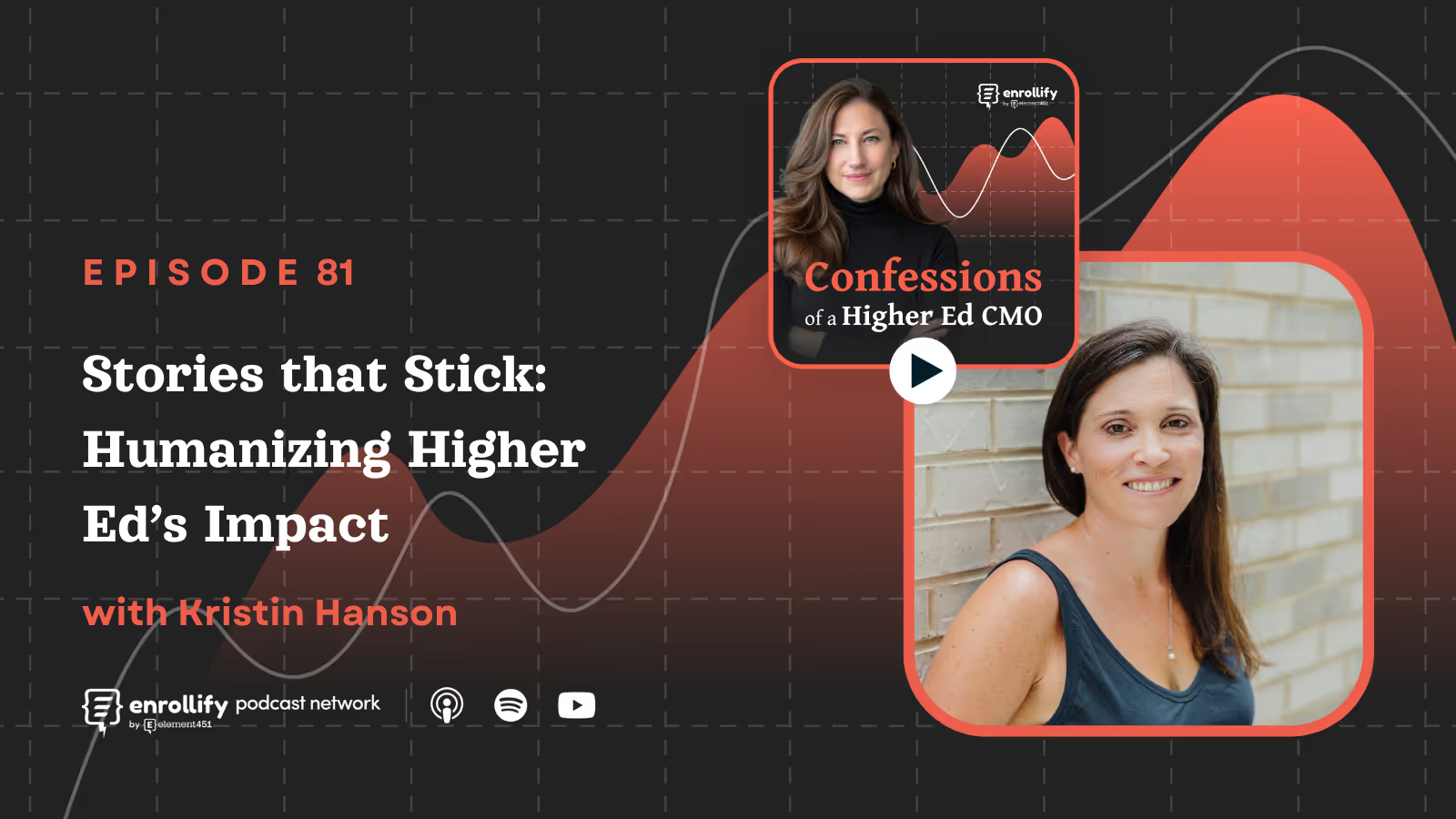
In this episode of Confessions of a Higher Ed CMO, host Jaime Hunt sits down with higher ed storyteller and communications strategist Kristin Hanson to unpack the strategic value of proactive storytelling. Together, they explore how colleges and universities can move from passive, transactional content to authentic, intentional narratives that deepen emotional connection, support enrollment and advancement goals, and highlight the real people behind the institution. If you're looking to elevate your storytelling game in higher education marketing, this conversation is your roadmap.
Key Takeaways
- Move from Passive to Proactive Storytelling: Build an editorial infrastructure that allows you to anticipate storytelling opportunities instead of reacting after the fact.
- Storytelling Is Your Differentiator: In a sea of similar offerings, your people—and their stories—are what make your institution truly unique.
- Create a Storytelling Unit: Combine creatives, copywriters, strategists, and content producers under one mission: telling emotionally resonant stories.
- Think Like a Journalist: Adopt a beat system to surface story leads and maintain relationships across departments.
- Make the Case Internally: Use qualitative and anecdotal feedback to demonstrate storytelling’s persuasive power and ROI.
- Leverage Freelancers Strategically: Bring in experienced higher ed writers who understand your voice, goals, and institutional context.
- Use AI for Process Efficiencies: Let tools like Notebook LM and ChatGPT help with synthesis, repurposing, and outlining—but keep the human voice front and center.
- Focus on Emotional Arcs: Stories that highlight obstacles and transformation resonate far more than fact-driven, flat content.
What does it mean to go from passive to proactive storytelling in higher education?
Kristin breaks down this vital shift as moving from reactionary content creation—like scrambling to write a news release or a donor feature after something big happens—to anticipating the moments, milestones, and people who will shape your institutional story months in advance. She encourages institutions to start by aligning storytelling with the natural rhythms of the academic year and building an infrastructure that captures those stories as they unfold, rather than reconstructing them later.
What does a strong storytelling infrastructure look like?
Kristin shares the blueprint from her time at Johns Hopkins: a collaborative content team that functions like a newsroom, complete with beats assigned across departments. Each member is responsible for keeping tabs on a handful of academic or administrative units, meeting quarterly to identify story leads, and maintaining a running database of story ideas. This system not only keeps storytelling aligned with institutional priorities but also creates a nimble content operation that can pivot quickly when needed.
Why does higher ed often struggle to tell compelling stories?
It’s not a lack of will—it’s a lack of time and resources. Marketing and communications teams in higher ed often face a barrage of competing priorities and limited bandwidth. Kristin emphasizes that creating space for strategic planning and establishing clear content priorities can make proactive storytelling not just possible, but powerful. She also points out that outdated perceptions about what “counts” as valuable storytelling—especially internal pressure to stick to quotes and boilerplate—hinder creativity and connection.
How can you use storytelling to stand out in enrollment and advancement marketing?
Good marketing is good storytelling. Kristin and Jaime both stress that storytelling is the most effective way to differentiate in a crowded higher ed landscape. Prospective students, parents, and donors don't connect with degrees or dollar amounts—they connect with people, transformation, and emotion. Sharing the full arc of a story—including the challenge, the growth, and the outcome—builds empathy and trust, which are critical drivers of engagement.
How can institutions work with freelancers to strengthen their storytelling?
Kristin advises institutions to seek out freelancers who already understand the complexities of higher ed communications. Look for writers who can mirror your institutional tone and elevate your stories with a fresh perspective. Whether you find them through word-of-mouth, professional networks, or conferences, clear communication about expectations, goals, and tone is key to a successful partnership.
Can storytelling be measured—and is it worth it?
While traditional metrics like open rates and click-throughs don’t always tell the full story, Kristin encourages teams to collect qualitative feedback, run small A/B tests in newsletters or social media, and use surveys to gauge what content resonates. She also advocates for demonstrating value through anecdotal success—like faculty members sharing their stories with pride or development officers reporting donor engagement tied to a specific piece.
How can AI tools support (not replace) higher ed storytelling?
Kristin uses AI tools like Notebook LM to speed up her synthesis process—ingesting transcripts, articles, and notes to quickly surface key insights and structure content. She also uses ChatGPT to brainstorm headlines and reframe stories for different channels. But she’s quick to stress: AI should support creativity, not replace it. The emotional depth and strategic nuance required for great storytelling still rely on human touch.
Connect With Our Host:
Jaime Hunt
https://twitter.com/JaimeHuntIMC
About The Enrollify Podcast Network:
Confessions of a Higher Ed CMO is a part of the Enrollify Podcast Network. If you like this podcast, chances are you’ll like other Enrollify shows too!
Some of our favorites include Talking Tactics and Higher Ed Pulse.
Enrollify is produced by Element451 — the next-generation AI student engagement platform helping institutions create meaningful and personalized interactions with students. Learn more at element451.com.
Attend the 2025 Engage Summit!
The Engage Summit is the premier conference for forward-thinking leaders and practitioners dedicated to exploring the transformative power of AI in education.
Explore the strategies and tools to step into the next generation of student engagement, supercharged by AI. You'll leave ready to deliver the most personalized digital engagement experience every step of the way.
👉🏻 Register now to secure your spot in Charlotte, NC, on June 24-25, 2025!