






About the Episode
About the Episode:
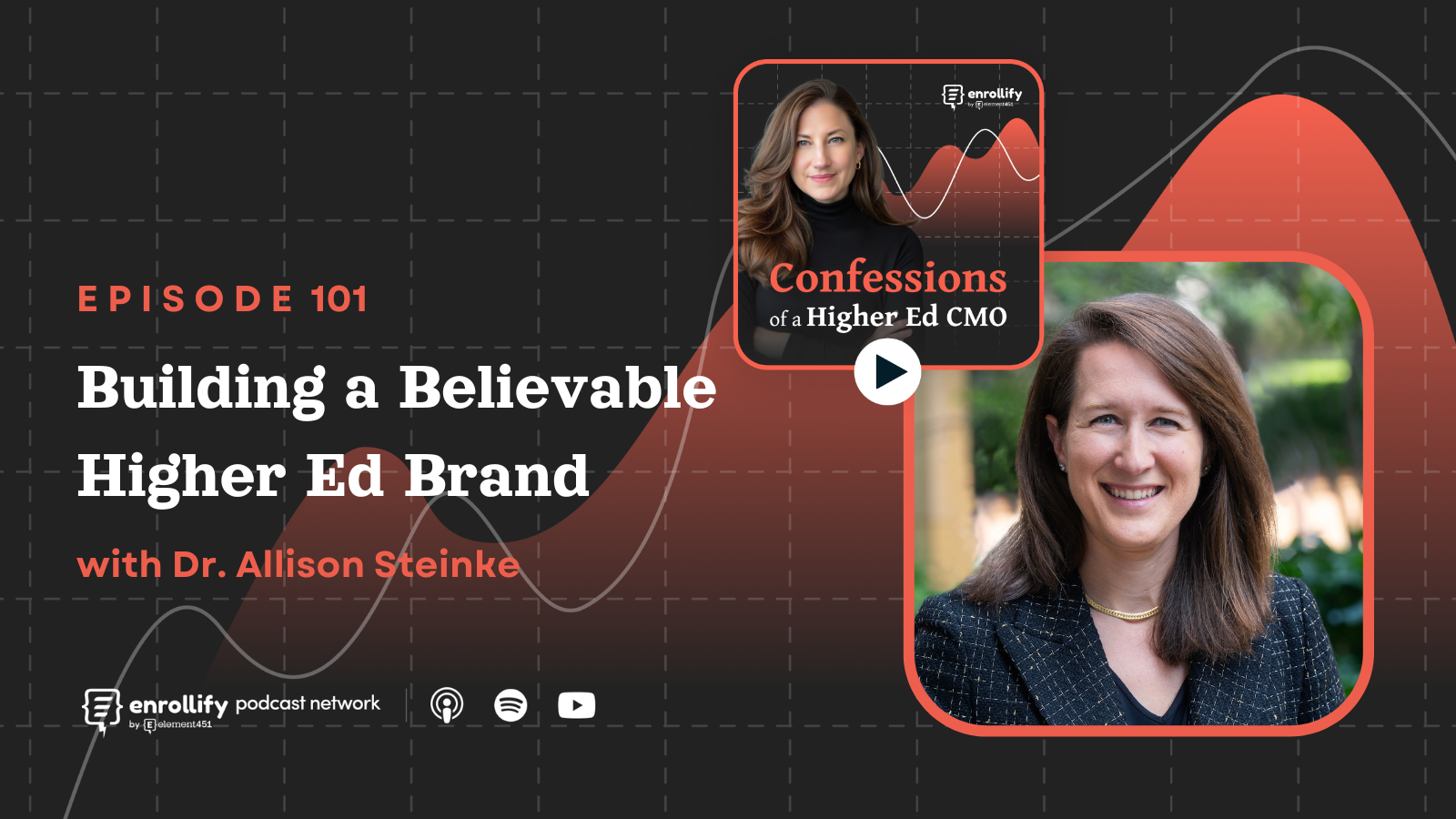
Jaime Hunt sits down with Dr. Allison Steinke to unpack what it really takes to build a believable brand in higher education. Drawing from research with CMOs and Gen Z audiences, Steinke introduces a practical framework for brand believability rooted in authenticity, consistency, and emotional connection. The episode challenges traditional enrollment marketing approaches and reframes branding as a co-created, institution-wide effort. If you’re navigating trust, differentiation, or AI in higher ed marketing, this conversation is a must-listen.
Key Takeaways
- Brand believability is the foundation of trust and loyalty in higher education marketing—not rankings or price alone
- Authenticity and consistency are critical for delivering on your enrollment marketing promises
- Co-creation drives stronger brand alignment across students, faculty, staff, and alumni
- Purpose statements are emerging as essential tools for combating misinformation and uniting stakeholders
- Internal audiences are your most powerful brand ambassadors—ignore them at your own risk
- AI in higher education must be approached with caution, prioritizing ethics, authenticity, and student trust
- Emotional connection + credibility = enrollment impact—you need both to influence decision-making
- Journey mapping and empathy mapping are powerful tools for understanding the student experience
Episode Summary
What Is Brand Believability in Higher Education Marketing?
Brand believability is more than a buzzword—it’s the linchpin of effective enrollment marketing. As Steinke explains, believability sits at the center of a framework built on six core elements: authenticity, consistency, innovation, quality, emotional attachment, and credibility. When these elements align, institutions create brands that students trust—and ultimately choose.
In a landscape shaped by skepticism and a “post-truth” mindset, students are increasingly evaluating whether institutions deliver on their promises. If marketing messages don’t match the lived student experience, institutions risk eroding trust before students even enroll. That disconnect can have long-term implications for retention, reputation, and alumni engagement.
For higher ed leaders, this means shifting focus from surface-level branding to deeply aligned storytelling. It’s not just about what you say—it’s about whether students believe you. And that belief is earned through consistent, authentic experiences across every touchpoint.
How Can Universities Balance Legacy and Innovation?
One of the biggest challenges in higher education content marketing is honoring institutional legacy while staying relevant. Steinke highlights that legacy builds credibility—but it can’t come at the expense of innovation. The most successful institutions think of themselves as “100 years young,” not just “100 years old.”
This mindset opens the door for co-creation with emerging student generations. By involving Gen Z and Gen Alpha in shaping brand narratives, institutions can evolve in ways that feel both authentic and forward-thinking. This approach ensures that branding efforts resonate with modern audiences while staying grounded in institutional values.
Ultimately, balancing tradition and transformation requires intentionality. Leaders must actively assess their brand positioning, listen to stakeholder feedback, and create space for innovation without losing sight of what makes their institution distinctive.
Why Is Co-Creation Essential for Enrollment Marketing Success?
If there’s one theme that stands out, it’s this: brands are no longer built in silos. Co-creation—bringing together students, faculty, staff, alumni, and community voices—is essential for building a brand that people actually believe in.
Steinke and Hunt emphasize that co-creation fosters buy-in and strengthens emotional connection. When stakeholders see themselves reflected in the brand, they’re more likely to champion it. This is especially critical in higher ed, where internal culture directly impacts external perception.
Practical tactics like listening sessions, focus groups, and journey mapping can uncover valuable insights about how different audiences experience your institution. These insights not only inform your marketing strategy for student recruitment but also help ensure that your messaging aligns with reality.
What Role Do Faculty and Staff Play in Brand Believability?
Your employees are your brand—whether you formalize that or not. Faculty and staff shape the student experience daily, making them critical to delivering on brand promises. Yet, as Hunt notes, internal audiences are often overlooked in branding efforts.
Steinke introduces the “knowing, caring, doing” framework to address this gap. Do employees understand the brand (knowing)? Do they feel emotionally connected to it (caring)? And are they actively living it out (doing)? When all three are aligned, institutions create powerful internal ambassadors who reinforce brand credibility.
Ignoring internal culture creates risk. If external messaging doesn’t match internal reality, students will notice—and trust will erode. Investing in internal alignment isn’t optional; it’s foundational to student success strategies and long-term brand equity.
How Should Higher Ed Leaders Think About AI and Brand Authenticity?
AI is transforming trends in higher education marketing, but Steinke urges leaders to proceed with caution. While AI can enhance personalization and efficiency, it also introduces risks related to ethics, data privacy, and authenticity.
Students are increasingly skeptical of AI-generated content, and for good reason. Over-reliance on automation can strip away the human elements that make a brand believable. As Hunt points out, using AI in ways that misrepresent reality—like generating inauthentic experiences—can actively damage trust.
The takeaway? Use AI strategically, not blindly. Focus on solving real problems, protect student data, and ensure that any AI-driven efforts align with your institution’s values. Authentic storytelling should always take precedence over convenience.
What Mindset Shift Do CMOs Need to Build Stronger Brands?
Perhaps the most powerful insight from the episode is this: marketing is not promotion—it’s proof. Steinke encourages CMOs to rethink their role, moving away from broadcasting messages and toward building belief systems.
This means centering brand strategy around purpose, culture, and experience—not just campaigns. It also requires breaking down silos and fostering collaboration across campus. When marketing becomes a shared responsibility, institutions can create more cohesive and believable brands.
For leaders, this shift is both strategic and cultural. It demands curiosity, humility, and a willingness to co-create with stakeholders. But the payoff is significant: stronger trust, deeper engagement, and more effective enrollment marketing outcomes.
Connect With Our Host:
Jaime Hunt
https://twitter.com/JaimeHuntIMC
Enrollify is produced by Element451 — the next-generation AI student engagement platform helping institutions create meaningful and personalized interactions with students. Learn more at element451.com.



.svg)
.svg)
