About the Blog
Innovation in higher education needs an assist. Because we have so much on our list of tasks, getting people excited to explore AI rarely happens on its own. It needs help from leaders.
As leaders, we may have several ideas of how AI could help our teams and organizations. As practitioners, our employees may see opportunities to build something more complex using AI. In one scenario, the person has ideas but doesn’t have time to make it a priority. In the other, the person has ideas but doesn’t have access to resources to bring an AI tool to fruition. Both scenarios can be positively impacted by incentivizing innovation.
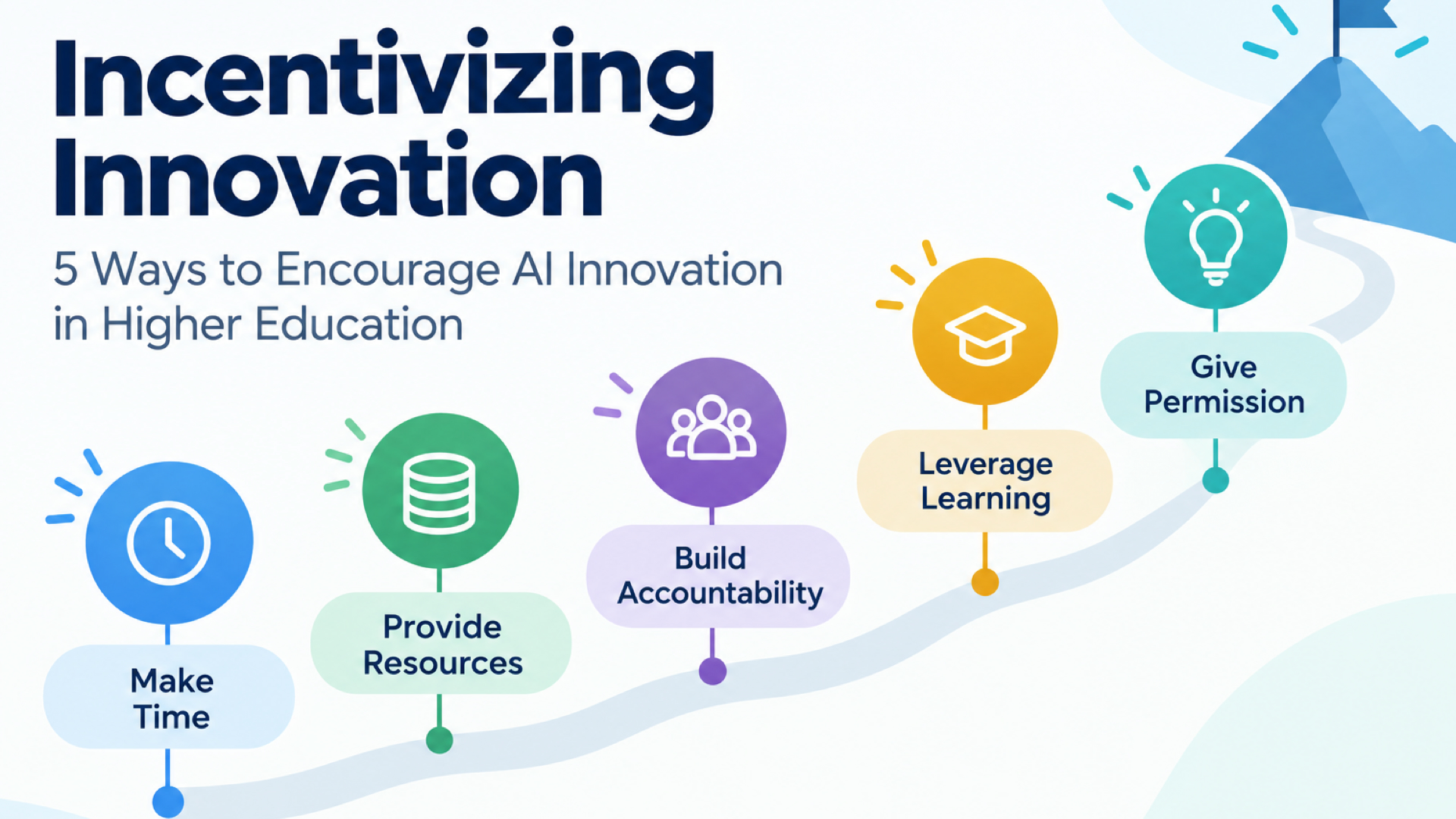
Five Strategies to Incentivize Innovation
Make Time – The first way to spur innovation is to make sure time for innovative work is on the calendar. If people are asked to innovate and develop AI solutions on their own, it’s never going to work because of competing interests. If it is a priority, it should be reflected on calendars.
Two approaches:
1. A quarterly workshop – Bring people together quarterly to workshop problems or ideas in real time. This allows for networking and community awareness of how others across the institution are using AI. It also gives those working on AI projects dedicated time for AI development.
2. Fourth Fridays – Our team at UA Little Rock has done this, and it’s an easy way to prioritize AI. On the fourth Friday of each month, the group gathers for pizza and presentations from two or three presenters about how they are using AI for their work. Seeing other use cases helps everyone brainstorm and get excited about using AI in their work.
Provide Resources – Innovation requires funding. Developing something new, especially with AI, may require additional tokens, enhanced tools, or server connections. These likely don’t exist in the current tech stack. As leaders, we need to plan to provide resources if we want to see AI innovation.
Two approaches:
1. Mini-grants – This idea works at both the institutional and department level. Offering mini-grants to cover the cost of pilot projects builds excitement and encourages our teams to explore new ideas. Additionally, the idea of winning a grant builds confidence in developing new ideas. Each year, I set aside funding in my MarComm budget to experiment and support good ideas that come forward.
2. Release time – This works best on the faculty side where a course release can give employees time away from their regular duties to focus on new AI projects. Being relieved of some duties each week to support AI can help give people time to experiment. While harder on the staff side, this could be accomplished by removing a few tasks and assigning those to a graduate assistant temporarily.
Build Accountability – Honestly, innovation and AI work are strategic, but they can easily get pushed aside for more urgent things. When innovation is consistently the thing that doesn’t get accomplished, it becomes a leadership issue. We must find ways to prioritize it alongside other responsibilities.
Two approaches:
1. Annual goals – One way to do this is to make AI innovation part of each employee’s annual goals. I’ve done this for everyone who reports to me. The goals differ based on job responsibilities and AI familiarity, but they all incorporate accountability and the expectation of regular AI exploration and development.
2. One-on-One check-ins – As part of one-on-one conversations, make sure that AI is part of the conversation at each meeting. This can be as easy as asking about AI wins and losses, but it creates the expectation it should be happening. When people know they must report on it, they’re much more likely to experiment and may find a use case to further develop.
Leverage Learning – Part of the challenge with telling people to experiment is they don’t know where to begin. If you’ve never built a custom GPT or developed a skill, that feels intimidating. As leaders, our job is to equip our teams with baseline skills. Once employees have these skills, they’re empowered to begin to understand how AI could work for them.
Two approaches:
1. PD with a purpose – AI learning looks different. It’s much more hands-on, making it hard to get practical during a one-hour conference session. If it’s a priority, we must rethink what professional development looks like and find ways for our employees to get this training. Our job is to figure out what will best support our teams and help make that happen.
2. Get outside the industry – When it comes to AI innovation, we should be watching private industry. As leaders, encouraging our teams to attend trainings in the corporate space helps them to see what kinds of development are possible. Sometimes these trainings are frowned upon because they’re outside higher education, but we need to support this for AI innovation.
Give Permission – Too often great ideas are not heard. As leaders, we have a responsibility to encourage our teams to make things better. One way we can do that is by creating a culture of continuous improvement where we always want to do better. This works well in AI innovation because the work is constantly changing.
Two approaches:
1. One project – A great way to empower people is to ask our team members for one idea that AI could make their work easier, more efficient, or simply better. This empowers team members to think creatively and signals we are interested in how AI can help them in their daily tasks.
2. Stop work – Too often we see projects and new technology as additive, making it one more thing for teams to manage. To get employees excited about AI innovation, we need to help teams see what they can stop. That could mean eliminating a task to free up time for innovation, or it could be a task they don’t enjoy and can quit because AI can do it for them. Both are powerful motivators for exploring AI.
Innovation is a Team Sport
For true AI innovation to happen, everyone needs to explore how AI can improve the work. As leaders, we may not always be the technical expert doing the work. However, our role is to create a culture where innovation can happen. Innovation doesn't happen just because we tell people it's important. We must create the conditions that make it possible.