






About the Episode
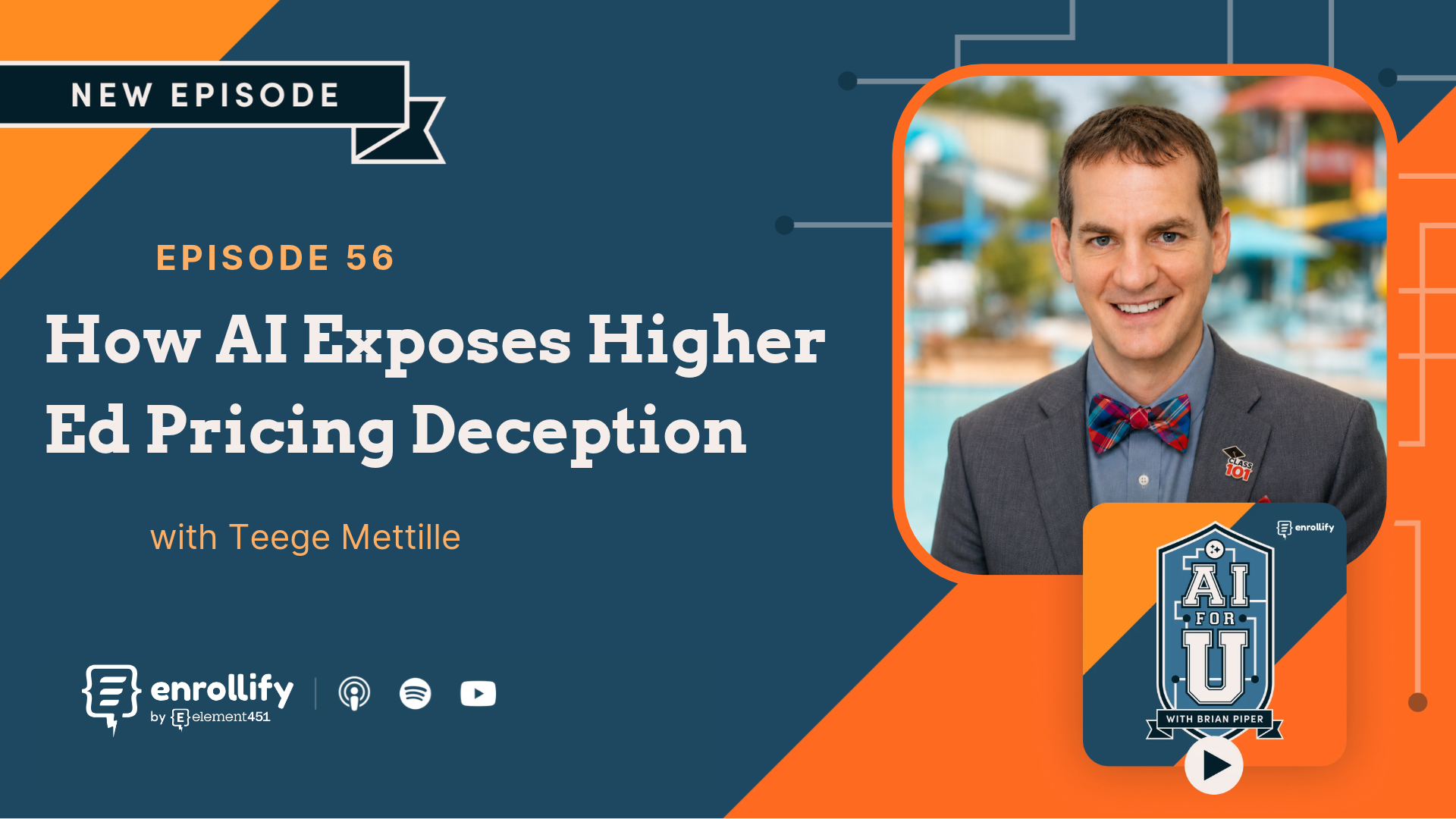
Higher education is confronting a massive erosion of public confidence, and the emergence of artificial intelligence is about to accelerate that reckoning. Host Brian Piper sits down with Teege Mettille, author of College Is Broken (And What We Can All Do to Fix It), to unpack how the higher ed trust deficit is being broken wide open by AI-driven transparency. Teege argues that just as Kelley Blue Book stripped used-car dealers of their information monopoly, accessible AI tools now empower under-resourced families to interrogate opaque pricing models, debunk inflated medical school admit rates, and cut through manipulated post-grad employment statistics. Despite the systemic dysfunctions, Teege lays out an optimistic case for campus practitioners: because higher education built these broken structures, everyday enrollment and marketing leaders possess the power to dismantle them and rebuild genuine trust.
Join us as we discuss:
- [2:09] AI’s role in the trust problem that pervades higher ed’s pricing model
- [10:29] Addressing the mass destruction of traditional entry-level positions
- [13:51] Why traditional presidential leadership is the biggest barrier to real change
- [25:51] How the perception of college-student engagement is changing in real-time
To hear this interview and many more like it, subscribe on Apple Podcasts, Spotify, or our website, or search for AI for U with Brian Piper in your favorite podcast player.
Episode prompt:
You are auditing how visible and honest the cost information is on a college or university website, from the perspective of a prospective student and family with no insider knowledge and no counselor helping them.
INSTITUTION CONTEXT
Institution: [name, private or public, URL, size]
Primary audience for this audit: [first year, graduate, parents, etc.]
Cost landing page: [URL]
Published cost of attendance: [$]
Net price calculator (if available): [URL]
TASK
Inventory every place a prospective family could encounter cost information. For each item you find, record:
- What it is (a number, a calculator, a scholarship page, a payment plan, an FAQ)
- Exact URL
- Clicks from the homepage, and the path a family would have to guess to get there
- Whether it is findable by site search using the words a family would type ("how much does it cost", "tuition", "price", "can I afford")
- The exact language used, quoted
- Whether it states a single number, a range, or a conditional answer
- Whether it covers one year or the full time to a degree
- Whether fees, housing, food, books, travel, and program specific costs are included, excluded, or unmentioned
- Whether the page says what happens in years two, three, and four, including tuition increases and whether scholarships renew
- Reading level and whether financial aid jargon is defined on the page
Present this as a table. Do not summarize. I want every instance, including the ones that contradict each other. Flag contradictions explicitly.
Then, based on the growing challenges that higher ed is facing (from the demographic cliff to the perceived value of higher ed), create a list of opportunities for this institution to be more transparent and helpful with prospective students to build trust and to make it as easy as possible for them to get the information they need.



.svg)
.svg)
