

cancel

Search podcasts, blog posts, people

Data science leader and strategic advisor JC Bonilla joins host Brian Piper to reveal why the real AI revolution isn't about better prompts, but about building fully AI-native organizations.
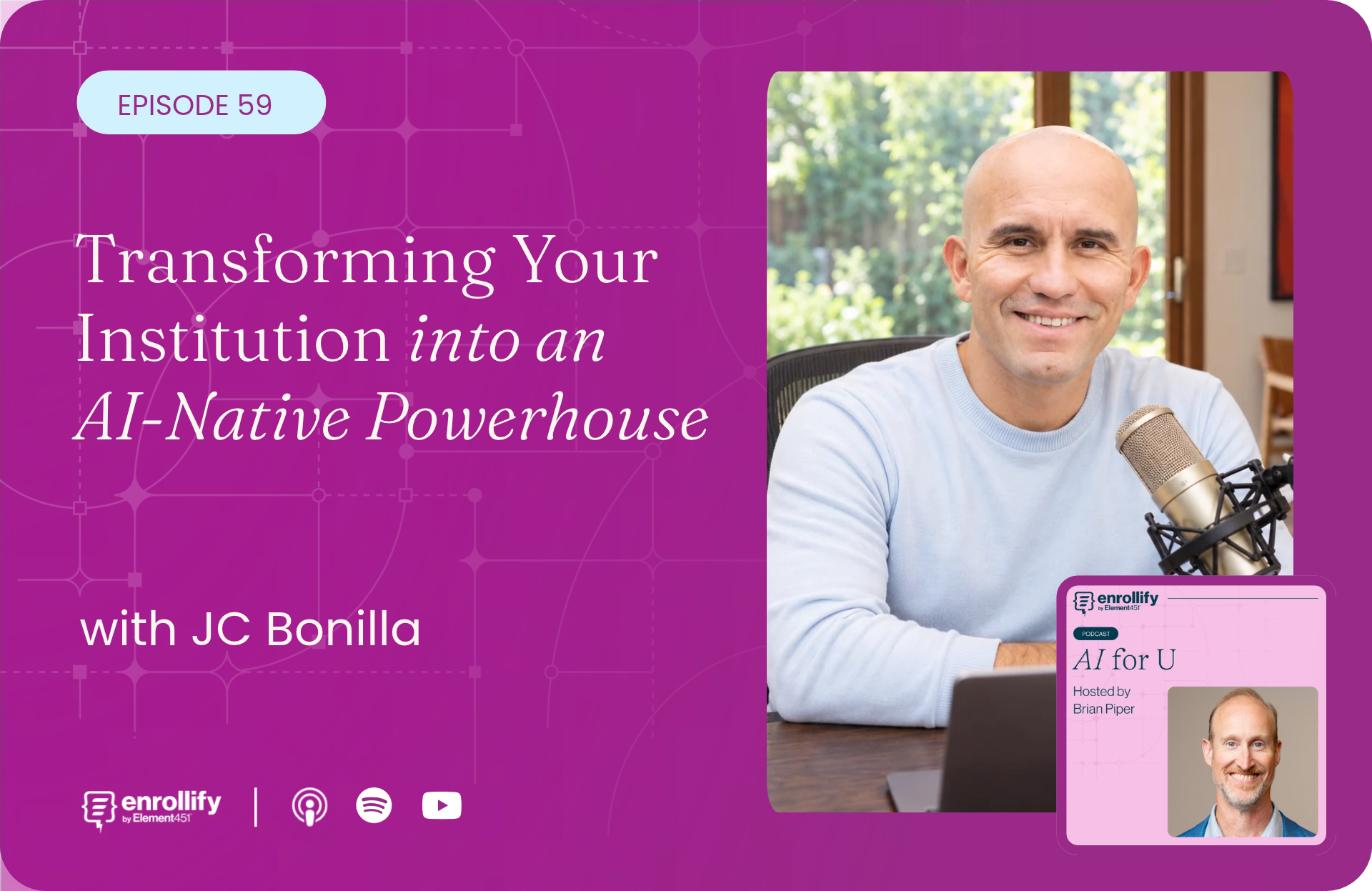
Are you stuck using AI just to summarize text while autonomous agents are quietly reshaping entire organizations? Data science leader and strategic advisor JC Bonilla joins host Brian Piper to reveal why the real AI revolution isn't about better prompts, but about building fully AI-native organizations. He exposes why AI is actually an organizational design challenge rather than a tech issue, and shares how higher education leaders can seize the massive opportunity ahead. From mastering model routing and token budgets to conquering prompt drift, JC lays out the playbook for orchestrating AI agents, breaking down data silos, and taking ruthless ownership of your final output.
To hear this interview and many more like it, subscribe on Apple Podcasts, Spotify, or our website, or search for AI for U with Brian Piper in your favorite podcast player.
Episode prompt:
I want a high-level assessment of my institution's AI governance and where it sits on an AI maturity model. Do not ask me for an inventory. Work from what
I tell you and say clearly where you are guessing.
INSTITUTION
Type and size: [community college, regional public, private, R1, other]
My role: [title and office]
AI tools in use that I know of: [official and unofficial]
Current AI policy or guidelines: [paste, summarize, or say "none"]
Who owns AI at the institution today: [a person, a task force, a council, nobody]
Any pilots or deployments so far: [briefly]
What leadership has said publicly about AI: [briefly, or "nothing"]
STEP 1 — GOVERNANCE SNAPSHOT
Assess us on three lenses and score each 1 to 5 with a one sentence reason:
- Output: is anyone checking what our AI tools produce against an authoritative source or a quality standard, and how often?
- Model: do we know which models our workflows run on, who chooses, and what it costs, or is everything on whatever was picked on day one?
- Harnessing: is there any rule about what our AI tools and agents are allowed to connect to (calendars, email, CRM, student records), and who decides?
STEP 2 — THE FOUR THAT HAVE TO MOVE TOGETHER
For people, process, technology, and culture, say in one sentence each whether it is ahead of, level with, or behind our governance. Name the one that is furthest behind.
STEP 3 — MATURITY STAGE
Place us on this five-stage model and explain why in a short paragraph:
- Stage 0, Shadow AI: people are using tools, nobody is tracking it, no policy or a policy nobody reads
- Stage 1, Experimenting: individuals and a task force are trying things, governance is a guideline document
- Stage 2, Piloting: one or two official deployments, someone reviews output, no shared standard across offices
- Stage 3, Scaling: named owners, a prompt and tool library, model and connection decisions made deliberately, leadership sponsors it, and it has budget
- Stage 4, Culture shift: governance is routine, drift is checked on a schedule, offices share data and workflows, agents cover real work with human review built in
Also flag any rogue AI exposure: places where tools are touching sensitive data or acting on their own without anyone watching. This can happen at any stage.
STEP 4 — ONE MOVE
Give me the single most useful thing to do in the next 90 days to reach the next stage. It should be something my role can start without a cabinet vote.
Then name the one decision that does need leadership, in a sentence I could say to a president or provost.
Keep the whole response under 600 words. Plain language, no jargon.
Get new podcasts, articles, videos, and exclusive content from Enrollify delivered straight to your inbox.
Search podcasts, blog posts, people