


About the Blog
What if you could serve 60% more students without adding a single staff member?
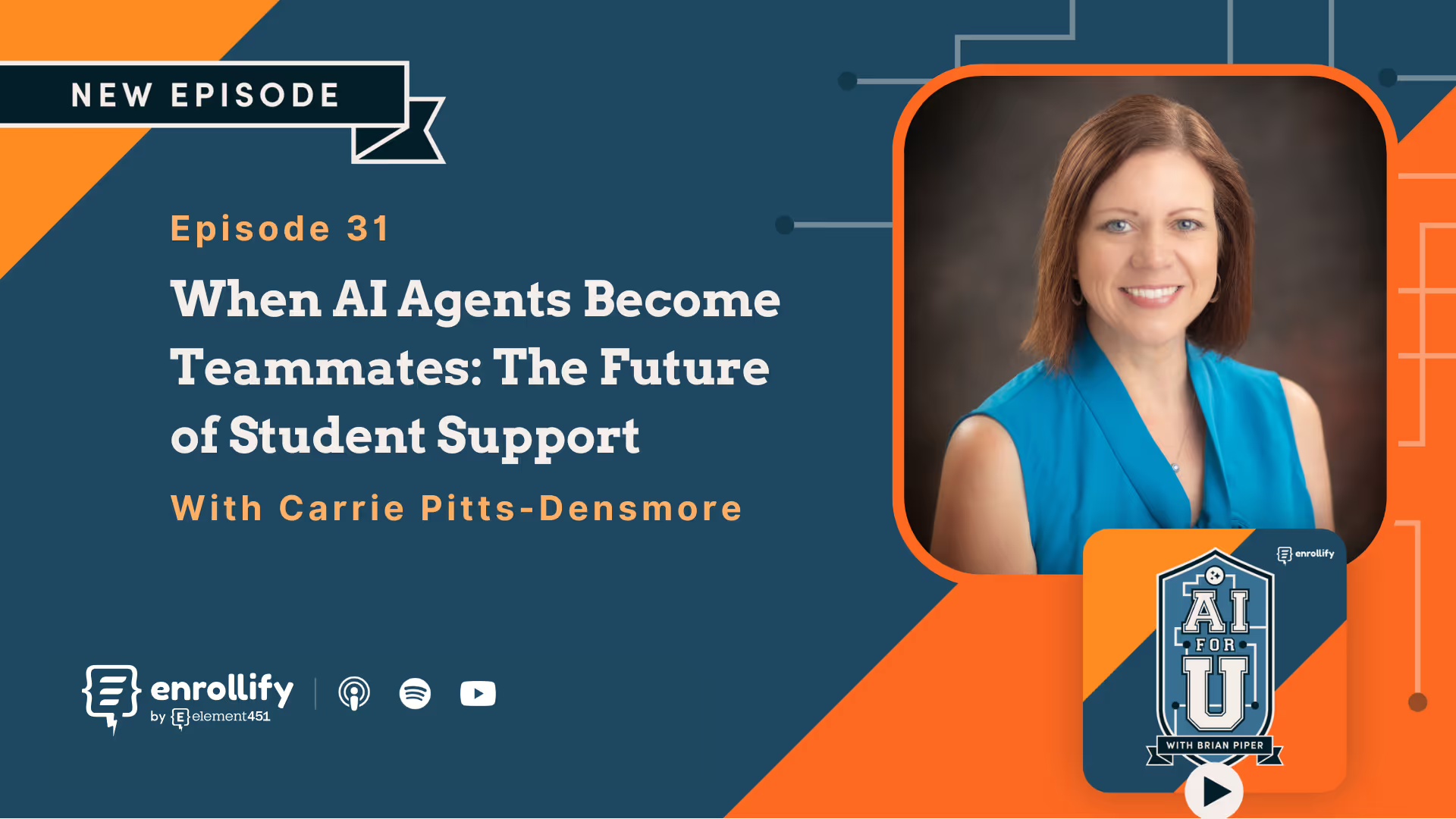
For Carrie Pitts-Densmore, Vice President of Enrollment and Marketing at Johnston Community College (JCC), that question became a reality — thanks to AI.
In this episode of AI for U, host Brian Piper talks with Carrie about how her team built ten AI agents inside their Element451 CRM, saving more than 120,000 human minutes while making communication more personalized, not less. The conversation goes beyond automation — it’s about creativity, culture, and rethinking how AI can become a trusted teammate instead of a threat.
Scaling Without Breaking
When Johnston Community College saw enrollment grow 60% since 2021, the math didn’t add up. Funding lagged, hiring stayed flat, and yet student expectations for responsiveness only grew.
“We didn’t get to hire 60% more people,” Carrie explained. “So our AI agents became that missing team.”
These digital colleagues now handle routine questions about admissions, dual enrollment, and financial aid — including a phone agent that routes and answers calls automatically. It’s freed up human staff to tackle the deeper, more complex student issues that can’t be solved with canned responses.
And the results speak for themselves: 120,000 minutes saved, equivalent to nearly 250 workdays — or an entire year of full-time labor reclaimed for higher-impact work.
Experiment First, Perfect Later
Carrie’s approach to AI mirrors her philosophy on innovation: “Try it, test it, tweak it.”
“We can’t know what something will do for us until we experiment,” she said. “You can’t mess it up too badly — and if you do, we fail forward.”
Her curiosity isn’t new. She was an early adopter of social media in higher ed back in 2008, helping peers integrate video and digital storytelling before it became standard practice. That same curiosity drives her AI work today — including building a custom GPT to help her team write website content.
“I love a challenge and I love learning,” she added. “The only way to keep up is to stay curious.”
Fear, Governance, and the Speed of Change
Carrie sees three major hurdles slowing AI adoption in higher ed:
- Fear and misunderstanding.
Many professionals worry about data privacy and job security — both valid concerns, but ones that can be addressed through ethical guardrails and education. - Shared governance paralysis.
“We love to talk things to death,” she said. “But AI moves too fast for committees to spend months debating. You have to be nimble.”
- Rising competition.
Community colleges once served their local populations with little rivalry. Now, online programs, free tuition incentives, and national marketing mean students have choices — and expect “Amazon-level service.”
AI, she argues, is what helps JCC deliver that kind of responsive, always-on support without overloading human staff.
Personalization at Scale
JCC’s real win isn’t automation — it’s individualization.
“We can now speak to each student, no matter how many we have,” Carrie said. “That’s something we couldn’t do before.”
Every AI interaction is backed by human oversight — staff monitor responses, correct inaccuracies, and jump in when the conversation requires empathy or nuance. The result: scalable personalization with a human safety net.
And that human-plus-AI blend has strengthened, not weakened, student connection.
“We’re connecting with students in ways we never did when all we had was mass email,” she said.
AI as a Teammate, Not a Threat
Carrie is clear: AI isn’t replacing people — it’s reinforcing them.
“Let me build you a teammate,” she tells hesitant staff.
Her “digital colleagues” now handle tasks around the clock — answering questions, segmenting audiences, drafting messages, and freeing her team to focus on relationships and results.
It’s the same concept she applies to writing: using AI to break through creative blocks, not to replace her voice.
“Writer’s block is real,” she said. “Now, instead of staring at a blank page, I can ask AI to finish a sentence or offer options. It keeps the momentum going.”
That mindset shift — from competition to collaboration — may be the most important cultural change higher ed leaders can foster right now.
Teaching the Workforce of the Future
Carrie also believes institutions must prepare both students and employees for a world where AI fluency is table stakes.
“We have to start teaching this as a skill,” she urged. “Jobs are going to evolve. If you’re afraid to learn AI, you might get replaced — not by AI itself, but by someone who knows how to use it.”
Surveys back her up: between 2023 and 2024, the share of higher ed employees who said their institution’s AI stance affects their desire to stay jumped from 1% to 34%.
Forward-thinking institutions that embrace AI literacy and ethical experimentation aren’t just modernizing — they’re protecting retention and morale.
From Emails to Empathy: Getting Started
Carrie’s advice for AI beginners is refreshingly simple:
“Just try something.”
Start small — use Microsoft Copilot to organize email, or ChatGPT to draft a campaign. Build confidence before scaling.
“That’s exactly how we started,” she said. “We asked our CRM to write six emails for one audience. It worked. Then we built on it.”
Every win, she says, fuels curiosity — and that curiosity builds momentum for larger transformation.
The Bigger Picture: Reclaiming Time for Human Work
By reimagining AI as a partner, not a shortcut, Johnston Community College has built a model many institutions could learn from:
- 120,000+ minutes saved = staff focus on complex human needs.
- 60% enrollment growth = no compromise on student experience.
- AI teammates = scalable service with empathy intact.
Carrie’s story is proof that innovation doesn’t have to come at the expense of humanity. In fact, done right, it makes higher ed more human.
🎧 Listen to the Full Episode
Catch the full conversation between Brian Piper and Carrie Pitts-Densmore on AI for U, Episode 31: Overcoming Writer’s Block and Building AI Teammates, now streaming on the Enrollify Podcast Network.

.svg)
.svg)
