






About the Episode
Got a story to tell? An innovative idea to share? Fill out our guest nomination form and let's chat!
About The Episode:
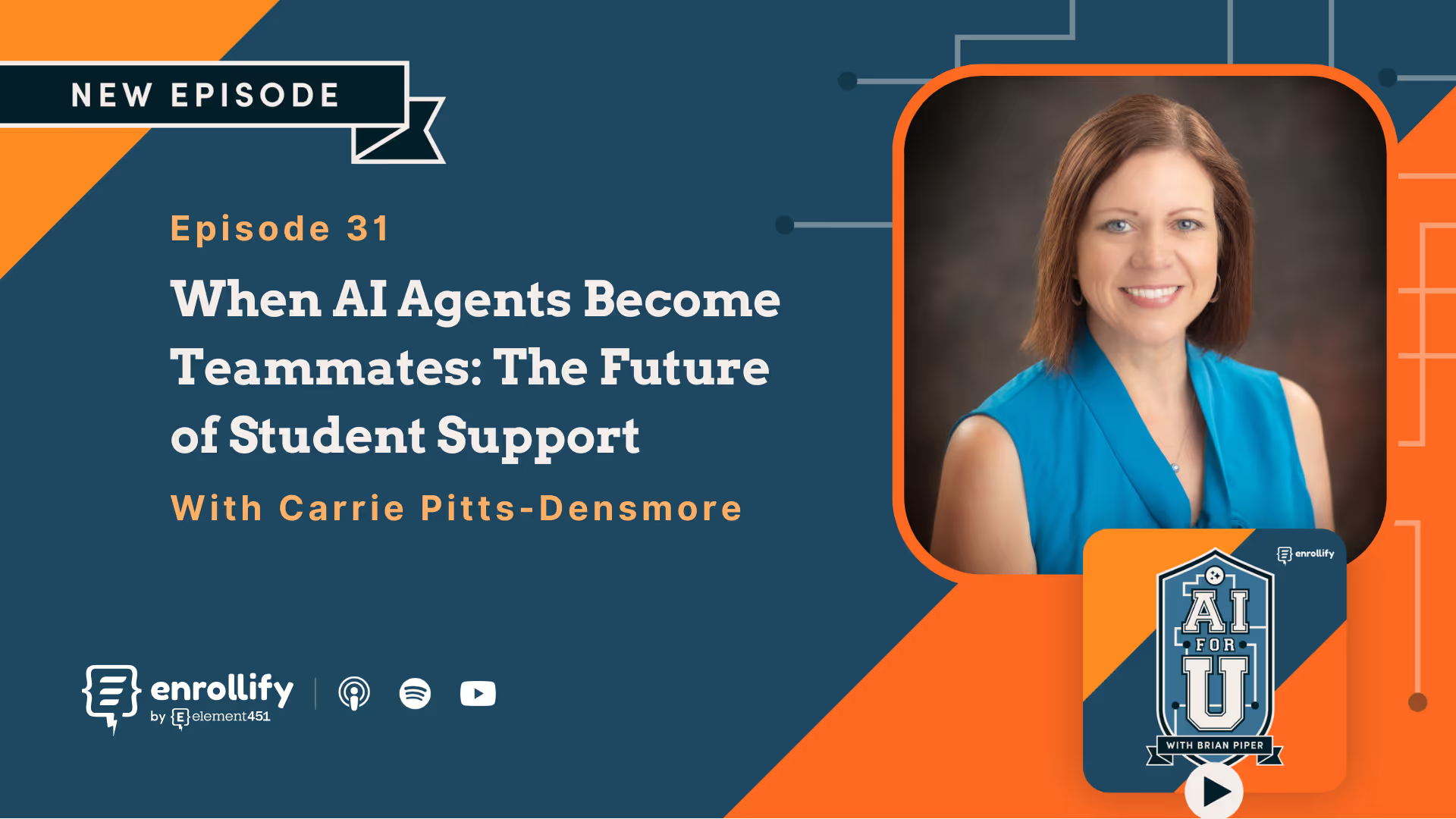
In this episode, Brian sits down with Carrie Pitts-Densmore, VP of Enrollment and Marketing at Johnston Community College, to talk about how higher ed can embrace AI as a partner rather than a threat. Carrie shares how her team built ten AI agents inside their CRM to handle student inquiries, scale enrollment communications, and free staff to focus on more complex, human-centered work. From saving 120,000+ human minutes in one year to envisioning AI as a personal assistant, Carrie’s insights show how institutions can move from hesitation to hands-on experimentation and success.
Join us as we discuss:
- [2:12] How Johnston saved 120,000 human minutes with automation
- [12:36] Why AI is a teammate, not a replacement
- [17:25] How higher ed jobs are evolving with AI, not disappearing
Check out these resources we mentioned during the podcast:
To hear this interview and many more like it, subscribe on Apple Podcasts, Spotify, or our website, or search for AI for U with Brian Piper in your favorite podcast player.
How is Johnston Community College using AI in enrollment marketing?
Johnston Community College has built 10 AI agents into their CRM platform, Element451. These agents assist with everything from responding to common admissions and financial aid questions to writing email campaigns and running a phone bot. With a 60% increase in student enrollment since 2021 and no proportional increase in staff, these AI solutions have become essential teammates—answering repetitive questions so human staff can focus on complex, high-touch interactions.
What measurable impact has AI made on operations?
According to Carrie, their AI agents saved over 120,000 minutes of human labor in one year. That’s equivalent to nearly 250 workdays. These savings allowed her team to manage a significant uptick in student demand while maintaining service quality. As Carrie puts it, “those are minutes we wouldn’t have been able to give our students otherwise.”
What challenges does higher ed face with AI adoption?
Carrie identifies fear and institutional inertia as the two biggest hurdles. Many leaders are wary of data privacy issues and struggle with the rapid pace of technological change. Additionally, the traditional culture of shared governance—while valuable—can slow decision-making. Carrie argues that AI requires a more agile mindset: “You have to be nimble. You have to be able to make decisions. And I think that is a challenge for higher education.”
How does Carrie view AI—as a threat or opportunity?
Firmly in the opportunity camp, Carrie describes herself as an early adopter and sees AI as a teammate—a digital assistant that helps staff perform better. She encourages others to “fail forward” and treat AI like a science experiment: test, iterate, and improve. She even uses a custom GPT she built to help with web writing and credits AI with eliminating her writer’s block. “I can go, ‘Hey, I’m stuck. Give me some ideas.’ That’s a game changer.”
What advice does she have for AI beginners in higher ed?
Just start. Carrie recommends simple first steps like using ChatGPT or Microsoft Copilot to organize emails or brainstorm content. Her team began by using AI to write a basic email campaign. Over time, as tools improved, they expanded into building more sophisticated AI workflows. The key? Don’t wait for perfection. Just get in the game.
What are the broader implications of AI on higher ed roles and retention?
AI literacy is becoming a competitive advantage—not just for students but also for staff. A 2024 survey showed that 34% of higher ed employees would factor in an institution’s stance on AI when deciding whether to stay—a significant jump from just 1% in 2023. Carrie notes, “We need to start teaching this to students and employees. It’s going to be a required skill.”
How does AI help with personalization in student communication?
Carrie’s favorite AI use case is the ability to create “segments of one.” With the help of data segmentation, her team can send tailored messages that resonate with each student’s journey. The result? More meaningful engagement, stronger relationships, and a deeper sense of belonging—something that generic mass emails often fail to provide.
Does Carrie see AI replacing humans in higher ed?
Not at all. Instead, she sees job roles evolving. Some manual tasks may be automated, but AI enables staff to spend more time on strategic, empathetic work. Her philosophy: “Let me build you a teammate... that can work in the background while you focus on the human part of your job.”
Episode prompt:
You are an expert writer.
I'm going to ask you to help me overcome writer's block that I'm experiencing with a piece of content I need to create. Instead of writing it for me, I want you to help me work through this creative obstacle as a collaborative partner.
**What I'm Working On:**
- Content type: [Email, blog post, social media, website copy, etc.]
- Target audience: [Who will read this]
- Main purpose/goal: [What I want to accomplish]
- Key message: [The core point I want to make]
- Approximate length: [How long this should be]
- Deadline pressure: [Timeline I'm working with]
**Where I'm Stuck:**
- What I've tried so far: [Any drafts, notes, or approaches attempted]
- Specific obstacle: [Can't find the right opening, don't know how to organize ideas, struggling with tone, etc.]
- What's making this challenging: [Complexity of topic, multiple audiences, sensitive subject matter, etc.]
Help me diagnose what's causing my block and suggest 3-4 specific strategies to move forward, but don't write the content for me.
Connect With Our Host:
Brian Piper
https://www.linkedin.com/in/brianwpiper/
About The Enrollify Podcast Network:
AI for U is a part of the Enrollify Podcast Network. If you like this podcast, chances are you’ll like other Enrollify shows too!
Some of our favorites include Generation AI and Mastering the Next.
Enrollify is produced by Element451 — the next-generation AI student engagement platform helping institutions create meaningful and personalized interactions with students. Learn more at element451.com.





.svg)
.svg)
