


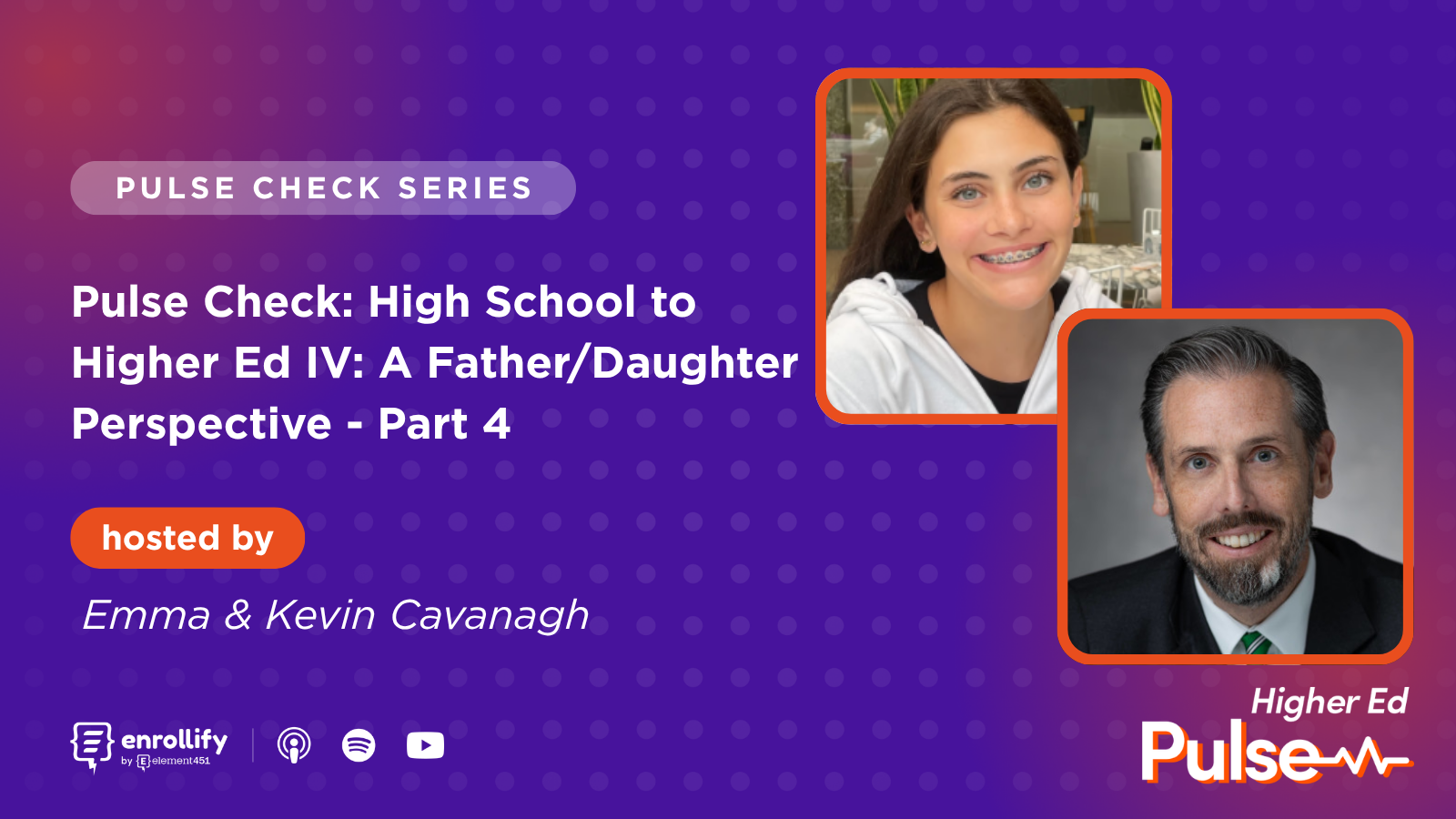




About the Episode
About The Episode:
Emma and Kevin Cavanagh take a nostalgic—and revealing—look at the college search process before the digital age. From paper applications and typewriters to word-of-mouth recommendations and VHS campus tours, this episode explores how dramatically enrollment marketing and higher education content marketing have evolved. Through humor and honest reflection, Kevin contrasts his 1990s experience with Emma’s modern-day journey. The result? A compelling look at how access to information has reshaped the way students discover and choose colleges.
Key Takeaways
- Enrollment marketing has transformed dramatically: From paper catalogs and mailed applications to digital platforms and AI-driven tools, today’s students have unprecedented access to information.
- Information overload is the new challenge: While previous generations struggled with limited data, today’s students must navigate an overwhelming volume of content and messaging.
- Word-of-mouth once ruled the college search: Guidance counselors, family, and printed materials were the primary sources of truth before the rise of digital channels.
- Demonstrated interest looked very different: Typing (not writing!) applications and physically requesting materials were early indicators of student intent.
- Student decision drivers remain consistent: Despite technological changes, factors like academic programs, campus culture, and personal fit still guide decisions.
- Confidence gaps can shape application strategy: Kevin reflects on limiting his reach schools—a reminder of the importance of encouraging students to aim higher.
- The emotional journey hasn’t changed: Excitement, anxiety, and anticipation are still core to the college search experience.
Episode Summary
How Has Enrollment Marketing Evolved Over Time?
Kevin’s college search experience highlights just how far enrollment marketing has come. In the early 1990s, there was no Common App, no Google, and certainly no social media. Instead, students relied on physical college catalogs, printed directories like Barron’s, and conversations with counselors to build their lists.
The absence of digital tools meant institutions had fewer channels to tell their story. Brochures and VHS tapes served as primary storytelling mediums, offering limited but curated glimpses into campus life. This made higher education content marketing far more controlled—but also far less accessible.
Today, the script has flipped. Colleges now compete in a crowded digital landscape, leveraging websites, social media, video, and even AI in higher education to reach prospective students. The challenge is no longer visibility—it’s differentiation and clarity in a noisy market.
What Did the College Application Process Look Like Before Ed Tech Tools?
Before modern ed tech tools, applying to college was a manual, time-intensive process. Students had to physically obtain applications—either from guidance offices, college fairs, or by calling admissions offices to request them by mail.
Once in hand, applications were often completed on typewriters. Mistakes required white-out, and neatness mattered. This analog approach made the process feel more deliberate, but also more restrictive, limiting how many schools students could realistically apply to.
Contrast that with today’s streamlined systems like the Common App and CRM-driven workflows. While technology has increased efficiency and access, it has also raised application volumes—forcing institutions to rethink performance indicators in education and how they evaluate student interest and fit.
How Do Students Evaluate Colleges Without Digital Access?
Without YouTube tours or Instagram feeds, students like Kevin had to rely heavily on in-person visits and secondhand insights. Campus visits, open houses, and even chance interactions shaped perceptions—sometimes in unexpected ways (like a memorable, slightly mortifying campus drive).
Printed materials offered some insight, but they lacked the immersive storytelling students expect today. As a result, decisions were often based on limited data points, making intuition and personal recommendations more influential.
Now, students can explore campuses virtually, analyze reviews, and compare programs instantly. While this empowers more informed decisions, it also contributes to analysis paralysis—a growing challenge in trends in higher education marketing.
What Hasn’t Changed About the College Search Experience?
Despite the technological evolution, the emotional core of the college search remains the same. Kevin emphasizes the excitement of discovering new opportunities and imagining life beyond high school. That sense of possibility still drives students today.
Students are still searching for fit—academically, socially, and personally. Whether it’s finding the right major, campus size, or extracurricular opportunities, the fundamental questions haven’t changed.
However, today’s students also face heightened pressure. With more information comes more comparison, and with more competition comes more anxiety. This underscores the importance of thoughtful student success strategies and guidance throughout the process.
What Lessons Can Enrollment Marketers Learn From the Past?
Kevin’s reflection on not applying to more competitive schools reveals a key insight: students often limit themselves based on perception rather than potential. This highlights an opportunity for institutions to use data analytics in higher education to identify and encourage overlooked talent.
Additionally, the simplicity of past processes reminds us that clarity matters. While modern campaigns are more sophisticated, the core message—helping students understand why they belong—should remain front and center.
Finally, the evolution of the college search reinforces the need for balance. Institutions must provide enough information to inform without overwhelming, leveraging higher education content marketing strategically to guide, not confuse, prospective students.
Enrollify is produced by Element451 — the next-generation AI student engagement platform helping institutions create meaningful and personalized interactions with students. Learn more at element451.com.


.png)
.png)
.svg)
.svg)
