






About the Episode
About The Episode:
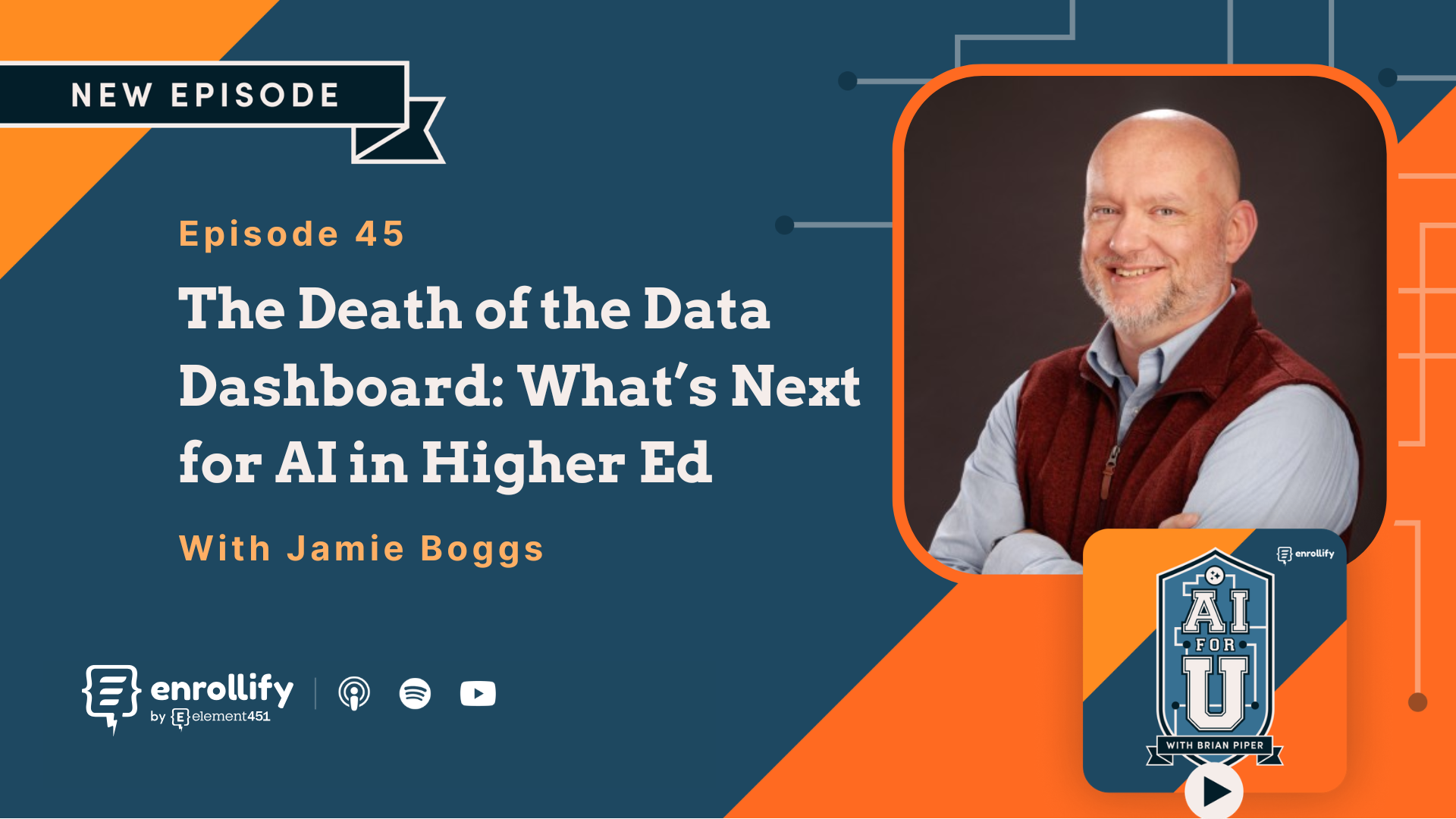
There’s a quiet shift happening in how we work with data. For years, the focus has been on collecting more of it, building better dashboards, and reporting on the right numbers. But as this conversation explores, that approach may be reaching its limit. That’s because having data isn’t the same as having insight. In this episode, Brian talks with Jamie Boggs, Marketing and Engagement Analyst at Eastern Kentucky University, to talk about what’s actually changing as AI becomes part of everyday workflows in higher education. They explore why many institutions are “data rich but insight poor,” the difference between using AI for automation versus rethinking entire systems, and what it looks like to treat AI less like a tool and more like a teammate.
Join us as we discuss:
- [3:59] What “data rich, insight poor” means for higher ed
- [18:05] The death of the data dashboard and what it means for student insights
- [26:24] What institutions should be doing now to future-proof their schools
Check out these resources we mentioned during the podcast:
To hear this interview and many more like it, subscribe on Apple Podcasts, Spotify, or our website, or search for AI for U with Brian Piper in your favorite podcast player.
Why Data Analytics in Higher Education Often Falls Short
Higher education institutions are collecting more data than ever before—but more data doesn’t automatically lead to better decisions. Jamie Boggs highlights a critical issue: teams often default to tracking what’s easy instead of what’s meaningful. Metrics like page views and impressions may look impressive in reports, but they rarely connect to actual enrollment or student success outcomes.
This disconnect creates a dangerous illusion of progress. Leadership teams may feel confident seeing upward trends in dashboards, while underlying strategic goals—like improving yield or retention—remain unaffected. Without aligning metrics to outcomes, institutions risk optimizing for the wrong things entirely.
AI changes this equation by helping teams identify which metrics truly matter. Instead of manually sifting through dashboards, institutions can use AI to connect data points to real goals—like enrollment growth or student engagement—making analytics more actionable and less performative.
Moving Beyond Vanity Metrics to Meaningful Insights
One of the most powerful themes in this episode is the distinction between vanity metrics and actionable insights. Vanity metrics are easy to measure but difficult to act on, while meaningful metrics directly inform strategy. Jamie emphasizes that institutions must rethink how they define success—and that starts with better questions.
AI plays a crucial role here by helping teams analyze complex datasets and surface patterns that humans might miss. For example, instead of simply tracking clicks, AI can reveal whether those clicks lead to deeper engagement or conversion. This shift allows marketers to focus on behaviors that actually drive enrollment outcomes.
The result is a more strategic approach to enrollment marketing. Teams can allocate resources more effectively, refine messaging, and ultimately improve ROI. It’s not about having more data—it’s about having the right data and knowing what to do with it.
How AI in Higher Education Is Transforming Analytics Workflows
AI isn’t just making analytics faster—it’s fundamentally changing how work gets done. Jamie shares how tasks that once took weeks or months—like cleaning datasets or building models—can now be completed in hours. This efficiency frees up teams to focus on higher-level strategy instead of manual processes.
But speed is only part of the story. AI also enables a more collaborative, iterative approach to analysis. Instead of treating analytics as a back-office function, teams can integrate AI into daily workflows—constantly refining models, testing hypotheses, and improving outcomes. This aligns with a broader shift toward data analytics in higher education as a strategic driver.
Perhaps most importantly, AI introduces the concept of “Jamie Plus”—augmenting human expertise rather than replacing it. Professionals who embrace AI gain a significant advantage, combining their domain knowledge with the power of machine intelligence to make smarter, faster decisions.
The Death of the Dashboard (and What Comes Next)
Dashboards have long been the cornerstone of higher ed analytics—but their relevance is fading. Jamie predicts a future where users no longer need to navigate complex reports. Instead, they’ll simply ask questions and receive curated, personalized insights in real time.
This shift represents a major evolution in how institutions consume data. Rather than static visualizations, AI will deliver dynamic answers tailored to each user’s role and needs. A VP of Enrollment might see high-level trends and recommendations, while a marketing manager receives channel-specific insights—all from the same underlying data.
The implications are huge for performance indicators in education. Reporting becomes more efficient, more relevant, and more actionable. And perhaps most importantly, it ensures that data actually gets used—not just collected and displayed.
Breaking Down Silos to Unlock AI’s Full Potential
Despite its promise, AI adoption in higher ed faces a major obstacle: silos. Departments often operate independently, using different tools and datasets, which limits collaboration and insight-sharing. Jamie warns that without intentional coordination, AI could actually deepen these divides.
To overcome this, institutions need a more unified approach. This includes standardizing tools, creating shared knowledge hubs, and fostering cross-department collaboration. When teams work together, they can build more robust models, share best practices, and avoid duplicating efforts.
Investing in training and governance is equally critical. Institutions that prioritize AI literacy and allocate resources for experimentation will be better positioned to succeed. In a rapidly evolving landscape, standing still isn’t an option.
Connect With Our Host:
Brian Piper
https://www.linkedin.com/in/brianwpiper/
Enrollify is produced by Element451 — the next-generation AI student engagement platform helping institutions create meaningful and personalized interactions with students. Learn more at element451.com.






.svg)
.svg)
