






About the Episode
About the Episode:
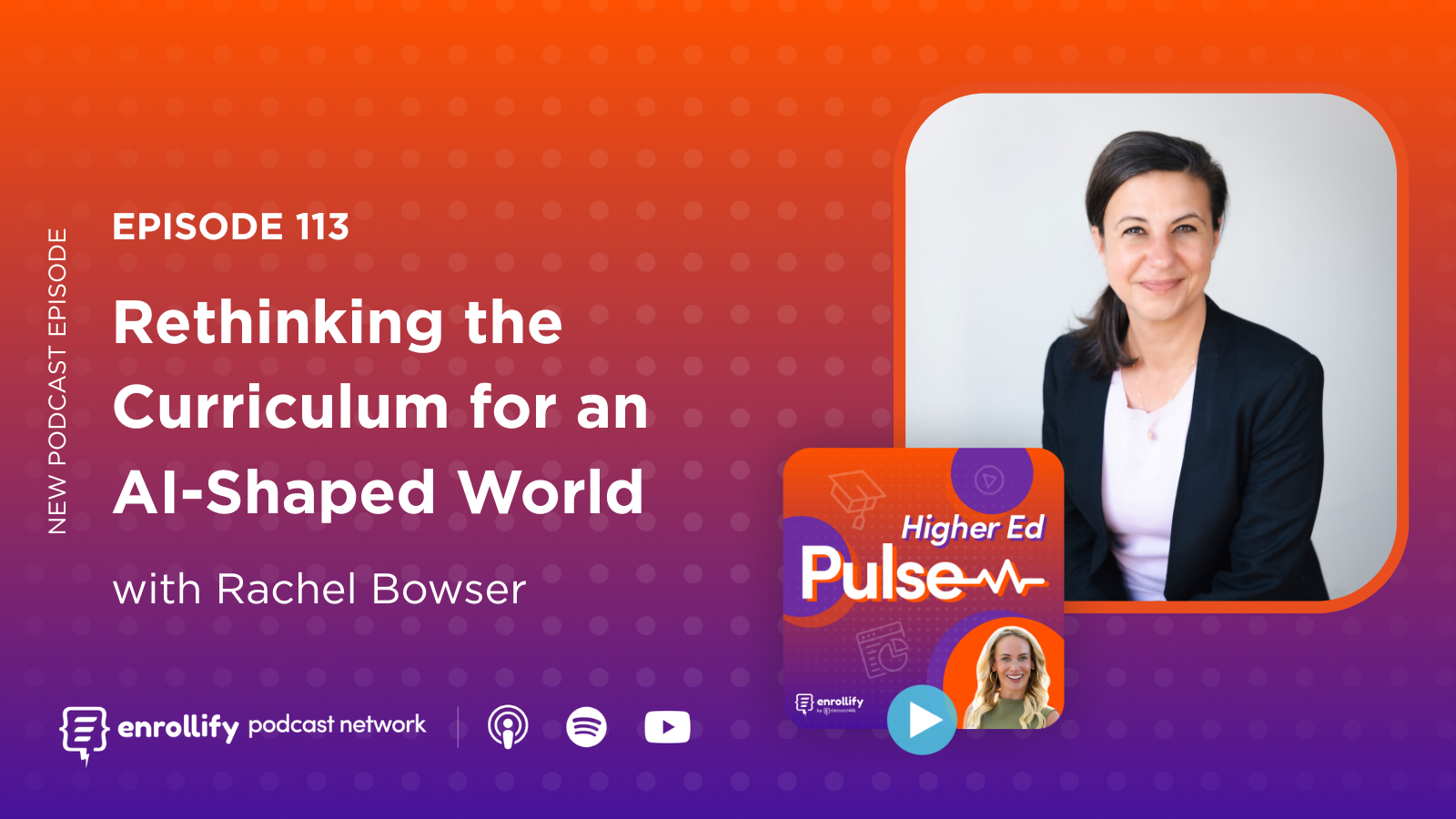
Mallory sits down with Rachel Bowser, Vice President for Academic Affairs and Dean of the College at Agnes Scott College, to unpack one of the most ambitious examples of AI in higher education today. Rather than treating AI as a supplemental skill, Agnes Scott is embedding AI literacy into the core first-year experience for every student. The conversation explores what it means to redesign curriculum at scale and why institutions must rethink how they prepare students for an AI-shaped future.
Key Takeaways
- AI literacy is becoming a baseline, not a bonus in modern higher education curricula
- Embedding AI in higher education requires cultural and structural change—not just new tools
- Liberal arts institutions are uniquely positioned to lead ethical AI education
- Students need judgment and critical thinking skills, not just technical AI proficiency
- Experiential learning remains critical alongside AI fluency for student success strategies
- Institutions must shift from gatekeeping knowledge to teaching ways of thinking and evaluation
- AI curriculum success should be measured through campus conversations and mindset shifts, not just technical outcomes
Episode Summary
Why AI in Higher Education Requires Curriculum Redesign
Agnes Scott didn’t just add an AI course—they reimagined the foundation of their academic model. Rachel Bowser explains that urgency across higher education is at an all-time high, with institutions facing pressure to align with workforce demands, student expectations, and rapid technological change. AI is not a future concern—it’s already shaping how students learn, think, and make decisions daily.
This shift reflects a broader trend in higher education content marketing and institutional strategy: prospective students and families increasingly expect schools to demonstrate relevance. By embedding AI into the first-year experience, Agnes Scott signals that it’s not just reacting to trends but actively shaping them.
Importantly, Bowser challenges the assumption that only technical institutions should lead AI adoption. Liberal arts colleges, with their emphasis on critical thinking and ethical reasoning, may actually be better positioned to teach students how to engage with AI thoughtfully and responsibly.
Teaching AI Literacy vs. AI Proficiency
One of the most compelling distinctions in the episode is between AI literacy and AI proficiency. Agnes Scott is intentionally focused on helping students evaluate, question, and contextualize AI—not simply use it. This aligns with growing conversations around student success strategies and long-term career readiness.
Students are taught to ask: When does AI সাহায্য my learning, and when does it hinder it? This metacognitive approach ensures that AI becomes a tool for growth rather than a shortcut that undermines skill development. Bowser emphasizes that students should move beyond a “cheating vs. not cheating” mindset and instead develop nuanced judgment.
This approach reflects a deeper commitment to education market research insights: employers are not just looking for technical ability—they want graduates who can think critically, communicate effectively, and navigate ambiguity. AI literacy, in this sense, becomes a core competency alongside traditional liberal arts outcomes.
Balancing AI with Human-Centered Learning
Despite the focus on AI, Agnes Scott is doubling down on human connection. Bowser notes that interest in experiential learning—internships, study abroad, and collaborative problem-solving—has only increased as AI becomes more prevalent.
This dual emphasis is key for marketing strategy for student recruitment. Prospective students aren’t choosing between technology and human experience—they expect both. Agnes Scott’s model ensures students gain AI fluency while still benefiting from immersive, community-based education.
The institution’s commitment to universal experiences—ensuring every student participates in key programs—also reflects a shift away from exclusivity. In an era where information is abundant, the value of higher education lies in how students learn, who they learn with, and how they apply that knowledge.
Overcoming Resistance and Driving Institutional Change
Curriculum redesign is never simple. Bowser is candid about the internal friction that comes with change, noting that productive tension is actually essential to higher education governance. Faculty and staff must wrestle with complex questions about ethics, tool adoption, and student autonomy.
Rather than cutting existing content, Agnes Scott evolved its curriculum. This iterative approach allowed them to integrate AI without sacrificing core learning outcomes. It’s a powerful example for institutions navigating similar transformations in trends in higher education marketing and academic design.
The conversation also highlights a critical mindset shift: moving from teaching static knowledge to teaching adaptability. AI tools will continue to evolve rapidly, but the ability to think critically about them will remain constant.
How Do You Measure Student Success in an AI-Driven Curriculum?
When it comes to how do you measure student success, Agnes Scott is taking both traditional and unconventional approaches. Yes, there are formal learning outcomes and assessments tied to AI literacy. But Bowser suggests that real success will show up in campus culture.
Are students engaging in balanced conversations about AI’s risks and opportunities? Are they thinking critically about its social impact? Are they making intentional choices about when—and when not—to use it? These qualitative indicators may be just as important as quantitative metrics.
This perspective aligns with evolving performance indicators in education, where success is increasingly defined by mindset, adaptability, and ethical reasoning—not just technical skill acquisition.
Connect With Our Host:
Mallory Willsea
https://www.linkedin.com/in/mallorywillsea/
https://twitter.com/mallorywillsea
Enrollify is produced by Element451 — the next-generation AI student engagement platform helping institutions create meaningful and personalized interactions with students. Learn more at element451.com.


.svg)
.svg)
