






About the Episode
About The Episode:
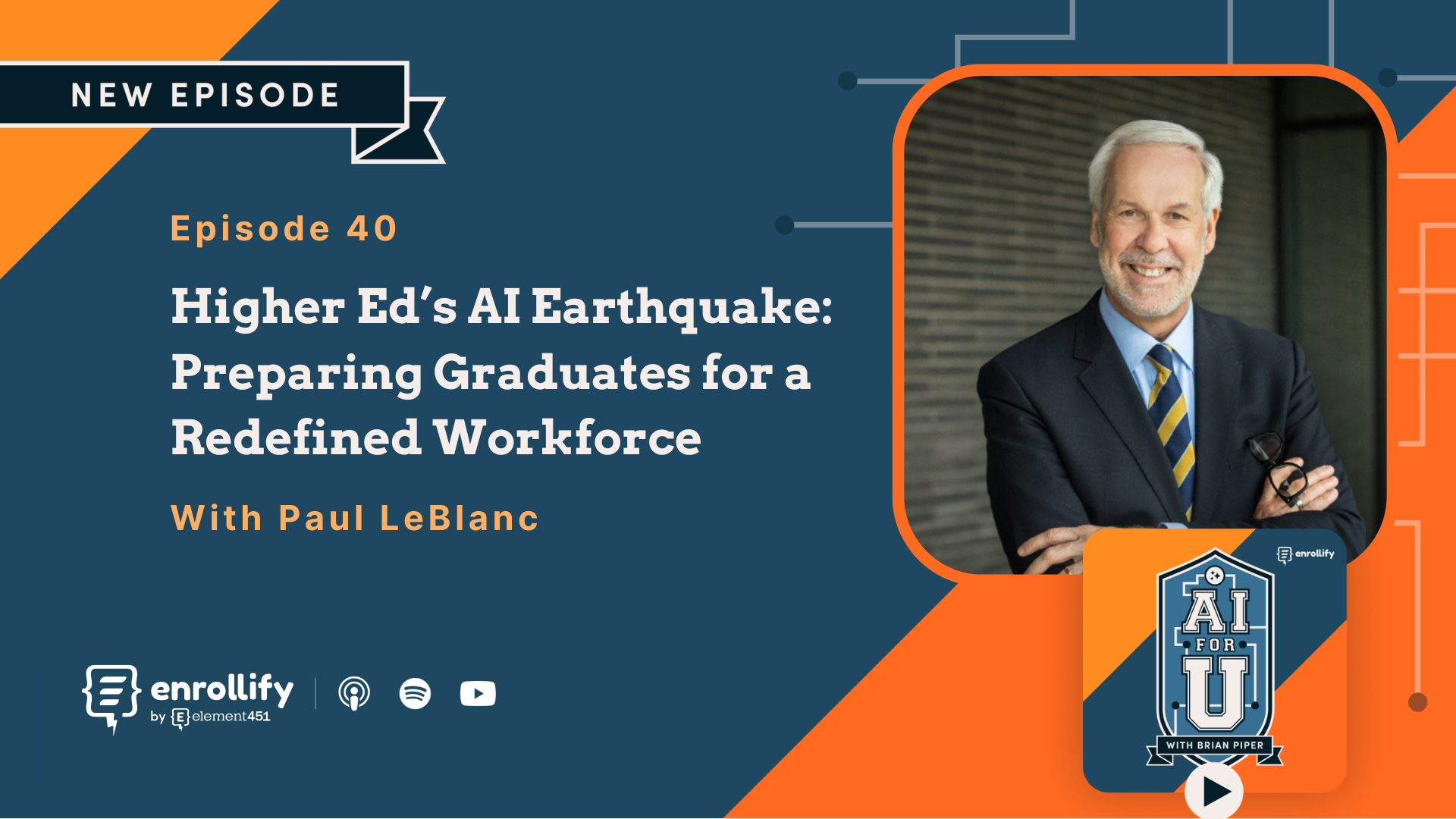
In this episode, host Brian Piper speaks with Paul LeBlanc, Visiting Scholar and Special Advisor at the Harvard Graduate School of Education. Paul explores the profound impact of AI on higher education, arguing that institutions must move beyond traditional knowledge transfer to focus on character formation and a “care economy.” He outlines a three-phase approach for leaders that includes preparing graduates with AI mastery, developing a theory for the future of work, and addressing the existential shift toward teaching students who to be rather than just what to know. Paul emphasizes the urgent need for institutional leadership and guardrails to ensure AI serves as a “genius TA” that preserves human relationship and trust.
Join us as we discuss:
- [3:46] Why higher ed leaders need to urgently prepare their graduates for an AI-assisted workforce
- [15:24] Preserving brand voice when using AI tools to augment content creation
- [24:38] Why higher ed needs to evolve from knowledge transfer to relationship-building
To hear this interview and many more like it, subscribe on Apple Podcasts, Spotify, or our website, or search for AI for U with Brian Piper in your favorite podcast player.
Phase One: The Urgency of AI in Higher Education
Dr. LeBlanc doesn’t mince words: universities must urgently prepare students for an AI-driven economy. According to recent reports, a majority of graduates feel underprepared for the workforce—especially as employers increasingly expect fluency in AI tools. If institutions fail to address this gap, they risk sending students into the labor market unprepared for reality.
This first phase is about AI mastery. Not theoretical understanding—but practical application. Graphic designers must know generative design tools. Marketers must understand AI-powered analytics. Healthcare professionals must be trained alongside AI-enabled systems. AI literacy is quickly becoming foundational.
But technical skill alone isn’t enough. Institutions must also define what responsible AI use looks like. Leaving policy decisions to individual faculty under the umbrella of academic freedom, LeBlanc argues, is a cop-out. Students deserve clarity around what’s permitted, what’s ethical, and how AI should be integrated into learning environments.
Phase Two: Data Analytics in Higher Education & the Future of Work
The second phase requires institutions to develop a clear theory of the future of work. What jobs will persist? What skills will endure? How should academic programs evolve in response?
LeBlanc points to real-time labor market intelligence—like co-op programs reporting back from employers—as more valuable than static job descriptions. Healthcare and care economy roles are expanding rapidly, signaling that human-centered professions may prove more resilient in an AI-saturated market.
This is where data analytics in higher education becomes mission-critical. Institutions already possess enormous amounts of student data—but much of it is siloed. AI-powered systems could unify and analyze that data to improve advising, predict risk factors, and personalize student support. The key? Using analytics ethically, transparently, and always in service of student success.
Phase Three: From Knowledge Transfer to Human Formation
The most provocative part of the conversation centers on higher ed’s long-term identity crisis. If AI can deliver knowledge faster, cheaper, and at scale—what is the university for?
LeBlanc argues that institutions must shift from epistemological questions (“What do you need to know?”) to ontological ones (“Who do you want to be?”). Knowledge transfer alone will not justify tuition in an AI-rich world. Human development, mentorship, values formation, and leadership cultivation will.
He points to institutions that already operate with strong value frameworks—Jesuit universities, military academies, HBCUs—as examples of how education can extend beyond credentialing. The future may demand more of this intentional identity-building across all institutions.
In this reimagined model, the classroom becomes precious human time. AI handles assessment, tutoring, and information delivery. Faculty focus on relationship-building, coaching, and curating transformative experiences. It’s the flipped classroom—on steroids.
Preserving Brand Voice While Leveraging AI
For enrollment marketers and content creators, the implications are immediate. AI can accelerate higher education content marketing, power SEO strategies, and streamline campaign development. But as LeBlanc warns, AI-generated writing often lacks authenticity.
The solution? Use AI as a productivity engine—not a voice replacement. Leverage it for research, redundancy checks, scenario analysis, and structured feedback. But retain human judgment to ensure messaging aligns with institutional values and brand identity.
In an era where AI content risks sounding homogeneous, authenticity becomes a competitive advantage. Institutions that pair efficiency with discernment will stand apart.
Trust, Ethics, and Institutional Responsibility
Perhaps the most sobering theme of the episode is trust. Universities and healthcare systems operate in high-trust environments. A misstep with AI—particularly involving sensitive data—can erode credibility quickly.
LeBlanc cautions against simply adopting enterprise AI licenses without governance, training, and clear policy frameworks. AI implementation must be intentional. Transparent. Thoughtful.
Higher education holds philosophers, technologists, ethicists, and economists within its walls. If any sector is equipped to guide society through the AI transition, it’s ours. The question is whether institutions will step into that responsibility—or retreat from it.
Connect With Our Host:
Brian Piper
https://www.linkedin.com/in/brianwpiper/
Enrollify is produced by Element451 — the next-generation AI student engagement platform helping institutions create meaningful and personalized interactions with students. Learn more at element451.com.




.svg)
.svg)
