






About the Episode
About the Episode:
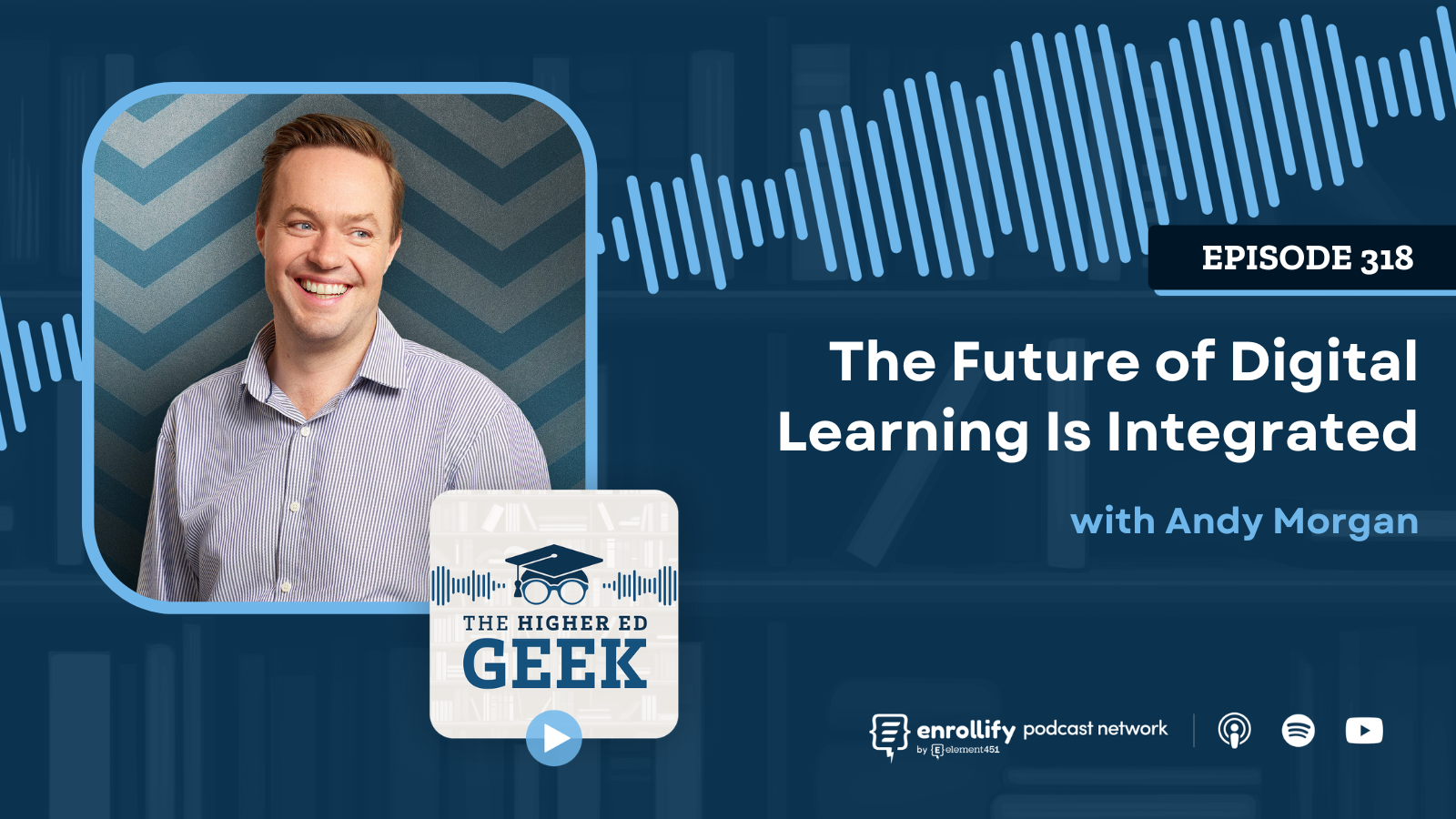
In this forward-looking conversation, Dustin sits down with Andy Morgan, Chief Partnerships Officer at 2U, to unpack what digital education looks like in 2026—and where it’s heading next. From the maturation of online learning to mounting regulatory pressure and the rapid acceleration of AI, Andy outlines the three major forces reshaping higher ed strategy today.
The big takeaway? Moving a program online isn’t innovation anymore. Institutions that thrive will build integrated, learner-first strategies that blend modality, rethink marketing, and use AI to enhance—not replace—human connection.
Key Takeaways
- AI in higher education is redefining the student experience—from marketing automation to classroom innovation.
- Simply moving a degree program online is no longer innovation; integrated, student-centered digital strategy is the new baseline.
- Enrollment marketing has changed more in the last 12 months than in the prior decade due to AI and shifts in digital media.
- Institutions must break down silos between degree and non-degree offerings to create coherent learner journeys.
- Financial and regulatory pressures are accelerating the need for strategic digital transformation.
- Human-to-human interaction remains the heart of student success strategies—AI should scale it, not replace it.
The Maturation of Online Education—and What Comes Next
Andy Morgan makes one thing clear: online learning is no longer fringe. What began as an experimental extension of traditional education has matured into a mainstream expectation. In fact, more students are engaging in some form of online learning than ever before—whether fully remote or as part of a hybrid campus experience.
But here’s the provocative truth: simply putting a program online in 2026 is not innovation. Institutions that treat digital education as a side initiative or isolated department risk falling behind. Today’s learners expect seamless pathways between online, hybrid, credit, and non-credit offerings—and they expect institutions to deliver that experience cohesively.
This is where integrated strategy becomes mission-critical. Rather than siloing continuing education, graduate programs, and online initiatives, forward-thinking institutions are aligning them under a unified vision. That coherence doesn’t just improve the student experience—it strengthens enrollment marketing performance and institutional resilience.
How AI in Higher Education Is Disrupting Enrollment Marketing
One of the most compelling moments in the episode centers on the dramatic shifts happening in digital marketing. According to Andy, enrollment marketing has experienced more change in the last year than in the previous decade—thanks largely to advances in AI and evolving search behavior.
Traditional Google-based strategies are being upended. Institutions must now rethink their marketing strategy for student recruitment through the lens of AI-driven discovery, personalization, and automation. The ability to find and engage the right learners cost-effectively is no longer a “nice-to-have”—it’s a financial necessity.
For partners like 2U, scale matters. Leveraging data analytics in higher education alongside AI-powered marketing tools enables more efficient audience targeting and stronger ROI. For institutions, the takeaway is clear: your digital presence must be intentional, integrated, and agile—or risk becoming invisible.
Financial Pressures, Regulation, and Strategic Urgency
Higher education leaders aren’t just thinking about innovation—they’re responding to mounting fiscal and regulatory pressures. From tuition scrutiny to endowment taxes and evolving Title IV conversations, institutions face an increasingly complex operating environment.
These pressures make long-term strategy more urgent than ever. As Andy notes, institutions often plan in decades, not quarters. But today’s landscape requires balancing that long-term mission with short-term agility. The institutions that thrive will be those that can maintain academic rigor while adapting quickly to market realities.
This moment demands courage. Leaders must question legacy assumptions and commit to meaningful action. Digital transformation isn’t about trend-chasing—it’s about sustainability and mission alignment.
AI’s Role in Teaching, Learning, and Student Success Strategies
Perhaps the most exciting part of the discussion focuses on the classroom itself. AI in higher education isn’t just about marketing efficiencies—it’s about reimagining teaching and learning.
Historically, online education models have followed a predictable pattern: watch a video, read content, complete an assessment, join a discussion. AI creates opportunities to move beyond that static format. By enhancing productivity, personalizing feedback, and scaling meaningful interactions, institutions can design more dynamic learning environments.
Importantly, AI should amplify—not replace—human connection. Learning is inherently social. Faculty-student and peer-to-peer interactions remain central to student success strategies. AI’s power lies in freeing up time, surfacing insights, and enabling faculty to focus on the moments that matter most.
What Will Differentiate the “Winners” in Higher Ed?
If there’s a throughline in this episode, it’s integration. The institutions best positioned for 2030 won’t be those with the most programs—they’ll be those with the most coherent strategies.
That means aligning marketing, academic portfolios, modality choices, and technology ecosystems around the learner. It means presenting prospective students with clear pathways instead of fragmented options. And it means using data analytics in higher education to inform decisions, not just report on them.
Andy predicts that even highly ranked institutions will increasingly embrace more progressive online and AI-integrated strategies—driven in part by financial necessity. The question isn’t whether digital education will expand. The question is how intentionally institutions will design it.
About the Show: The Higher Ed Geek Podcast explores the impact of edtech on the student experience by speaking with diverse leaders from institutions, companies, and nonprofit organizations. Each week we aim to provide an engaging, fun, and relevant dose of professional development that honors the wide range of work happening all across the higher ed ecosystem. Come geek out with us! The Higher Ed Geek Podcast is hosted by Dustin Ramsdell and is a proud member of the Enrollify Podcast Network.
Connect With Our Host:
Dustin Ramsdell
Enrollify is produced by Element451 — the next-generation AI student engagement platform helping institutions create meaningful and personalized interactions with students. Learn more at element451.com.





.svg)
.svg)
