






About the Episode
About The Episode:
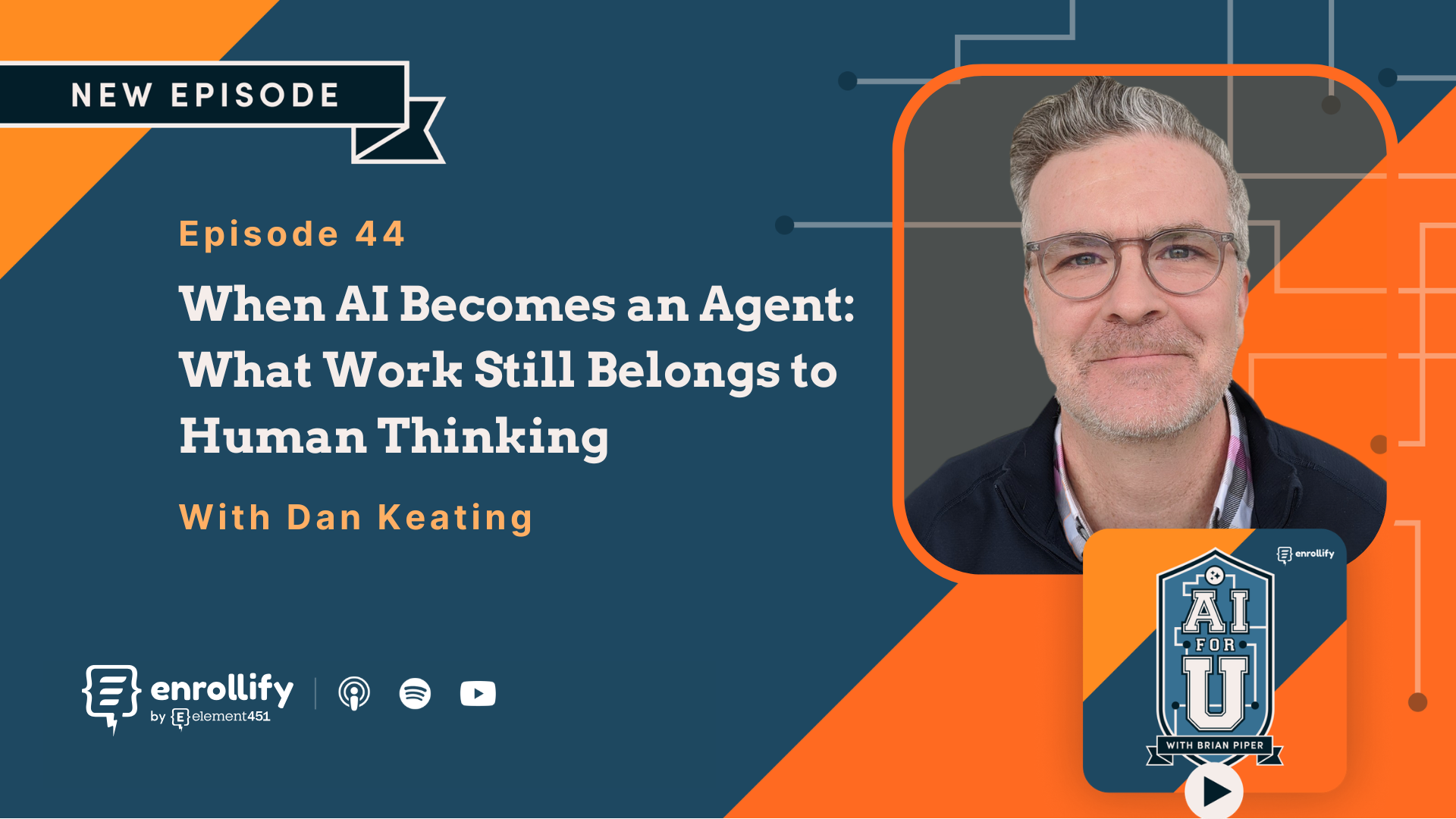
AI can already do the easy work, so how do higher ed professionals prove their worth? In this episode, Dan Keating, Clinical Associate Professor of Information Systems and AI at University of Rochester - Simon Business School, explains how AI is changing how we think, learn, and define expertise. The fundamentals still matter, but when AI can produce solid output in seconds, the question shifts to not can you do the work, but what do you add to it? Tune in to hear why the future doesn’t belong to the people who just use AI but to the ones who can explain why their thinking still matters.
Join us as we discuss:
- [2:21] Creating AI-ready teams through curiosity and critical thinking
- [10:07] Educating instructors, staff, and students during AI integration
- [23:28] What human value means in the age of AI
To hear this interview and many more like it, subscribe on Apple Podcasts, Spotify, or our website, or search for AI for U with Brian Piper in your favorite podcast player.
How Do You Identify AI Opportunities in Higher Education Workflows?
One of the most practical frameworks shared in this episode is deceptively simple: break down your daily workflows step by step. Instead of chasing the latest AI trend, Keating emphasizes starting with what teams already do—admissions processes, marketing tasks, advising workflows—and asking where AI can meaningfully assist. This approach aligns closely with evolving marketing strategy for student recruitment, where personalization and efficiency are key.
By focusing on workflows, institutions can uncover opportunities for both efficiency and innovation. AI isn’t just about doing things faster—it’s about doing things differently. For example, AI can help identify prospective students who may need earlier intervention or tailor communications based on behavioral data. These use cases go far beyond automation and into transformation.
This mindset shift is critical. As Keating notes, many professionals experience “AI paralysis” due to the overwhelming number of possibilities. Breaking work into smaller components makes AI adoption more approachable and actionable, helping teams build momentum over time.
What Does Successful AI Integration Look Like on Campus?
At the University of Rochester’s Simon Business School, AI integration didn’t happen by accident—it was driven by strong executive buy-in and a culture of experimentation. Leadership made a clear decision early on to invest in AI, providing both resources and encouragement to faculty and staff. This kind of top-down support is often the missing link in trends in higher education marketing and broader digital transformation efforts.
One standout initiative was the creation of faculty grants for AI experimentation. Faculty members were incentivized not only to integrate AI into their courses but also to share their findings with peers. This created a ripple effect, turning individual experiments into institutional knowledge.
The result? A collaborative learning environment where faculty, staff, and students all contribute to AI adoption. From admissions teams using AI for communication workflows to students learning responsible AI use during orientation, the approach is holistic and scalable.
How Is AI Changing Teaching, Learning, and Student Success Strategies?
AI is fundamentally reshaping how institutions think about teaching and learning. Keating introduces a helpful framework: course, classroom, and career. This model encourages educators to consider how AI supports course design, enhances in-class experiences, and prepares students for real-world applications.
In practice, this means shifting away from traditional assessments toward more experiential learning. If AI can generate a solid essay, then classroom time must focus on discussion, critical thinking, and application—areas where human insight still leads. This evolution is central to modern student success strategies and aligns with the growing demand for experiential education.
Additionally, AI enables more proactive student support. Institutions can use predictive analytics to identify at-risk students earlier and intervene more effectively. This mirrors strategies used in marketing and customer retention, highlighting the crossover between data analytics in higher education and student success initiatives.
What Do People Get Wrong About AI in Higher Education?
One of the most compelling parts of the conversation is Keating’s nuanced take on AI skepticism. Rather than dismissing concerns, he acknowledges that critics are often right—AI does raise valid issues around academic integrity, environmental impact, and the potential erosion of deep learning.
The real challenge isn’t overcoming skepticism—it’s working with it. Institutions must find ways to preserve the “struggle” that leads to true expertise while still leveraging AI’s capabilities. This is particularly important in higher ed, where learning is as much about the process as the outcome.
Ultimately, the goal is balance. AI should enhance—not replace—the human elements of education. By embracing both innovation and critical reflection, institutions can navigate this complex landscape more effectively.
How Should Higher Ed Professionals Think About Their Value in an AI-Driven World?
AI’s ability to produce competent, “B+ level” work raises an important question: what makes human expertise valuable? According to Keating, professionals must get better at articulating the unique value they bring—whether it’s judgment, creativity, or contextual understanding.
This has major implications for roles across campus, from marketing to HR to finance. As AI takes over routine tasks, professionals must focus on higher-level contributions and clearly communicate their impact. This shift is especially relevant for those working in higher education content marketing and strategy roles.
It’s not just about using AI—it’s about using it well. Those who can combine AI capabilities with human insight will be the ones who thrive. And that requires continuous learning, experimentation, and a willingness to adapt.
Connect With Our Host:
Brian Piper
https://www.linkedin.com/in/brianwpiper/
Enrollify is produced by Element451 — the next-generation AI student engagement platform helping institutions create meaningful and personalized interactions with students. Learn more at element451.com.



.svg)
.svg)
