






About the Episode
About the Episode:
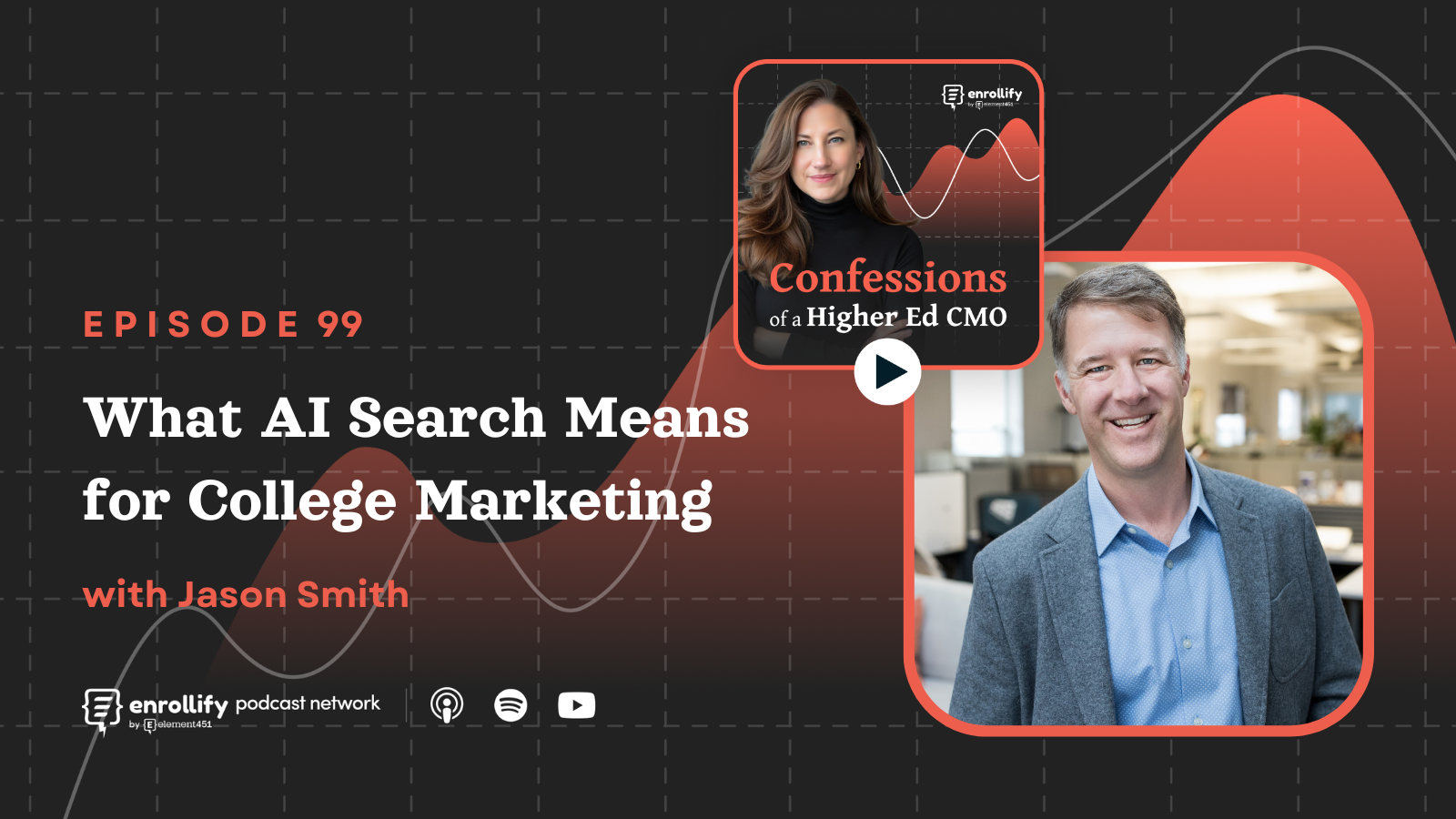
Jaime Hunt sits down with Jason Smith, Founder and Managing Director of OHO, to unpack how AI in higher education is fundamentally changing the way students search for colleges. As AI tools like ChatGPT and Gemini increasingly shape the student journey, institutions must rethink their approach to SEO for higher education and digital visibility.
Jason introduces OHO’s new AI Visibility Scorecard and shares eye-opening insights into where AI models pull information from—and why that matters for enrollment marketers. This conversation challenges higher ed leaders to move beyond traditional search strategies and prepare for an AI-driven future of student recruitment.
Key Takeaways
- AI search is accelerating zero-click behavior. Students increasingly find answers without ever visiting your website.
- Your website is still the primary source AI tools use for branded queries—but outdated or buried content can resurface in unexpected ways.
- Reputation and outcomes content are major blind spots for many institutions and often get pulled from third-party sources instead.
- SEO for higher education is not dead. Strong SEO practices directly influence AI visibility and search performance.
- Content governance is critical. Old blog posts, archived pages, and inconsistent messaging can negatively impact AI-generated answers.
- Structured, concise content wins. AI models favor clearly labeled, well-organized information—think “nutrition facts” for your programs.
- AI agents are coming. Institutions must prepare for a future where students outsource college comparisons entirely to AI tools.
Why AI in Higher Education Is Redefining College Search
The traditional student search journey is shifting—fast. In the past, prospective students might discover a school through Google and validate their interest on the institution’s website. Today, many students are conducting entire research processes inside AI tools like ChatGPT, never clicking through to campus websites at all.
Jason describes this as the next evolution of the “zero-click search” phenomenon. AI tools provide synthesized answers instantly, reducing the need for students to browse multiple pages. For enrollment marketing teams, this means visibility is no longer just about ranking on page one—it’s about being accurately represented in AI-generated responses.
The implications for marketing strategy for student recruitment are significant. If AI becomes the primary interface for discovery and comparison, institutions must optimize not only for human visitors but also for AI models ingesting and summarizing their content.
Where AI Models Are Actually Getting Their Information
One of the biggest revelations from OHO’s AI Visibility Scorecard is that most branded AI responses still pull heavily from institutional websites. That’s good news—but only if your content is current, structured, and aligned with your brand narrative.
When information isn’t available—or isn’t strong enough—AI fills the gaps with third-party sources. Outcomes data, rankings, and reputation-based insights often come from aggregator sites, coaching blogs, or public profiles. That means your story may be shaped by someone else’s framing.
Jason also notes some surprising patterns. National media mentions are often underrepresented because of paywalls, while Wikipedia and public LinkedIn pages are frequently indexed. Reddit appears less influential than many marketers assume, and YouTube is cited less often than expected. The takeaway? You need a comprehensive view of your digital footprint—not just your homepage.
The Content Governance Wake-Up Call
Higher ed websites have ballooned over the past two decades. Many institutions treat their site as an archive rather than a strategic business tool. But in an AI-driven world, every outdated page becomes a liability.
Jason shares a striking example: an old blog post announcing a discontinued program surfaced in AI responses as if the program were still active. Previously, buried content might have been harmless on page four of Google. Today, it can be elevated instantly into a polished AI summary.
This is where data analytics in higher education and structured governance come into play. Institutions must audit, prune, and clarify their digital ecosystems. Content that doesn’t serve prospective students—or that introduces confusion—needs to be revised, relocated, or retired.
Is SEO for Higher Education Still Relevant? Absolutely.
Despite concerns that AI will replace traditional search, Jason makes it clear: SEO for higher education is more important than ever. AI tools conduct web searches behind the scenes to build their answers. Strong SEO practices directly influence what AI can find and how it interprets your content.
What’s evolving is how we structure information. Clear labeling, concise summaries, schema markup experimentation, and “at-a-glance” program details (cost, duration, outcomes) help both humans and AI models understand your offerings. The overlap between good UX, strong SEO, and AI visibility is substantial.
Rather than chasing vanity metrics like total organic traffic, institutions should focus on optimizing high-intent pages—program details, admissions requirements, deadlines, and outcomes. These pages directly impact enrollment marketing performance and AI-generated answers.
Preparing for AI Agents and the Future of Enrollment Marketing
Looking ahead two to three years, Jason predicts a rise in AI agents that will act on behalf of students. Imagine a prospective applicant feeding their GPA, budget, career goals, and geographic preferences into an AI tool—and receiving a curated list of best-fit institutions.
If that becomes the norm, your website must function as both a data source and a conversion experience. Structured content will feed AI systems, while streamlined, action-oriented design will capture students when they decide to engage directly.
This shift requires bold thinking. CMOs must courageously question the status quo, refine their higher education content marketing strategies, and invest in SEO and governance today. The institutions that prepare now will shape their AI narratives rather than react to them later.
Connect With Our Host:
Jaime Hunt
https://twitter.com/JaimeHuntIMC
Enrollify is produced by Element451 — the next-generation AI student engagement platform helping institutions create meaningful and personalized interactions with students. Learn more at element451.com.



.svg)
.svg)
