






About the Episode
About the Episode:
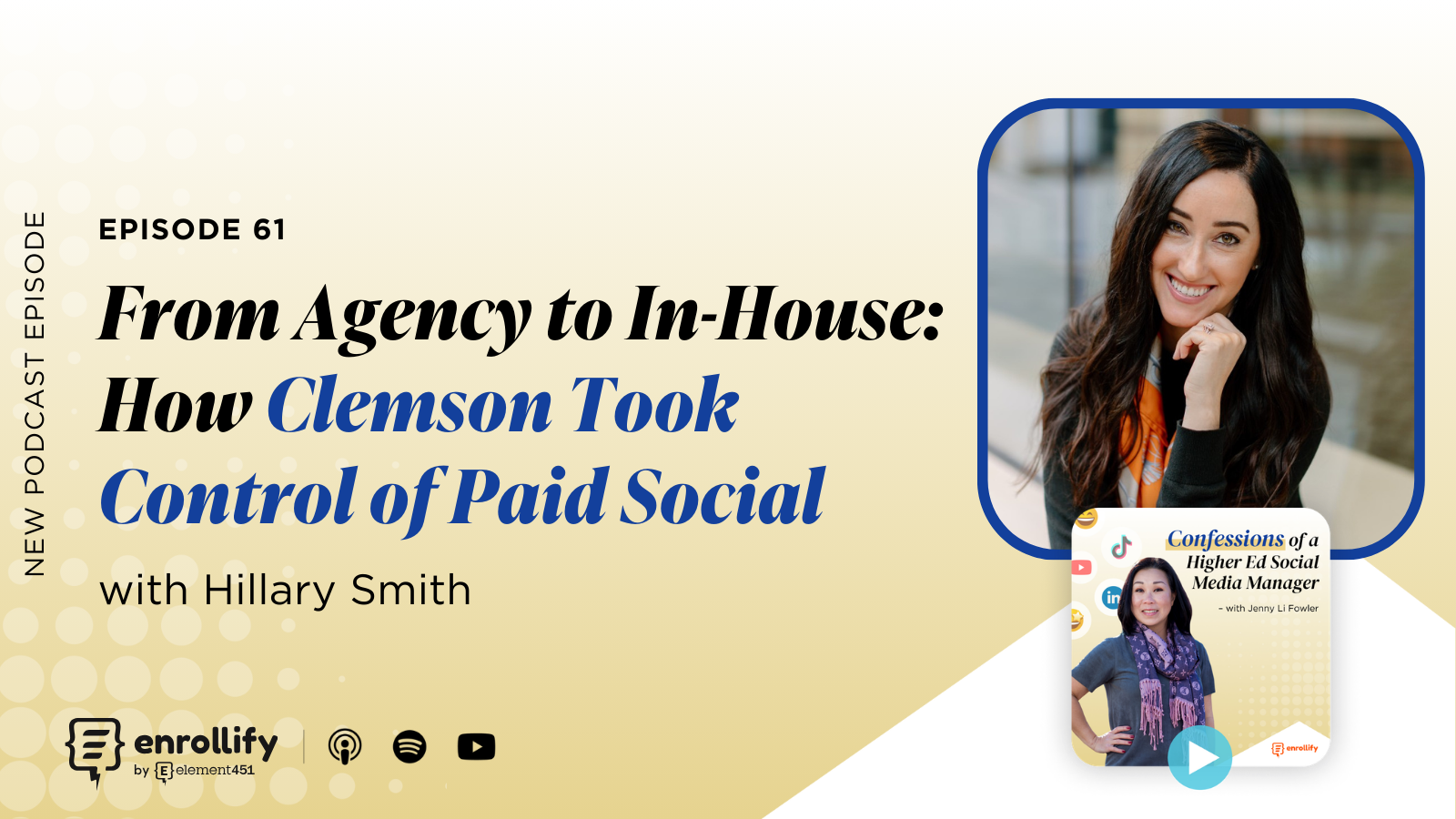
Jenny Li Fowler sits down with Hillary Smith of Clemson University to unpack a bold move: bringing paid social media in-house—and outperforming an agency in the process. What started as a learning opportunity evolved into a powerful case study in smarter enrollment marketing and stronger cross-team collaboration.
Hillary shares how Clemson’s centralized marketing structure, internal audience insights, and access to real-time data analytics in higher education led to better results at half the cost. This episode is a must-listen for higher ed marketers questioning whether agencies are always the right answer for paid campaigns.
Key Takeaways
- In-house paid social can outperform agencies when teams leverage internal audience insights and strong creative collaboration.
- Access to real-time data analytics in higher education is a game changer for optimizing campaigns quickly and effectively.
- Retargeting strategies significantly strengthen enrollment marketing efforts by creating multiple touchpoints with prospective students.
- Clear performance indicators in education—like link clicks, impressions, and reach—create measurable benchmarks for success.
- Centralized marketing structures enable nimble execution and smarter marketing strategy for student recruitment.
- Higher ed social teams should advocate for a seat at the table when agencies are hired or budgets are allocated.
Why Clemson Brought Paid Social In-House
When Clemson leadership initially partnered with an agency for paid social, the goal was support. Paid campaigns involve market research, creative execution, audience targeting, and performance reporting—no small lift for any team. At the time, Hillary was primarily focused on organic social but saw an opportunity to expand her skill set into paid strategy.
Rather than resisting the agency partnership, Hillary leaned in. She asked to join calls, observe reporting conversations, and learn how performance indicators in education were being measured. That curiosity became her crash course in paid media strategy—and laid the groundwork for something bigger.
After a year of observation, Hillary and her colleagues made a bold proposal: bring the campaign in-house. Armed with benchmark data from the agency’s work and a deep understanding of Clemson’s brand and audience, they believed they could execute a smarter, more agile enrollment marketing campaign internally.
The Power of Centralized Collaboration in Enrollment Marketing
One of the biggest factors in Clemson’s success? Structure. The university’s centralized marketing and communications division created the conditions for horizontal collaboration between social, creative, and brand teams.
Instead of operating in silos, teams worked together across writing, video, photography, design, and web. This structure made it possible to swap creative assets quickly, adjust messaging, and respond to real-time data without waiting on agency turnaround times. In today’s fast-moving digital landscape, that agility is invaluable.
Hillary emphasized that this evolution didn’t happen overnight. Clemson’s social team grew from “one and a half” staff members to five full-time professionals over several years. Those long-standing relationships built trust—making it easier to take calculated risks and experiment with a new marketing strategy for student recruitment.
Using Data Analytics in Higher Education to Drive Better Results
Here’s where things get exciting: the in-house campaign didn’t just match the agency’s performance—it exceeded it.
By focusing on key performance indicators in education—impressions, reach, and especially link clicks to Clemson.edu—the team built a data-backed comparison to the previous agency-led campaign. Because they mirrored the original structure, they had clear benchmarks for success.
The result? Clemson spent roughly half of what they budgeted for the agency and achieved the same or better outcomes across major KPIs.
The difference-maker was access. With full control over audiences and real-time data analytics in higher education platforms, Hillary’s team could monitor performance instantly, swap underperforming creative, and build retargeting audiences for future campaigns. That ownership transformed paid social from a one-off campaign into a long-term asset.
Why Brand Awareness Still Matters in Higher Ed
Even well-known institutions can’t afford complacency. Clemson’s brand awareness campaign wasn’t broad and generic—it was strategic and geo-targeted.
The team focused on shifting enrollment patterns and highlighted unique academic programs and research initiatives relevant to specific regions. By using paid social strategically, they ensured the right stories reached the right audiences at the right time.
This approach reflects larger trends in higher education marketing: institutions must actively shape perception, especially as competition for students intensifies. Brand awareness is no longer optional—it’s foundational to long-term enrollment marketing success.
Retargeting: A Smarter Marketing Strategy for Student Recruitment
One of the biggest lessons Hillary learned? The value of audience ownership.
By uploading prospect email lists and creating engagement-based audiences, Clemson could retarget users who interacted with brand awareness ads. Prospective students who engaged within 30, 60, or 90 days were served follow-up ads encouraging campus visits or deeper program exploration.
Retargeting created multiple digital touchpoints—moving prospects from passive awareness to active consideration. It’s a powerful reminder that higher education content marketing doesn’t stop at storytelling; it must create pathways for continued engagement.
When institutions rely solely on agencies without retaining audience access, they lose the opportunity to build long-term campaign equity. Clemson’s in-house model ensured that every campaign strengthened the next.
FAQs: What Higher Ed Social Media Managers Need to Know
Should higher ed institutions always use agencies for paid social?
Not necessarily. Agencies can be excellent partners, especially when bandwidth is limited. However, internal teams often have stronger audience insights and institutional knowledge, which can drive more authentic and effective enrollment marketing campaigns.
What metrics matter most in paid higher ed campaigns?
It depends on the goal, but for brand awareness campaigns, impressions, reach, and link clicks are essential performance indicators in education. For recruitment-focused efforts, conversions and engagement rates become even more critical.
How important is access to campaign data?
Full access to data analytics in higher education advertising platforms allows teams to optimize quickly, build retargeting audiences, and refine messaging in real time. Without that access, agility suffers.
How can social media managers advocate for involvement in paid strategy?
Start by asking to join meetings. Observe reporting conversations. Learn the language of paid media. As Hillary’s story proves, raising your hand can open doors—and position you to lead future campaigns.
What role does culture play in paid social success?
Institutional culture is everything. Agencies may understand marketing mechanics, but internal teams understand tone, audience nuance, accessibility standards, and the emotional drivers behind student decisions. That knowledge is difficult to outsource.
Connect With Our Host:
https://twitter.com/TheJennyLi
Enrollify is produced by Element451 — the next-generation AI student engagement platform helping institutions create meaningful and personalized interactions with students. Learn more at element451.com.


.svg)
.svg)
