






About the Episode
About the Episode:
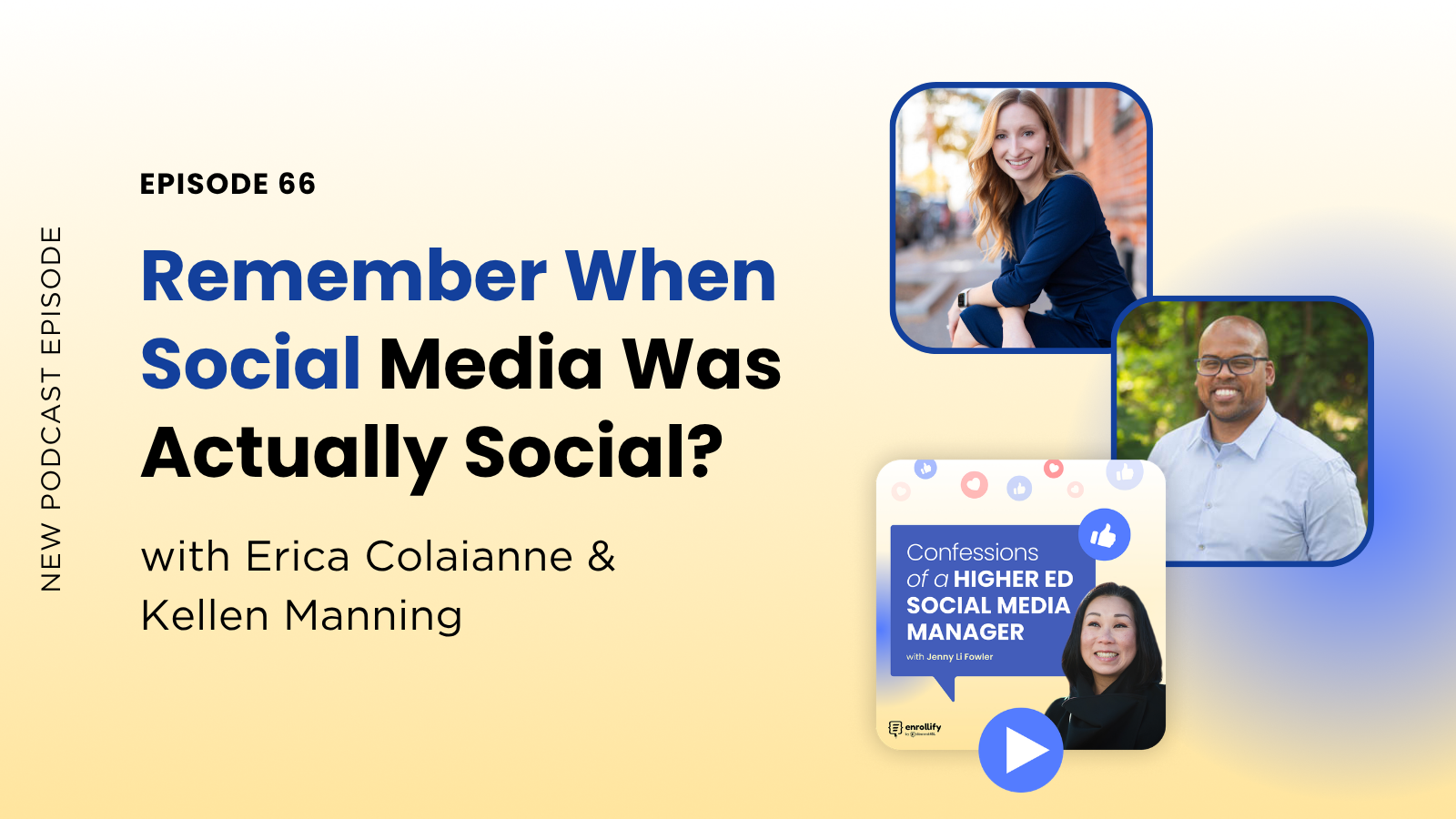
Jenny Li Fowler sits down with Erica Colaianne, Director of Content Strategy and Audience Development at the University of Michigan, and Kellen Manning, Director of Digital and Social Media Content at Penn State University, for an honest conversation about how social media in higher education has evolved over the last decade. From the early days of Twitter and live tweeting to today’s algorithm-driven, entertainment-focused landscape, the trio reflects on what’s changed, what hasn’t, and what higher ed marketers need to rethink moving forward.
This episode is packed with practical insights for enrollment marketers, higher education content marketing professionals, and social strategists navigating today’s increasingly fragmented digital ecosystem. The conversation explores platform evolution, social listening, audience engagement, crisis communications, and the growing role of social media in institutional strategy.
Key Takeaways
- Social media in higher education has evolved from a “side task” into a strategic communications function that requires dedicated expertise.
- Today’s social media professionals must balance content creation, analytics, audience engagement, crisis monitoring, and institutional reputation management.
- Platforms like Instagram, TikTok, LinkedIn, Reddit, and Yik Yak all serve different audience behaviors — and require different strategies.
- Social listening is one of the most underutilized tools in enrollment marketing and higher education communications.
- Modern audiences expect entertainment-first content, shifting social media away from pure community-building.
- Posting the same content across every platform is no longer an effective social media strategy.
- Adaptability is one of the most important skills for higher ed marketers working in digital communications.
- Authenticity and personality matter more than polished corporate messaging in higher education social media.
- Metrics alone don’t tell the whole story — social media teams also mitigate institutional risk and shape brand perception.
- The best higher education content marketing strategies are rooted in audience understanding, not just content distribution.
Episode Summary
How Has Social Media in Higher Education Changed Over Time?
One of the clearest themes throughout the episode is that social media management has become significantly more sophisticated. What began as a primarily writing-focused role centered around Facebook posts and tweets has evolved into a multifaceted discipline requiring expertise in video production, analytics, audience psychology, crisis communications, and strategic storytelling.
Kellen Manning reflected on how early social media roles often consisted of simply managing institutional accounts and publishing updates. Today, success requires understanding audience retention, video performance, platform-specific behavior, and evolving algorithms. Higher education social media professionals are now expected to interpret engagement trends and continuously optimize strategy based on audience behavior.
Erica Colaianne emphasized another major shift: leadership finally recognizes the strategic value of social media. While many institutions still under-resource their social teams, social media is increasingly viewed as an essential communications channel rather than an “other duties as assigned” responsibility. That shift reflects broader trends in higher education marketing, where digital engagement now directly impacts institutional reputation, enrollment marketing, and student experience.
Why Social Listening Matters More Than Ever
A major point of discussion centered around social listening and how many institutions still fail to use it effectively. Erica argued that too many organizations still use social media primarily for broadcasting information instead of learning from their audiences.
The conversation highlighted how audience feedback, online sentiment, and platform conversations can directly shape stronger content strategies. By monitoring comments, trends, memes, and student conversations, higher education marketers gain real-time insight into what their audiences actually care about. This is especially valuable for enrollment marketing teams looking to better understand prospective students and campus culture.
The episode also explored how social listening now plays a major role in institutional risk management. Social teams frequently identify emerging issues before they escalate, monitor conversations during crises, and help leadership understand public sentiment. In today’s landscape, social media professionals are not simply content creators — they are institutional intelligence hubs.
Is Social Media Still “Social”?
One of the episode’s most thought-provoking moments came when the conversation turned toward how social media platforms themselves have changed. Erica observed that many platforms now prioritize entertainment over connection, while Kellen argued that “social media isn’t social anymore — it’s just media.”
That distinction reflects a major shift in digital culture. Earlier versions of platforms like Twitter focused heavily on real-time connection, conversations, and community-building. Today’s algorithms prioritize entertainment, virality, and engagement retention, making platforms behave more like streaming services than networking spaces.
For higher education marketers, this evolution changes how content must be created. Institutions can no longer rely on informational posts alone. Successful higher education content marketing now requires audience-first storytelling, entertaining short-form video, emotionally resonant messaging, and platform-native creative strategies.
At the same time, smaller digital spaces like Discord, Reddit, and Yik Yak are increasingly becoming places where authentic student conversations happen. The discussion underscored the importance of understanding where communities actually exist — not just where institutions want them to exist.
Why Platform-Specific Strategy Is Essential
Another important takeaway from the episode was the growing need for platform-specific content strategies. The guests stressed that reposting identical content across every social platform is no longer effective.
Different platforms serve different audience behaviors. TikTok audiences consume content differently than LinkedIn users. Instagram audiences expect visual storytelling, while platforms like Reddit and Yik Yak foster discussion-based interactions. Successful higher education social media strategies require understanding the nuances of each environment.
This has major implications for enrollment marketing teams and higher education communications professionals. Institutions must become more intentional about where they invest resources and which audiences they are trying to reach. Rather than trying to dominate every platform, social teams should focus on the spaces where their communities are most active and engaged.
The conversation also reinforced how quickly platform expectations evolve. Algorithms shift constantly, audience preferences change rapidly, and trends can disappear overnight. Adaptability is no longer optional — it’s a foundational skill for anyone working in social media or higher education marketing.
What Advice Would They Give New Social Media Professionals?
Both Erica and Kellen shared valuable advice for emerging professionals entering the industry. Kellen encouraged newcomers to bring their personality, creativity, and authentic interests into their work rather than trying to sound overly corporate or “professional.”
He explained that some of the strongest social strategies are born from understanding internet culture, humor, and online behavior. Institutions that embrace authenticity often create more engaging and relatable content than those relying solely on polished institutional messaging.
Erica emphasized the importance of adaptability and resilience. Social media professionals operate in an environment where plans constantly change, priorities shift quickly, and unexpected moments emerge daily. Learning to pivot calmly and confidently is critical for long-term success.
The pair also discussed imposter syndrome and the importance of recognizing the true impact of social media work. Higher education social media teams shape institutional identity, influence reputation, provide critical information to communities, and create moments of joy and connection for students, faculty, alumni, and prospective learners alike.
Connect With Our Host:
https://twitter.com/TheJennyLi
Enrollify is produced by Element451 — the next-generation AI student engagement platform helping institutions create meaningful and personalized interactions with students. Learn more at element451.com.


.svg)
.svg)
