






About the Episode
About the Episode:
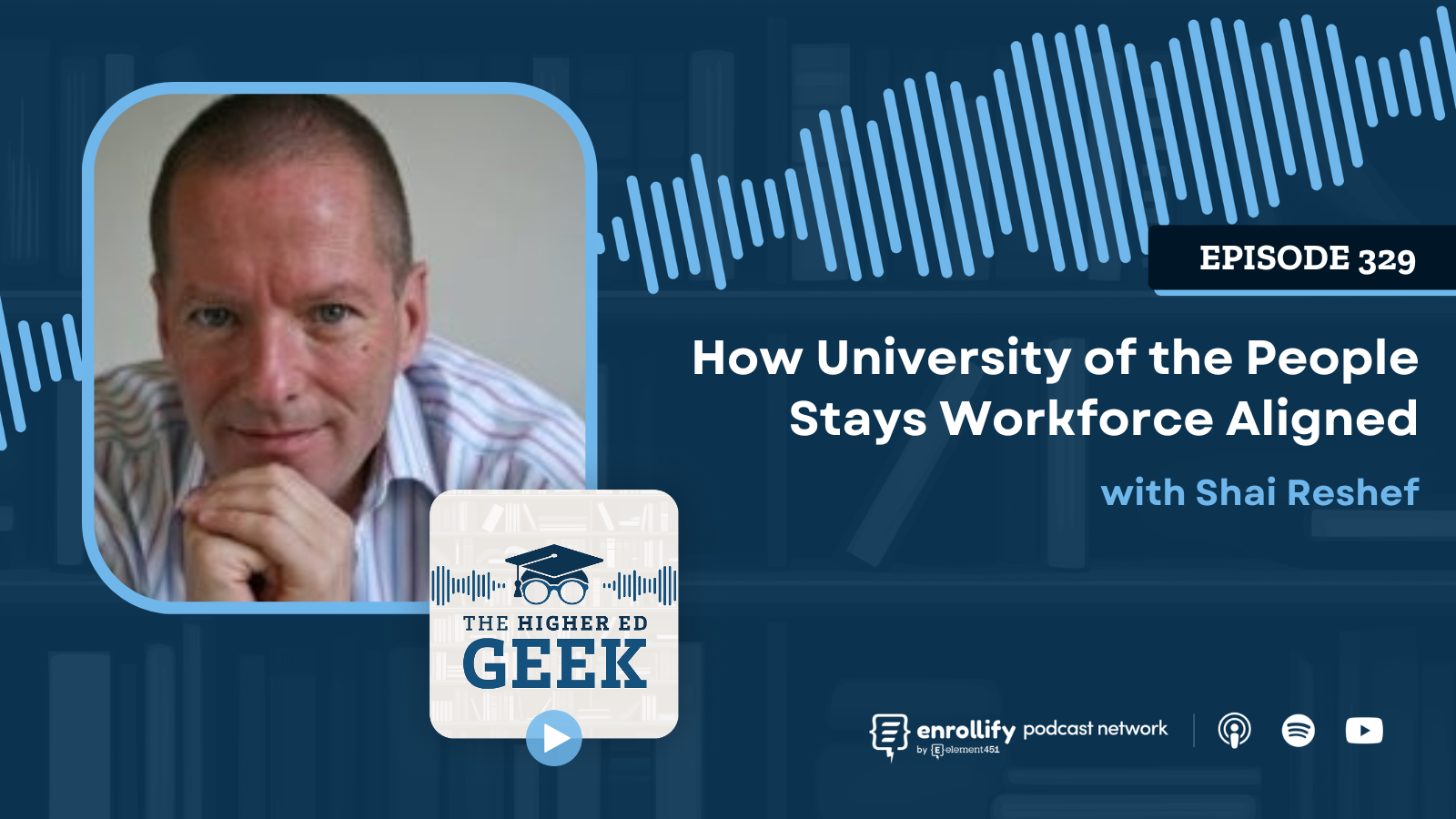
We’re pleased to welcome back Shai Reshef, founder of University of the People, to the show to talk more about his institution’s unique tuition-free, globally accessible model. We explore how aligning academic programs with workforce demand, while maintaining a strong foundation in critical thinking and general education, can create more equitable and sustainable pathways for students worldwide.
The conversation also highlights the rise of stackable certificates, the importance of affordability and relevance, and why institutions must rethink traditional structures to better serve today’s learners and remain viable in a rapidly changing landscape.
Key Takeaways
- University of the People is redefining affordability in higher education through a tuition-free, accredited online model serving 170,000 students across 213 countries.
- Career-aligned academic programs matter more than ever as students increasingly prioritize ROI and workforce outcomes when selecting institutions.
- Stackable certificates are becoming a powerful enrollment strategy that helps learners gain employable skills while progressing toward a degree.
- Gaming, cybersecurity, and data analytics certificates reflect growing demand for industry-specific credentials tied directly to emerging job markets.
- Student-centered operational models can reduce institutional costs while improving accessibility and scalability.
- Higher education institutions must evolve or risk closure, especially as students question rising tuition costs and unclear value propositions.
- General education still matters because critical thinking, adaptability, and lifelong learning remain essential in a rapidly changing workforce.
- Online learning and ed tech tools continue to expand global access to education, particularly for underserved populations and displaced learners.
- Simplifying admissions and enrollment processes can dramatically improve access and reduce institutional overhead.
- Affordability + relevance = the future of enrollment marketing in higher education.
Episode Summary
Why Affordable Higher Education Is Becoming a Competitive Necessity
Shai Reshef makes a bold but increasingly difficult-to-ignore argument throughout the episode: higher education must become dramatically more affordable if institutions want to remain sustainable. As Dustin Ramsdell points out, students and families are questioning whether traditional tuition models still make sense in a world where debt burdens continue to rise and institutional closures are becoming more common.
University of the People was built specifically to challenge that reality. Founded as the first nonprofit, tuition-free, accredited online university in the United States, the institution leverages open educational resources and scalable online infrastructure to serve learners who otherwise would not have access to higher education. Reshef explains that the institution intentionally minimizes operational costs while maximizing student impact.
What makes this conversation especially relevant for enrollment leaders is the growing emphasis on institutional efficiency. Reshef argues that colleges and universities must critically examine every operational decision through a student-centered lens. If a process, department, or system no longer serves learners effectively, institutions need the courage to rethink it before financial pressures force more dramatic outcomes.
How Stackable Certificates Support Student Success Strategies
One of the most forward-thinking discussions in the episode centers on the rise of stackable credentials and career-focused certificates. University of the People recently launched a new gaming certificate program designed to help students build employable skills while continuing progress toward a degree.
This approach aligns closely with current trends in higher education marketing, where prospective students increasingly seek shorter, skills-based learning opportunities tied directly to employment outcomes. Rather than forcing learners to choose between a full degree or standalone workforce training, the university integrates both experiences into a cohesive pathway.
Reshef explains that certificates in gaming, cybersecurity, and data analytics allow students to enter the workforce faster while still developing broader academic and critical thinking skills. For institutions focused on student success strategies, stackable credentials create opportunities for improved retention, increased flexibility, and stronger alignment between academic programs and workforce needs.
Why Career Relevance Is Reshaping Enrollment Marketing
Throughout the conversation, Dustin and Shai repeatedly return to one central theme: students want education that leads to meaningful employment opportunities. That reality is significantly influencing modern enrollment marketing and institutional strategy.
University of the People intentionally limits its degree offerings to programs with strong labor market demand, including business administration, computer science, health science, education, and IT. The institution’s philosophy is simple: if students are investing their time and energy into education, institutions should ensure those programs connect to viable career pathways.
At the same time, Reshef pushes back against the growing narrative that higher education should focus exclusively on vocational training. He argues that while workforce alignment matters, institutions also have a responsibility to cultivate critical thinking, adaptability, and civic understanding. According to Reshef, higher education should prepare students not only for their first job — but for a lifetime of evolving careers.
For enrollment marketers and academic leaders, this distinction matters. The institutions that will thrive are likely those that can balance workforce relevance with the broader intellectual development students still value.
The Role of Online Learning and Ed Tech Tools in Expanding Access
The episode also highlights how online education and ed tech tools continue to remove geographic and financial barriers for learners worldwide. University of the People currently serves refugees, working adults, and students from underserved regions who may never have had access to traditional campus-based education.
One particularly powerful example shared during the conversation involves the university’s Arabic-language programming. Originally launched to support Syrian refugees whose universities had been disrupted by conflict, the initiative now serves tens of thousands of students. This expansion demonstrates how digital learning models can quickly adapt to global educational needs.
Dustin notes that online education has fundamentally shifted expectations around accessibility and flexibility. Students increasingly expect institutions to meet them where they are — academically, financially, and technologically. Institutions that fail to embrace digital transformation risk becoming less competitive in an increasingly global higher education marketplace.
This conversation reinforces an important truth for higher ed leaders: online learning is no longer supplemental. It is central to the future of higher education access and growth.
What Higher Education Leaders Should Learn From University of the People
As the episode concludes, Reshef offers direct advice for institutional leaders navigating today’s challenges. His message is straightforward: every decision should begin with one question — does this serve students effectively?
That philosophy impacts everything from admissions processes to pricing structures to academic program design. University of the People even simplified admissions by allowing students to prove readiness through coursework rather than relying heavily on traditional admissions reviews. The institution’s focus remains on reducing barriers rather than adding complexity.
Dustin expands on this point by discussing how institutions often create friction for students unintentionally, particularly around tuition, financial aid, and enrollment processes. Student-centered design, he argues, should influence every aspect of the learner experience.
For leaders focused on marketing strategy for student recruitment, this episode serves as a reminder that authenticity, affordability, and relevance are becoming stronger enrollment differentiators than prestige alone. Students are increasingly looking for institutions that understand their realities — and help them move toward sustainable futures.
About the Show: The Higher Ed Geek Podcast explores the impact of edtech on the student experience by speaking with diverse leaders from institutions, companies, and nonprofit organizations. Each week we aim to provide an engaging, fun, and relevant dose of professional development that honors the wide range of work happening all across the higher ed ecosystem. Come geek out with us! The Higher Ed Geek Podcast is hosted by Dustin Ramsdell and is a proud member of the Enrollify Podcast Network.
Connect With Our Host:
Dustin Ramsdell
Enrollify is produced by Element451 — the next-generation AI student engagement platform helping institutions create meaningful and personalized interactions with students. Learn more at element451.com.




.svg)
.svg)
