






About the Episode
About the Episode:
How we think, how we teach: Five ways to think about AI in faculty work.
Leading Through Disruption: Higher Education Executives Assess AI’s Impacts on Teaching and Learning
2025 EDUCAUSE AI Landscape Study: Into the Digital AI Divide
An AI-Driven Optimism for Transforming Higher Education (It's Not What You Think)
Inside Higher Ed: Survey: Faculty Say AI Is Impactful—but Not In a Good Way.
The Chronicle: Faculty are overwhelmed and conflicted by AI.
Inside Higher Ed: Integrating AI Across the Liberal Arts
Campus Technology,: Beyond the Hype: 5 Actionable Steps for Higher Ed to Master AI in 2026
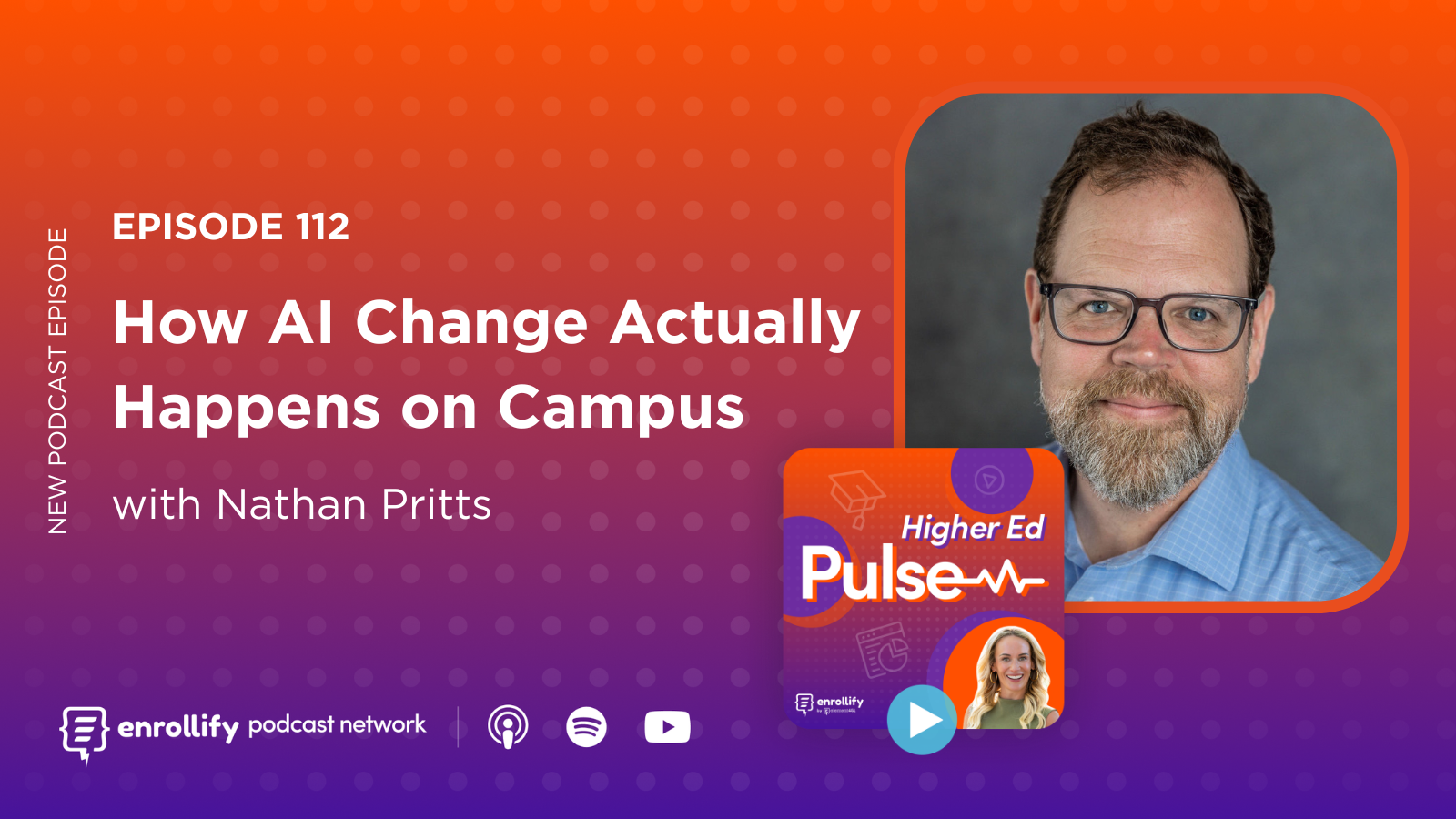
Mallory sits down with Dr. Nathan Pritts, Faculty Fellow for AI Strategy at the University of Arizona Global Campus, to unpack what real AI adoption looks like inside higher education. Moving beyond tools and policies, the conversation dives into the messy, human side of institutional change. Dr. Pritts shares how faculty-led experimentation, shared frameworks, and trust-building are essential to sustainable AI strategy. This episode is a must-listen for leaders navigating AI in higher education and evolving enrollment marketing and learning strategies.
Key Takeaways
- AI adoption is a people problem, not a technology problem—success depends on trust, training, and shared understanding.
- Faculty development is critical to scaling AI initiatives across institutions.
- Soft power drives change—relationship-building matters more than top-down mandates.
- Students are already using AI—policies must reflect real-world behavior, not ideal scenarios.
- Institutions must prioritize practice over policy to create meaningful AI strategies.
- Pilot programs and feedback loops are essential for improving adoption of ed tech tools.
- Human-centered learning remains the core value—AI should enhance, not replace, judgment and creativity.
- Data analytics in higher education must include qualitative insights, especially from faculty and students.
Episode Summary
Why AI Strategy in Higher Education Needs Faculty नेतृत्व
AI conversations in higher education often start in boardrooms—but according to Dr. Pritts, they should start in classrooms. Faculty are the ones experiencing AI’s impact in real time, navigating its implications for teaching, assessment, and student engagement. Without their input, institutional strategies risk being disconnected from reality.
Dr. Pritts emphasizes that higher ed has treated AI like a rollout problem—focused on tools, procurement, and policies—rather than a human challenge. The real work lies in building shared understanding and aligning AI initiatives with institutional values. This shift is essential for creating sustainable AI in higher education strategies.
By embedding faculty into leadership conversations, institutions can bridge the gap between theory and practice. This ensures that AI adoption reflects the lived experiences of both educators and students, not just administrative priorities.
The Real Barrier: Adoption, Not Technology
One of the most compelling insights from the episode is that AI adoption struggles are rarely about the technology itself. Instead, they stem from a lack of clarity, training, and trust. Even when institutions roll out sophisticated platforms, usage often lags behind expectations.
Dr. Pritts shares a striking example: while 99% of students may use AI tools, only a fraction engage with institutionally approved platforms. This gap highlights a major flaw in many ed tech tools rollouts—building the solution isn’t the same as ensuring it’s used.
To address this, institutions must invest in onboarding, experimentation, and continuous feedback. Pilot programs, like the one Dr. Pritts is leading, create opportunities to learn how AI fits into real workflows. This approach aligns with best practices in data analytics in higher education, where iterative learning drives better outcomes.
Faculty Resistance or a Support Problem?
Are faculty resistant to AI—or simply under-supported? According to Dr. Pritts, the answer is both. Some resistance is rooted in valid concerns about ethics, critical thinking, and student identity. Other resistance stems from uncertainty and lack of exposure.
This distinction matters. When leaders misinterpret hesitation as opposition, they risk overlooking the need for better training and resources. Providing dedicated time, clear guidelines, and practical models can transform skepticism into engagement.
Ultimately, building confidence is key. Institutions that prioritize student success strategies alongside faculty support will be better positioned to integrate AI effectively. Trust, not mandates, is what drives meaningful change.
Human-Centered Learning in an AI-Driven World
Despite the rapid rise of AI, Dr. Pritts argues that higher education’s core mission hasn’t changed. Learning isn’t about efficiency—it’s about struggle, discovery, and growth. Over-optimizing for speed risks undermining the very purpose of education.
He encourages both institutions and individuals to define what should remain انسانی—what aspects of thinking, creativity, and identity should never be outsourced to AI. This perspective reframes AI as a partner, not a replacement.
Higher ed’s slower pace, often seen as a weakness, may actually be an advantage. It allows institutions to thoughtfully integrate AI while preserving the values that define meaningful education. This balance is critical as schools refine their marketing strategy for student recruitment and academic positioning in an AI-driven landscape.
From Experimentation to Institutional Transformation
The future of AI in higher education won’t be shaped by one-off initiatives—it will be built through continuous experimentation. Dr. Pritts highlights the importance of creating feedback loops that inform long-term strategy.
This means moving beyond isolated pilots and toward systemic change. Institutions must ask: What does an AI-enabled campus look like in three years? How do workflows evolve? How do roles shift?
By focusing on learning—not just implementation—higher ed leaders can create adaptive, resilient strategies. This mindset is essential for staying ahead of trends in higher education marketing and ensuring institutions remain competitive in a rapidly changing landscape.
Connect With Our Host:
Mallory Willsea
https://www.linkedin.com/in/mallorywillsea/
https://twitter.com/mallorywillsea
Enrollify is produced by Element451 — the next-generation AI student engagement platform helping institutions create meaningful and personalized interactions with students. Learn more at element451.com.





.svg)
.svg)
