






About the Episode
About the Episode:
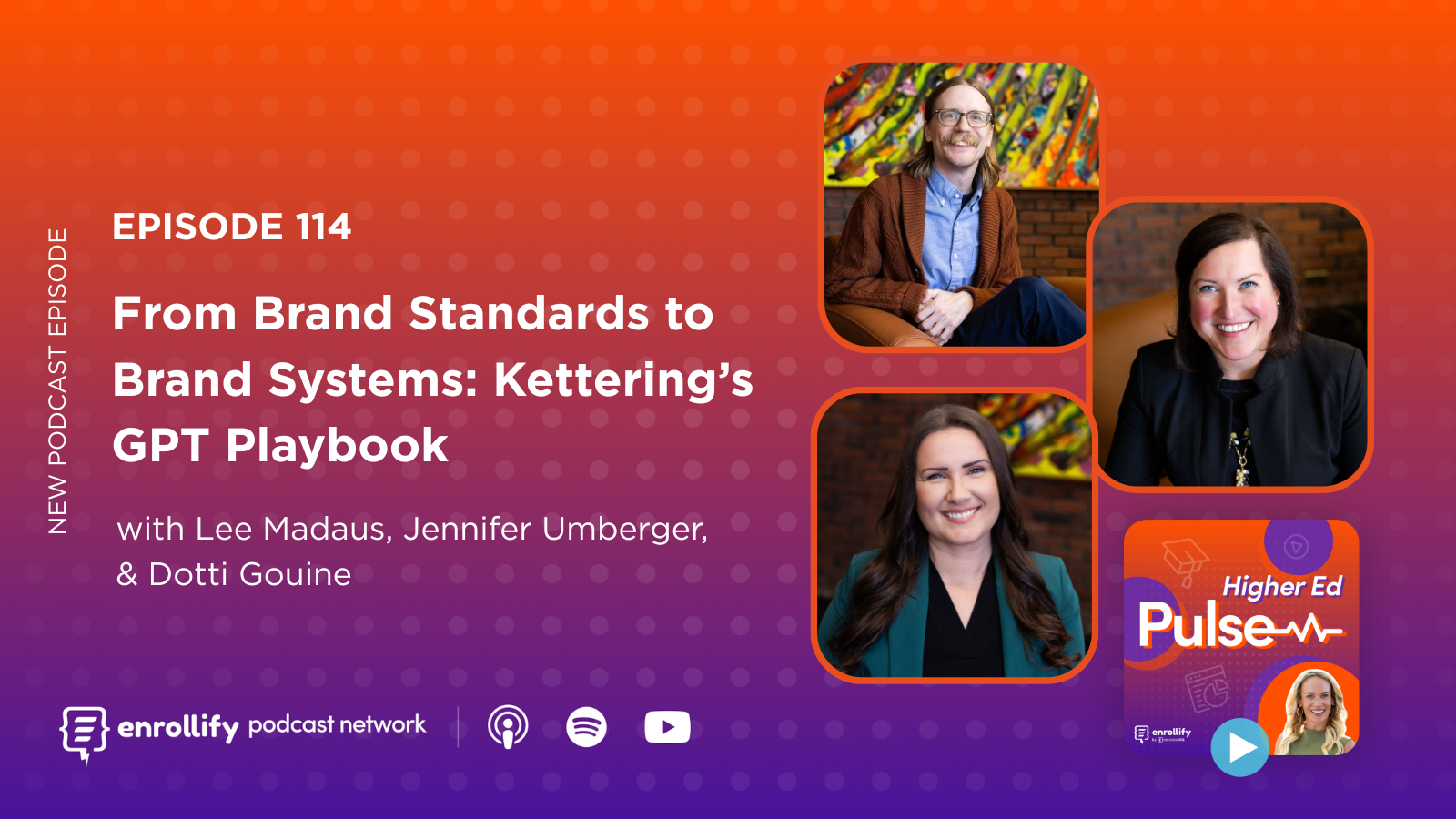
In this episode of Higher Ed Pulse hosted by Mallory Willsea, the team from Kettering University shares how they transformed a custom GPT from a simple experiment into a trusted, embedded part of their marketing workflow. Featuring Jennifer Umberger (VP & CMO), Lee Madaus (Content & Communications), and Dottie Gouine (Digital Storytelling), the conversation dives into how disciplined processes—not just access to AI—drive real results. From brand alignment to team adoption, this episode explores how AI in higher education can power smarter, more consistent enrollment marketing.
Key Takeaways
- Trust > Tooling: Building a GPT is easy—earning team trust requires consistent training, iteration, and integration into daily workflows.
- Process Drives Performance: Most teams don’t have an AI problem—they have a process problem. Consistency beats speed every time.
- Better Inputs = Better Outputs: Feeding GPTs with brand guides, leadership communications, and real institutional content improves accuracy and alignment.
- 80% Is the Sweet Spot: AI should get you most of the way there—humans still refine for creativity, nuance, and voice.
- Leadership Buy-In Matters: Institutional support accelerates adoption and reduces resistance to AI tools.
- Persona Reinforcement Is Critical: Continually grounding AI outputs in audience personas prevents generic, flattened messaging.
- AI as a Teammate: When properly trained, GPTs evolve from draft generators into collaborative partners in content creation.
How Can AI in Higher Education Move Beyond Experimentation?
The Kettering team makes one thing clear: the barrier to effective AI in higher education isn’t access—it’s discipline. Many institutions experiment with GPTs, but few integrate them into real workflows. At Kettering, the difference was timing and intention. They built their custom GPT alongside a full brand rollout, ensuring the system learned their voice as it was being defined.
This alignment allowed their GPT to evolve in tandem with their institutional identity. Instead of relying on static inputs, the team continuously fed it new materials—campaigns, speeches, internal memos—turning it into a living system. This approach reflects a broader shift in trends in higher education marketing, where adaptability and iteration are key.
Ultimately, their success came from embedding AI into everyday processes. Team members actively reference their GPT (affectionately named tools like “Brandbot”), reinforcing its role as a collaborator rather than a novelty. This operational integration is what separates experimentation from transformation.
What Makes a Custom GPT Effective for Enrollment Marketing?
The conversation highlights a critical insight: effective GPTs are built on rich, diverse inputs. Beyond brand guidelines, Kettering included commencement speeches, board decks, enrollment materials, and leadership communications. These artifacts captured the institution’s tone, priorities, and strategic direction in ways a standard brand guide cannot.
This approach strengthens enrollment marketing by ensuring messaging consistency across channels. When AI understands not just what you say—but how and why you say it—it produces outputs that feel aligned and intentional. This is especially valuable in higher ed, where messaging must resonate with multiple audiences across the student lifecycle.
However, the team emphasizes that AI isn’t a shortcut to creativity. It’s a tool for consistency. As Lee notes, chasing speed often leads to mediocre content faster. Instead, institutions should focus on building systems that enable repeatable, high-quality output—an essential principle in higher education content marketing.
When Should Teams Trust AI-Generated Content?
Trust doesn’t happen overnight—it’s earned through iteration. For Kettering, the turning point came when GPT outputs required refinement rather than full rewrites. At that stage, the tool became a reliable starting point instead of a rough draft generator.
This “80% rule” is a powerful benchmark. If AI can consistently get you most of the way there, it frees up time for higher-value creative work. The team compares this process to art: AI sketches the outline, but humans add the nuance and polish. This balance is essential for maintaining authenticity in higher education marketing strategy.
Still, limitations remain. GPTs can struggle with tone shifts—especially in nuanced scenarios like yield communications versus recruitment messaging. Recognizing these gaps helps teams decide when to refine versus override, ensuring quality never slips.
How Do You Drive AI Adoption Across a Marketing Team?
Adoption is often the biggest hurdle in implementing ed tech tools. At Kettering, leadership support played a key role. With both the president and CMO actively encouraging AI use, the team had the confidence to experiment and iterate.
But top-down support isn’t enough. Practical use cases are what win people over. Demonstrating simple, time-saving applications—like OCR scanning or content summarization—helps skeptics see immediate value. Once users experience these “aha” moments, they’re more likely to explore advanced applications.
The team also emphasizes that adoption is incremental. Not everyone will embrace AI at the same pace, and that’s okay. The goal isn’t instant transformation—it’s steady integration. Over time, these small wins build momentum and normalize AI as part of the workflow.
How Can Institutions Maintain Brand Voice with AI?
One of the biggest risks of AI is message flattening. Without careful oversight, outputs can become generic and lose the nuance that defines a brand. Kettering addresses this by continuously reinforcing audience personas and contextual inputs at the start of each interaction.
This practice ensures that messaging remains tailored—whether speaking to prospective students, admitted applicants, or families. It also highlights the importance of data analytics in higher education, as understanding audience segments is key to effective personalization.
Additionally, the team experimented with modeling GPT outputs on their president’s voice. By training the system on speeches, podcasts, and written communications, they created a tool that could replicate his tone with surprising accuracy. However, strict guardrails and limited access ensure this capability is used responsibly.
Connect With Our Host:
Mallory Willsea
https://www.linkedin.com/in/mallorywillsea/
https://twitter.com/mallorywillsea
Enrollify is produced by Element451 — the next-generation AI student engagement platform helping institutions create meaningful and personalized interactions with students. Learn more at element451.com.






.svg)
.svg)
