






About the Episode
About the Episode:
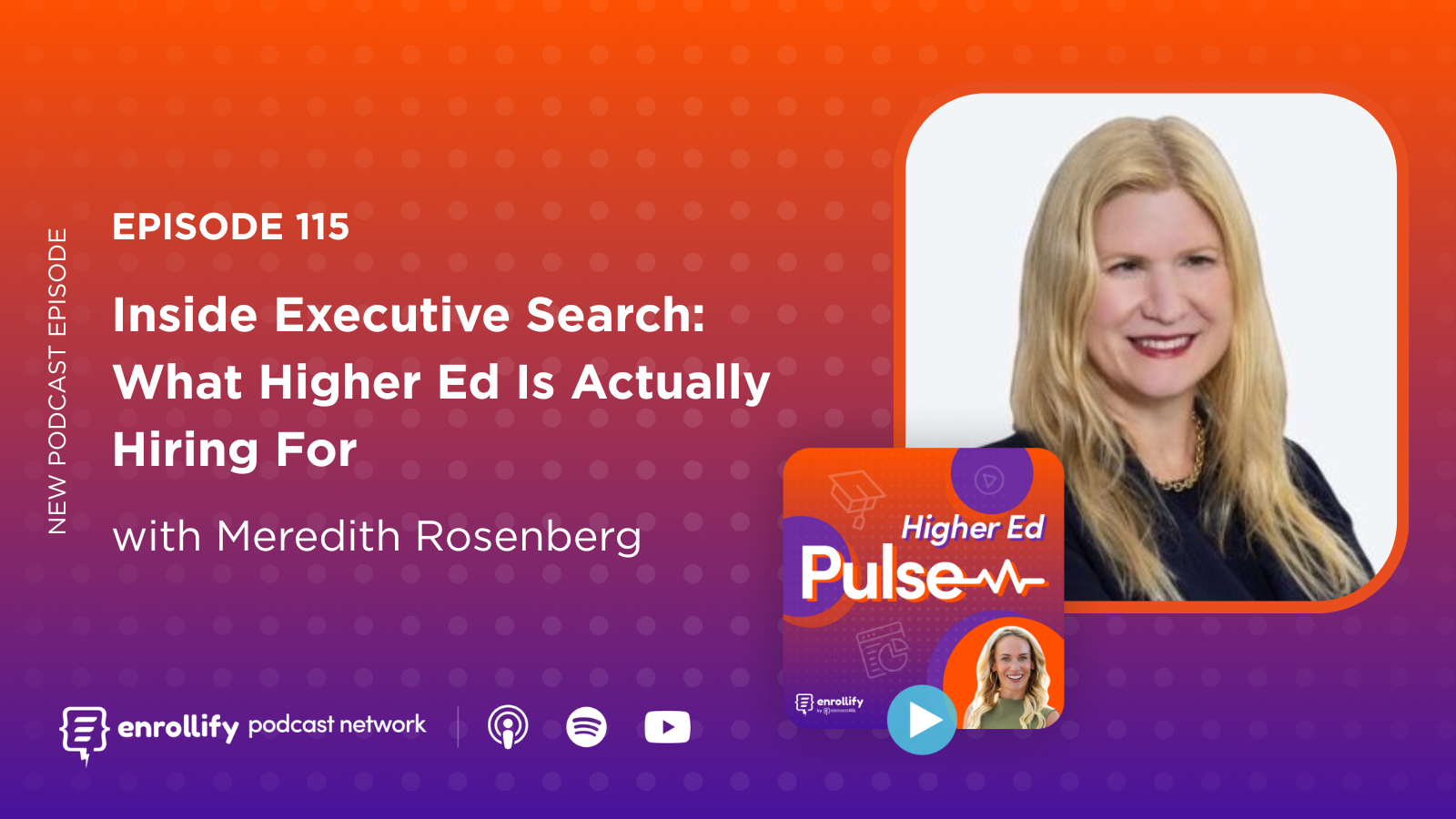
Mallory sits down with Meredith Rosenberg, co-founder and partner at NU Advisory Partners, to unpack what’s really happening behind the scenes in higher education leadership hiring. Drawing from her vantage point at the intersection of higher ed and edtech, Meredith reveals how institutions are approaching executive search—and where they’re getting it wrong. The conversation explores leadership turnover, hiring mismatches, and the growing influence of AI in higher education leadership decisions. If you’re thinking about your next career move or refining your enrollment marketing strategy, this episode offers a rare inside look.
Key Takeaways
- Hiring mismatches are common: Institutions often hire based on tradition rather than aligning talent with real business needs
- Top leaders are “talent magnets”: The best candidates attract, develop, and retain high-performing teams
- Impact > titles: Search committees prioritize measurable outcomes and repeatable success over pedigree
- AI in higher education is reshaping leadership expectations: Candidates now evaluate institutions based on AI adoption and innovation mindset
- Cross-sector hiring requires adaptability: Moving between edtech and higher ed demands cultural awareness and pace adjustment
- Boards must align on priorities: Conflicting visions around innovation vs. tradition often stall effective hiring decisions
- Self-awareness is a career differentiator: Knowing what problems you solve best is key to advancing in leadership
Episode Summary
Why Hiring Strategy Must Align with Institutional Goals
One of the most revealing insights from this episode is the disconnect between what institutions say they need and what they actually hire for. Meredith explains that many colleges default to traditional hiring practices, even when their challenges require new thinking. This misalignment often results in leadership turnover, especially in roles tied to enrollment marketing and growth.
Instead of starting with candidate profiles, Meredith’s firm begins with a more strategic question: what problem is the institution trying to solve? This reframing shifts the focus from resumes to results, helping organizations identify the competencies required for future success. It’s a mindset shift that challenges long-standing norms in higher ed hiring.
For enrollment leaders and marketers, this has direct implications. If institutions don’t clearly define success metrics or align hiring with strategic goals, even the most talented CMOs can struggle. This is why understanding performance indicators in education is becoming increasingly critical at the executive level.
What Makes a Strong Higher Ed Leader Today?
According to Meredith, the strongest candidates share two defining traits: they are talent magnets and they have a clear understanding of their impact. Talent magnets don’t just lead—they attract and develop high-performing teams, creating a ripple effect across the organization. This kind of leadership is especially valuable in times of transformation.
Equally important is the ability to articulate measurable outcomes. Leaders who can clearly define their contributions—and demonstrate repeatable success—stand out in today’s competitive landscape. This emphasis on impact aligns closely with broader trends in data analytics in higher education, where decision-making is increasingly driven by evidence.
For mid-career professionals, this is a call to action. Start documenting your wins, understanding your strengths, and identifying the problems you solve best. These insights not only strengthen your personal brand but also position you for future leadership opportunities.
How AI in Higher Education Is Changing Executive Hiring
AI is no longer a future consideration—it’s actively shaping how institutions evaluate leadership talent. Meredith notes that candidates are now assessing whether organizations are embracing AI in their operations. If an institution isn’t leveraging AI, it may struggle to attract top-tier talent.
This shift highlights a broader transformation in ai in higher education. Leaders are expected to understand both how AI impacts their organization internally and how it enhances the products or experiences they deliver. It’s not about replacing people—it’s about augmenting decision-making and improving efficiency.
Interestingly, AI is also changing the nature of executive roles. With automation handling more operational tasks, leaders are being evaluated more heavily on judgment, strategy, and people leadership. These human-centric skills are becoming the true differentiators in an AI-enabled world.
The Reality of Crossing Between EdTech and Higher Ed
There’s a growing trend of professionals moving between edtech companies and higher education institutions. While this cross-pollination can drive innovation, it’s not without challenges. Meredith emphasizes that success depends on an individual’s ability to adapt to different organizational cultures and operating speeds.
For example, leaders transitioning from the private sector must adjust to influencing rather than directing. Conversely, those moving into edtech need to embrace faster decision-making and higher accountability. These differences can make or break a transition.
Ultimately, the key is self-awareness. Understanding your strengths—and how they translate across environments—can help you navigate these shifts more effectively. This insight is especially relevant for professionals exploring new marketing strategies for student recruitment or broader leadership roles.
What Boards and Institutions Still Get Wrong
Boards play a critical role in shaping leadership outcomes, but they often struggle with alignment. Meredith points out that differing perspectives—especially around innovation versus tradition—can lead to inconsistent hiring decisions. This lack of clarity can stall progress and perpetuate ineffective practices.
In many cases, boards default to “safe” choices, prioritizing pedigree over potential. While this approach may feel comfortable, it rarely drives the transformation institutions need. Instead, boards must be willing to challenge assumptions and embrace new leadership profiles.
Equally important is the onboarding process. Hiring the right leader is only half the battle—institutions must also create an environment where that leader can succeed. This includes aligning internal teams, setting clear expectations, and providing the necessary resources for impact.
Connect With Our Host:
Mallory Willsea
https://www.linkedin.com/in/mallorywillsea/
https://twitter.com/mallorywillsea
Enrollify is produced by Element451 — the next-generation AI student engagement platform helping institutions create meaningful and personalized interactions with students. Learn more at element451.com.






.svg)
.svg)
