






About the Episode
About the Episode:
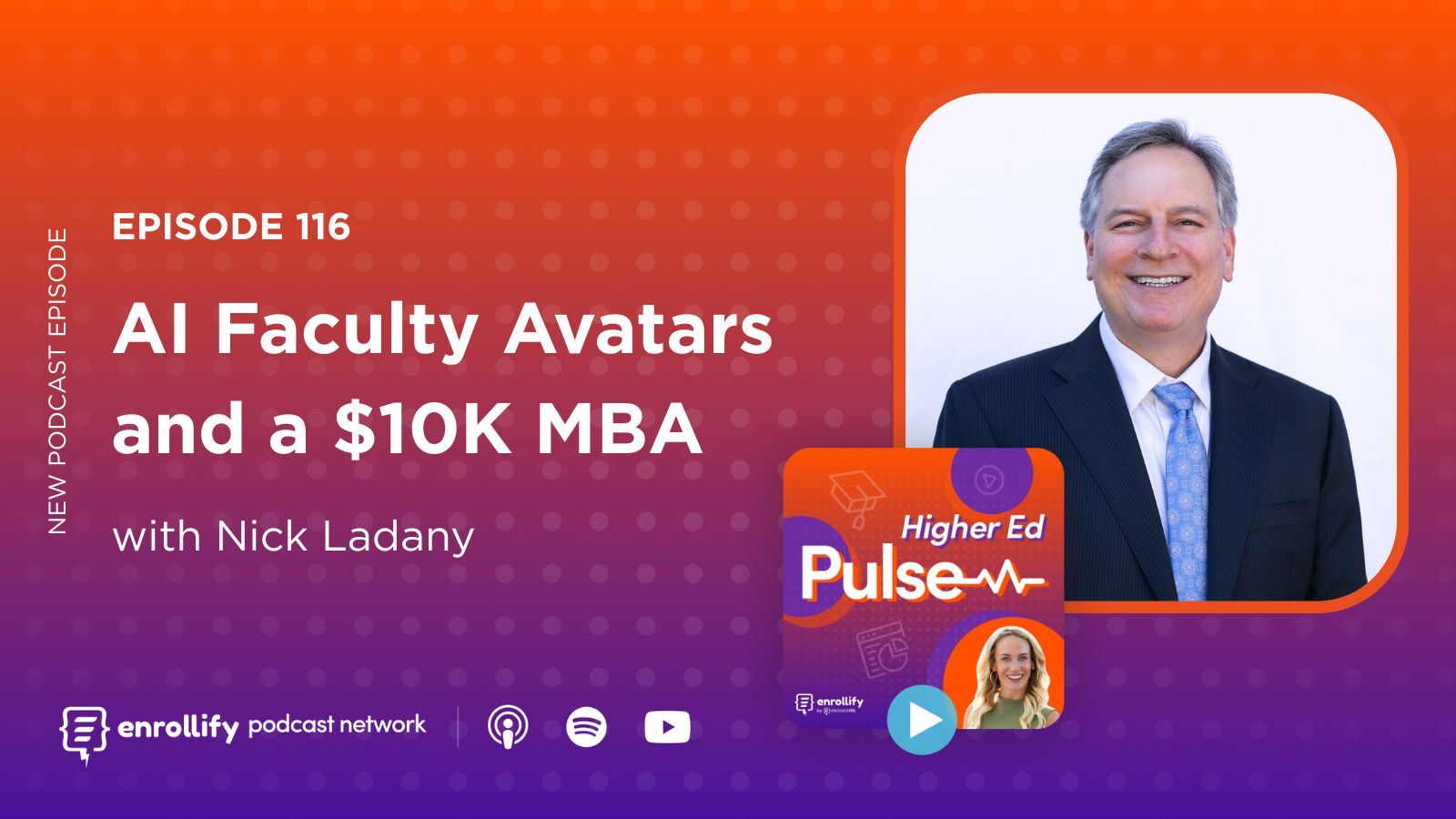
Mallory Willsea sits down with Dr. Nick Ladany, President of San Francisco Bay University, to unpack one of the boldest experiments in AI in higher education and student success strategies happening today. Together, they explore how SFBU is designing a human-centered, AI-integrated learning model that prioritizes capability development, workforce readiness, affordability, and access over outdated systems built around seat time and content delivery.
Dr. Ladany shares how SFBU’s innovative approach includes a $10K MBA, three-year bachelor’s degrees, AI avatar professors, and neighborhood campuses designed to bring education directly into communities. The conversation challenges long-held assumptions about faculty roles, tuition pricing, curriculum design, and what students actually need to succeed in a rapidly evolving workforce.
Key Takeaways
- AI in higher education should enhance human connection, not replace it. SFBU’s model combines AI-powered instruction with faculty mentorship, career coaching, and relationship-building.
- The traditional credit-hour model is outdated. Dr. Ladany argues that 120-credit degrees and fixed timelines are relics of a century-old system that no longer serves modern learners.
- Affordability is central to innovation. SFBU’s $10K MBA and low-cost three-year degrees directly address growing concerns around ROI and student debt.
- Faculty roles are evolving. Instead of acting primarily as content deliverers, faculty are positioned as mentors, advisors, and facilitators of transformative learning experiences.
- Deliberate practice beats passive learning. Students learn through real-time application, feedback loops, and AI-powered simulations rather than passive lectures.
- Access matters more than prestige. SFBU is building “neighborhood campuses” to bring learning directly into communities and expand educational accessibility.
- Higher education leaders must challenge legacy systems. Dr. Ladany emphasizes that institutions unwilling to rethink long-standing structures risk becoming obsolete.
- Human-centered AI requires safeguards. SFBU has built closed AI systems with extensive oversight and validation to ensure safe, ethical learning experiences.
- Student success strategies should prioritize outcomes over tradition. The conversation reframes higher education around workforce readiness, adaptability, and lifelong learning.
- The future of enrollment marketing will increasingly focus on flexibility, affordability, and relevance.
Episode Summary
Why Is the Traditional Higher Education Model Struggling?
One of the biggest themes throughout the episode is that higher education continues to operate on systems built for a different century. Dr. Ladany explains that the modern credit-hour structure dates back more than 100 years to the Carnegie Unit, yet institutions still organize learning around fixed timelines, content delivery, and rigid degree requirements. The result? Students often leave college with significant debt but without the adaptive skills employers actually need.
Dr. Ladany argues that many universities have mistaken content delivery for meaningful education. Simply exposing students to information doesn’t guarantee learning or capability development. He describes this outdated approach as the “germ theory of education” — the belief that if students are exposed to content, learning will automatically occur. In reality, students need opportunities to practice, receive feedback, iterate, and develop confidence over time.
This shift has major implications for enrollment marketing and institutional strategy. Today’s students are increasingly evaluating colleges through the lens of ROI, flexibility, and career outcomes. Institutions that continue prioritizing legacy systems over learner-centered innovation may struggle to remain competitive in the years ahead.
How Is SFBU Using AI to Personalize Learning?
SFBU’s approach to AI in higher education is intentionally designed around what Dr. Ladany calls the integration of AI and “human insight.” Rather than replacing faculty, AI handles scalable content instruction while faculty focus on the deeply human elements of learning — mentorship, networking, coaching, and relationship-building.
One example shared during the episode involves AI avatar professors teaching negotiation skills within SFBU’s MBA program. Students engage directly with the AI instructor, practice negotiation scenarios in real time, and receive immediate feedback on their performance. If they struggle, they can revisit the lesson, retry the exercise, or meet with a human faculty member for additional support.
This model reflects a broader shift toward deliberate practice and competency-based learning. Instead of passively consuming lectures, students actively apply concepts in realistic workplace simulations. The learning experience becomes adaptive, personalized, and iterative — much closer to how skill development happens in real life.
What Role Will Human Faculty Play in an AI-Integrated University?
A major misconception about AI-powered education is that faculty become obsolete. Dr. Ladany pushes back strongly against that narrative. In SFBU’s model, faculty become even more important — but their responsibilities evolve significantly.
Rather than spending most of their time lecturing, faculty focus on mentorship, advising, career preparation, and community building. These are the experiences students consistently remember long after graduation. As Mallory points out during the episode, the professors who make the biggest impact are often the ones who take extra time to invest personally in students’ growth and professional development.
This reimagined faculty role also supports better student outcomes. Smaller class sizes, stronger relationships, and industry-connected instructors create a more supportive and workforce-aligned learning environment. It’s a model that challenges many assumptions about academic labor while opening new possibilities for student success strategies across the sector.
Why Is SFBU Offering a $10K MBA and Three-Year Degrees?
The conversation repeatedly returns to affordability and access. Dr. Ladany believes higher education pricing has become unsustainable, with tuition increases outpacing even healthcare costs over the past two decades. SFBU’s response is straightforward: strip away unnecessary expenses and focus resources on delivering high-quality learning experiences.
The university’s $10K MBA and accelerated three-year bachelor’s degrees directly challenge the idea that higher education must be expensive to be valuable. By leveraging AI-supported learning models, streamlining degree structures, and eliminating unnecessary overhead, SFBU believes it can dramatically lower costs while improving educational quality.
This affordability-first mindset also reflects changing student expectations. Prospective learners increasingly want clear pathways to career advancement without decades of debt. Institutions that ignore these concerns may face growing enrollment challenges as students seek alternative educational models that offer stronger value propositions.
What Could the Future Campus Experience Look Like?
Perhaps the most forward-thinking concept discussed in the episode is SFBU’s vision for “neighborhood campuses.” Instead of requiring students to relocate or invest heavily in residential experiences, SFBU plans to create localized learning hubs within communities.
These smaller campuses could operate inside public libraries, community centers, or partnerships with local organizations. The goal is to make higher education more accessible, flexible, and integrated into everyday life. Dr. Ladany believes future universities will prioritize community connection and workforce integration over sprawling campuses filled with expensive amenities.
This vision also raises important questions for trends in higher education marketing. As institutions rethink physical infrastructure, prospective students may increasingly prioritize convenience, accessibility, flexibility, and career alignment over traditional prestige signals. The campuses of the future may look dramatically different from the ones many institutions continue investing in today.
Connect With Our Host:
Mallory Willsea
https://www.linkedin.com/in/mallorywillsea/
https://twitter.com/mallorywillsea
Enrollify is produced by Element451 — the next-generation AI student engagement platform helping institutions create meaningful and personalized interactions with students. Learn more at element451.com.


.svg)
.svg)
