






About the Episode
About the Episode:
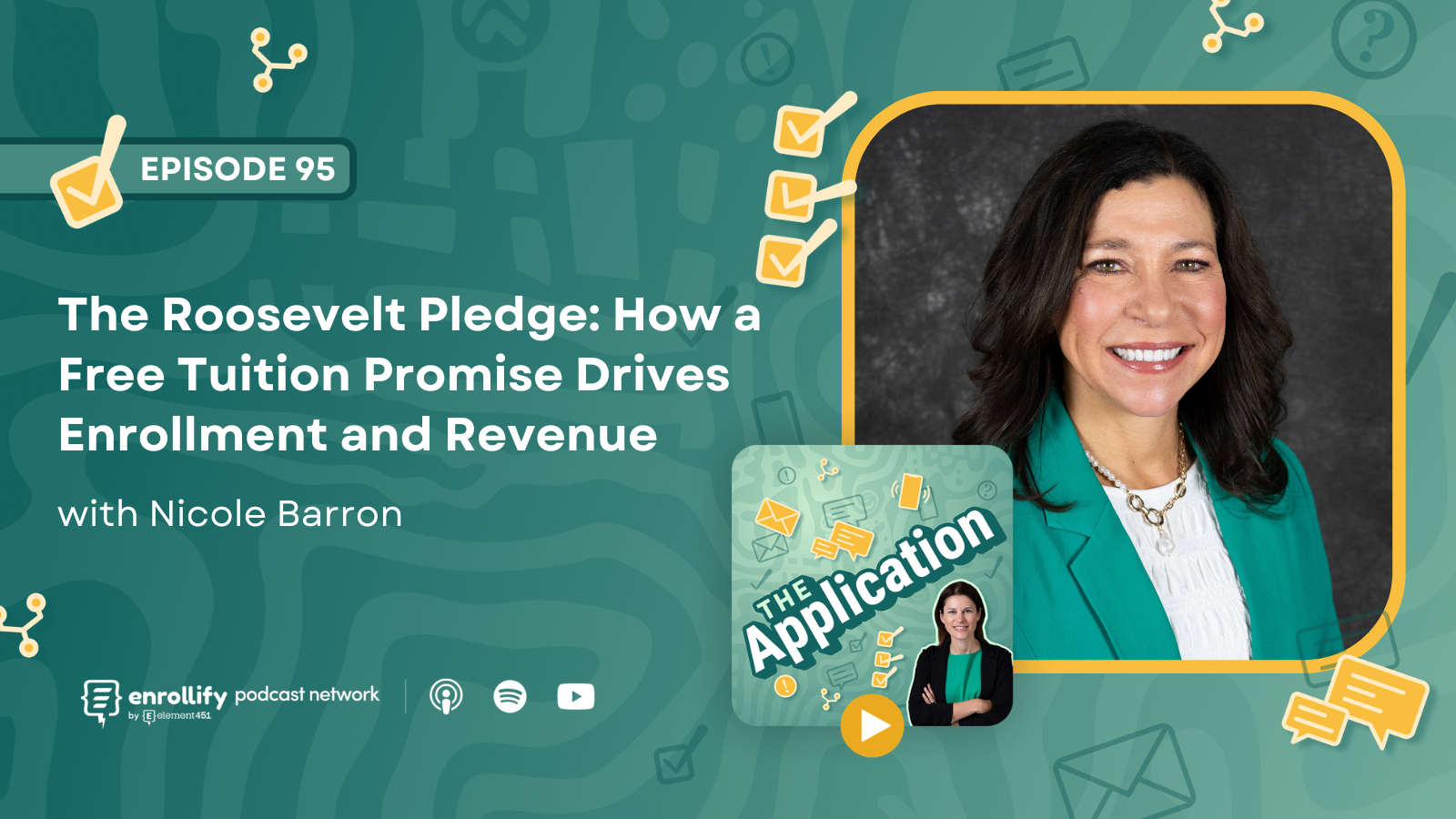
What if affordability isn’t just a financial aid strategy, but a positioning strategy? In this episode, we sit down with Nicole Barron, Senior VP of Enrollment Management at Roosevelt University, to unpack the Roosevelt Pledge, a program guaranteeing free tuition for qualifying students. What started as a tuition reset became a clear, compelling promise that now drives nearly 40% of their application pool. Nicole shares how Roosevelt turned complexity into clarity, using financial aid modeling, competitive data, and thoughtful marketing to increase enrollment, improve retention, and grow net tuition revenue all at once.
Join us as we discuss:
- [2:08] How Roosevelt moved from a tuition reset to affordability positioning
- [11:14] Internal buy-in and making the case for an affordability pledge
- [16:29] The full-cycle impact and future outlook of the Roosevelt Pledge
Check out these resources we mentioned during the podcast:
To hear this interview and many more like it, subscribe on Apple Podcasts, Spotify, or our website, or search for “The Application with Allison Turcio” in your favorite podcast player.
How Can Affordability Guarantees Transform Enrollment Marketing Strategy?
Roosevelt University’s journey began with a tuition reset—lowering sticker price from $32,000 to $20,000—and evolved into the Roosevelt Pledge, a bold promise of free tuition for qualifying students. This shift wasn’t about changing the financial aid model entirely, but about reframing it in a way that resonated with prospective students. By turning a complex aid structure into a clear, compelling guarantee, the university addressed one of the biggest barriers in enrollment marketing: cost uncertainty.
This repositioning highlights a critical truth in higher education content marketing: clarity converts. Students and families often struggle to interpret scholarships, grants, and net price calculators, leading to confusion and hesitation. By simplifying the message, Roosevelt created a value proposition that was instantly understandable and emotionally compelling. The result? A surge in applications, with pledge-eligible students now making up nearly 40% of the applicant pool.
For enrollment marketers, the takeaway is clear—sometimes the most impactful innovation isn’t creating something new, but communicating what already exists in a better way. In a landscape defined by the “sea of sameness,” differentiation often comes down to storytelling, not just strategy.
What Role Does Data Analytics in Higher Education Play in Enrollment Growth?
Behind the Roosevelt Pledge is a sophisticated foundation of financial aid modeling and education market research. Barron emphasizes the importance of partnering with financial aid optimization experts and leveraging tools like clearinghouse data and competitor insights. These resources allowed Roosevelt to identify market gaps and confidently reposition its affordability strategy without jeopardizing institutional revenue.
What makes this case particularly compelling is the outcome: increased enrollment, improved net tuition revenue, and a stabilized discount rate. These are metrics that rarely move in the same direction. By using data analytics in higher education to guide decision-making, Roosevelt was able to balance access with financial sustainability—an increasingly critical challenge for institutions nationwide.
The lesson here is that bold ideas require rigorous validation. Enrollment leaders must ground innovation in data, ensuring that strategies are not only mission-aligned but նաև financially viable. When data, intuition, and institutional goals align, transformative results become possible.
How Do Student Success Strategies Impact Retention and Long-Term Outcomes?
A common concern with access-focused initiatives is student retention. However, Roosevelt’s data tells a different story: students in the pledge program achieved a 92% fall-to-spring retention rate, challenging assumptions about risk and preparedness. This success underscores the importance of pairing enrollment growth with intentional student success strategies.
Roosevelt didn’t stop at recruitment—they invested in dedicated financial aid counselors and student success coaches to support pledge recipients throughout their journey. These touchpoints ensure students understand their financial commitments and receive the academic support needed to persist. This holistic approach reflects a growing trend in higher education marketing: the integration of recruitment and retention strategies.
Ultimately, this reinforces a powerful idea—enrollment marketing doesn’t end at deposit. Institutions that prioritize the full student lifecycle, from first inquiry to graduation, will see stronger outcomes across the board. Marketing, in this sense, becomes a driver of both access and achievement.
What Can Other Institutions Learn from the Roosevelt Pledge?
For institutions considering similar affordability initiatives, Barron offers practical guidance: start with data, collaborate across departments, and understand your competitive landscape. Financial modeling is essential to ensure sustainability, while marketing teams must craft a message that differentiates the institution in meaningful ways.
Equally important is internal alignment. Launching a program like the Roosevelt Pledge requires buy-in from leadership, finance, marketing, and student success teams. It’s not պարզապես a campaign—it’s an institutional strategy. This level of collaboration ensures that the initiative delivers on its promise, both for students and the university.
Perhaps the most important takeaway is this: standing out in higher education requires courage. In a market where many institutions rely on similar messaging, bold moves—grounded in mission and executed with precision—can redefine what’s possible in enrollment marketing.
Connect With Our Host:
Allison Turcio
https://www.linkedin.com/in/allisonturcio/
https://twitter.com/allisonturcio
Enrollify is made possible by Element451 — the next-generation AI student engagement platform helping institutions create meaningful and personalized interactions with students. Learn more at element451.com.



.svg)
.svg)
