


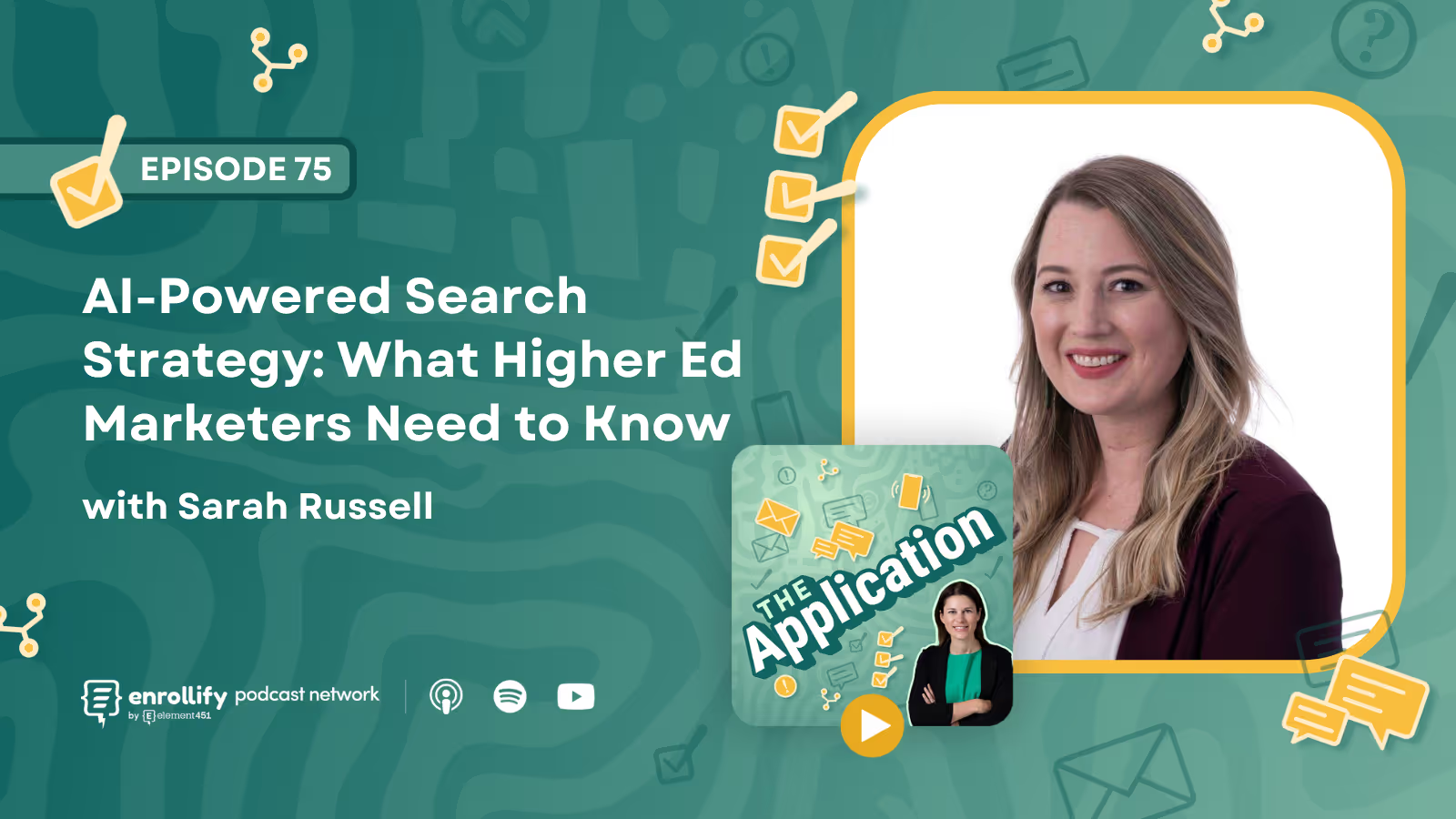




About the Episode
Got a story to tell? An innovative idea to share? Fill out our guest nomination form and let's chat!
About the Episode:
Search marketing isn’t what it used to be, and in higher ed, that opens the door to new possibilities. In this episode, Sarah Russell, Vice President of Marketing at Education Dynamics, joins Allison to explore how AI is reshaping the way prospective students search for and engage with colleges and universities. From Google’s Search Generative Experience (SGE) to the rise of zero-click search, Sarah unpacks what these shifts mean for your digital strategy. You’ll hear how to strengthen your technical SEO, rethink your content approach, and connect the dots between performance marketing and brand awareness.
Join us as we discuss:
- [2:19] How student search behavior is becoming more conversational
- [9:58] What to automate vs. what to manage manually
- [16:29] How to measure success with AI density and search share of voice
Check out these resources we mentioned during the podcast:
How is search marketing changing—and why does it matter for enrollment?
Traditional SEO strategies built around keyword rankings and click-through rates are no longer enough. Thanks to Google's AI Overviews and the rise of conversational search, prospective students are now getting detailed answers directly on the search results page, bypassing traditional links altogether. This is what’s known as zero-click search—and it’s becoming the new reality.
As Sarah Russell explains, this shift means institutions must stop thinking about SEO as a list of rankings and start thinking about it as AI-first discoverability. It’s not just about being clickable—it’s about being present and relevant in the AI-generated narrative that students see first.
What is AI density—and why is it a game-changer for SEO in higher ed?
AI density is a metric that tracks how often your content is cited as a source in Google’s AI Overviews or other large language models (LLMs). This matters because AI is now curating the top of the enrollment funnel. If your institution isn’t part of the AI's answer set, you’re not even in the conversation.
To improve AI density, Sarah suggests broadening your focus beyond your website. Think about your entire content ecosystem: social media posts, YouTube videos, PR hits, third-party blogs—all of these help train the AI on your institution's authority and credibility. SEO for higher education is no longer a solo channel—it’s a team sport.
What do students’ new search behaviors mean for content strategy?
Search queries are getting longer and more specific—students now ask highly personalized, multi-point questions like: “What are the best online MBA programs for working parents with flexible schedules?” These aren't just search terms; they're conversations. And they demand a content strategy that answers nuanced questions across multiple platforms.
That means content teams need to create conversational, multi-dimensional content that mirrors the way students search. You also need to ensure your content is structured so AI can easily parse and summarize it—think clear headlines, bullet points, structured data, and clean UX. And please, stop hiding your best info in seven-page PDFs.
What should enrollment marketers be doing differently with performance marketing?
AI-first performance marketing is less about managing keywords manually and more about training the algorithm. Russell explains that campaign success now depends on the quality of the data you feed the platform—not how many keyword variations you can think up. That means tracking higher-value conversions (like applications and interviews) instead of just form fills.
Institutions also need to use first-party data to train the algorithm. This includes feeding platforms with signals on what a high-quality applicant looks like based on historical enrollment data. Think of it this way: you’re not just running ads—you’re training your digital recruiter to find students who look like your best-fit enrollments.
Which tools and tactics are essential in this new AI-first era?
To succeed in this evolving search landscape, Sarah Russell recommends doubling down on your technical SEO, ensuring robust data tracking across your site, and investing in tools like SEMrush, Conductor, or Ahrefs to track your AI density and search share of voice. These tools show how often you're appearing in AI-generated content and how much total real estate your brand owns on a given results page.
Performance marketing platforms like Google Ads also require a strategic rethink. Embrace automation tools like Performance Max and broad match keywords, but only after ensuring your data architecture and conversion tracking are strong. AI can do the heavy lifting—but only if it's properly trained and supported by a smart, human-led strategy.
What metrics matter now—and what should we stop obsessing over?
Clicks are no longer king. Instead, focus on metrics that reflect your relevance and influence in the AI-driven search landscape:
- AI Density: How often your content appears in AI-generated answers.
- Search Share of Voice: Total presence on the search results page across all formats—organic, paid, local, social, and AI.
- Higher-Order Conversions: Applications, interviews, and deposits—not just inquiries.
- Content Engagement: Time on page, scroll depth, and video views now matter more than raw traffic.
Performance metrics must evolve alongside the tools. If your measurement strategy still hinges on click-through rates and keyword rankings, it’s time to upgrade.
Connect With Our Host:
Allison Turcio
https://www.linkedin.com/in/allisonturcio/
https://twitter.com/allisonturcio
About The Enrollify Podcast Network: The Application with Allison Turcio is a part of the Enrollify Podcast Network. If you like this podcast, chances are you’ll like other Enrollify shows, too!
Some of our favorites include Mission Admissions and Visionary Voices: The College President’s Playbook.
Enrollify is made possible by Element451 — the next-generation AI student engagement platform helping institutions create meaningful and personalized interactions with students. Learn more at element451.com.




.svg)
.svg)
