






About the Episode
About the Episode:
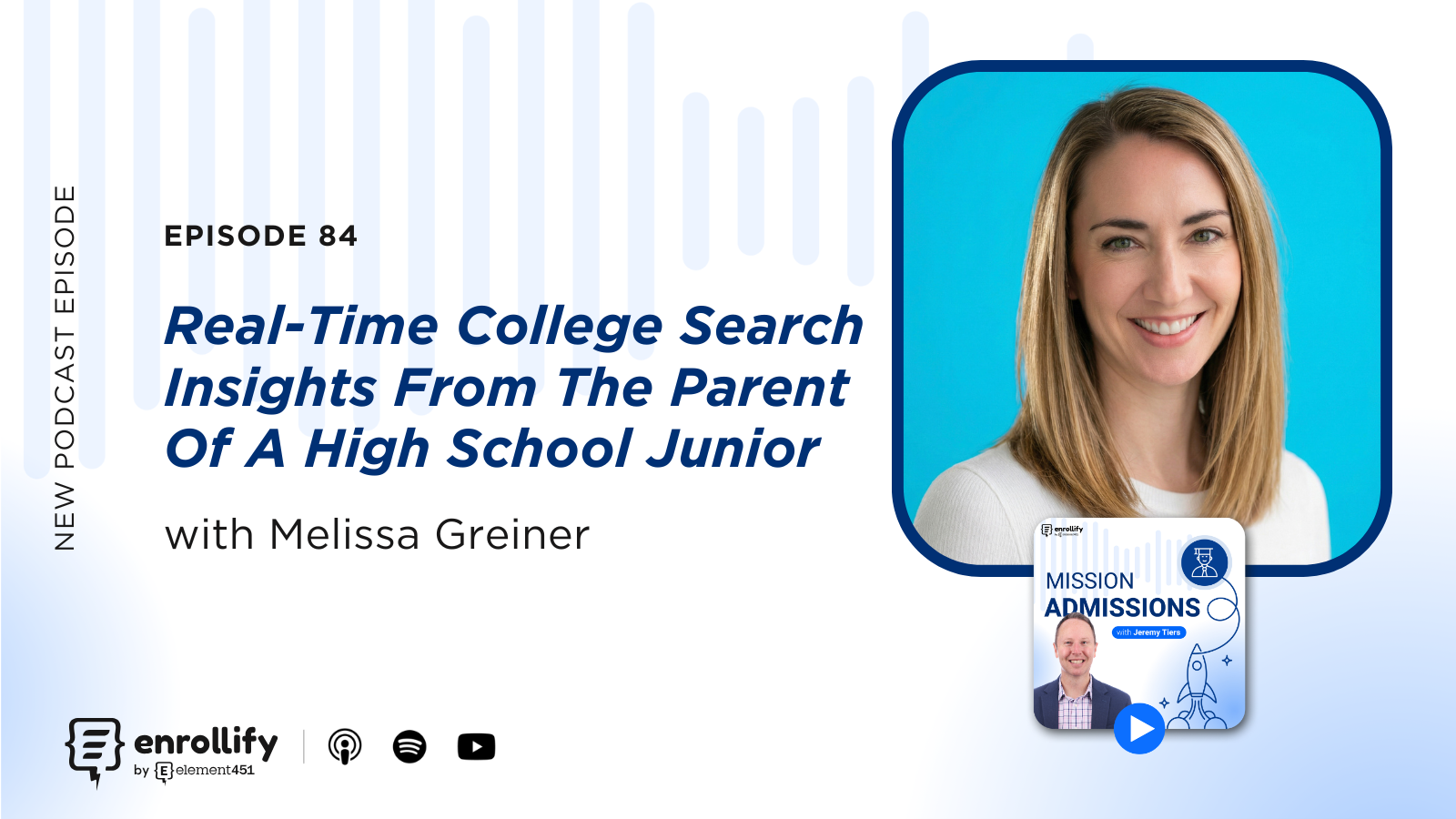
In this episode of Mission Admissions, host Jeremy Tiers and his guest Melissa Greiner discuss the college admissions process from a parent’s perspective. Melissa reveals the different experiences and feelings she’s had so far as she helps her son - a high school junior - navigate his search.
Key Takeaways
- Families feel the outreach volume is “incessant,” but the bigger issue is irrelevance—messages often don’t match stated academic interests.
- When students sense colleges aren’t “listening,” they opt out fast (blocking emails, ignoring mailers).
- Parents want schools to ask questions, not just push CTAs—two-way communication creates better-fit messaging.
- Early-stage parent needs are clear: timeline guidance, financial aid clarity, and “what makes you different” in plain language.
- Campus visits convert uncertainty into clarity when families can talk to students and faculty, not just hear polished talking points.
- Student stories build trust for parents, too—families look for proof their student will be safe, supported, and successful.
- AI is becoming part of the search journey: families are using tools like ChatGPT to speed up research (and then fact-checking).
- A key trend: parent confidence in the ROI of a college education is declining, increasing the pressure to communicate outcomes.
Episode Summary
What’s it like to go through the college search as a parent right now?
Melissa describes the process with one word: humbling. Even with years of professional experience in parent and family engagement, living the journey as a parent changes everything. The emotions hit differently when it’s your own kid, and the volume of information feels heavier when you’re trying to protect them from overwhelm while still moving things forward.
Jeremy relates this to what he hears at home too: students receive a lot of information, but much of it isn’t information they care about. Melissa confirms the same pattern with her son—constant emails and mail that feel disconnected from what he’s shared through test-taking and interest signals. When the messaging misses the mark early, frustration builds fast.
And once the student hits frustration? They don’t complain politely. They unsubscribe. They block. They tune out. That’s the part enrollment marketing teams need to sit with: you don’t get unlimited chances to prove you’re relevant.
Why does most early outreach feel so ineffective to students and families?
Melissa explains the mental model her son has: I gave you information, so use it to talk to me about what I care about. He expects colleges to connect his expressed academic interest to their programs. Instead, he’s getting messages from schools that don’t even offer the major he’s interested in—which feels confusing at best, and careless at worst.
That disconnect creates a “they’re not listening” narrative. Once a student believes that, everything else starts to sound the same. Even great schools get lumped into the noise if the communication doesn’t demonstrate basic alignment.
This is a major enrollment marketing warning sign: relevance isn’t a nice-to-have. It’s the cost of entry. If your outreach doesn’t reflect the student’s intent, you’re not building awareness—you’re building resistance.
What do parents actually want colleges to send them right now?
Melissa answers this in a way that’s both practical and revealing. Parents want a big-picture timeline of what happens when—especially around financial aid and decision cycles (and how early action/early decision changes everything). Families don’t want to feel like they’re constantly behind the process or missing key steps they didn’t know existed.
They also want help understanding what makes a school different—without the generic “we’re unique” language that every institution uses. It’s hard to capture culture in an email, but parents are looking for specifics that connect the dots between who their student is and why your school fits.
Most importantly, Melissa says schools should ask questions. Right now, communications are mostly one-way: “look at us” plus a CTA. But thoughtful questions are how you earn engagement and gather the data needed to create a campaign that actually excites a family.
What surprised parents most during campus visits?
Melissa shares that her husband was struck by how complex admissions feels now compared to decades ago—acceptance rates, expectations, and the overall intensity of the process. Whether it’s reality or the blur of time, the perception is clear: admissions looks harder, and that raises anxiety for families trying to guide their student.
He also cared deeply about the “vibes,” even if nobody wants to say “vibes.” He wanted proof their son would find his people, feel at home, and be supported in how he learns and socializes. And that led to an interesting parent behavior: asking the questions their student didn’t think to ask—or didn’t feel confident asking.
This is where your visit experience matters beyond logistics. Parents are scanning for belonging cues, support systems, and social fit—not just dorms and dining halls.
Why do student conversations matter so much—for parents, too?
Melissa describes the moment that created real excitement: talking to current students who reminded them of their son. Hearing why a student chose the school, what they’re studying, what clubs they joined, what internships they landed, and what happens after graduation makes the future feel real.
That’s not just a student recruitment insight. It’s a parent trust insight. Parents can look at their child—who may be physically grown but still feels like a kid—and struggle to visualize them thriving independently. Seeing a real student living that reality bridges the gap.
Jeremy reinforces the emotional core: families are being asked to hand over their two most valuable assets—their child and their bank account. Student stories and outcomes make that trust feel earned.
How are families using AI in the college search process?
Melissa shares a detail that should change how teams think about communication: they used ChatGPT to gather baseline school data quickly (size, acceptance rate, program details) and then fact-checked it. The key insight isn’t “AI is perfect”—it’s that families are already using it to reduce friction.
That means your website “homework” problem just got more intense. If families can ask a tool once and generate a comparison table in minutes, they’ll do it. Institutions should assume prospects are building lists faster—and filtering schools out faster—than in past cycles.
This is also a nudge toward data analytics in higher education and smarter content: if families are accelerating research, your messaging needs to be clearer, more structured, and easier to validate.
What’s one thing colleges should do differently when communicating with parents of sophomores and juniors?
Melissa’s advice: you probably can’t over-communicate with parents—if your communication is intentional and relevant. Students may feel overwhelmed, but parents are used to email volume and are actively trying to help their child navigate a high-stakes decision.
The catch is relevance. Communicate often, yes—but use the information families provide to tailor what you send and meet them where they are. And don’t be afraid to ask for more information if you’re prepared to use it well.
This is the heart of a better marketing strategy for student recruitment: don’t just add touches. Increase signal.
What trend should enrollment teams pay attention to right now?
Melissa points to a major shift: parent confidence in the ROI of a college education is dropping significantly. Families want evidence that the investment leads to advancement—career outcomes, internships, placement, starting salaries, and pathways that make the cost feel justified.
Many schools have this data and are proud of it. But the episode suggests a hard truth: if you’re not proactively communicating outcomes, families may assume you don’t have them—or that they’re not strong.
In a skeptical market, outcomes aren’t a “later in the funnel” message anymore. They’re foundational to trust.
Connect With Our Host:
Jeremy Tiers







.svg)
.svg)
