






About the Episode
About The Episode:
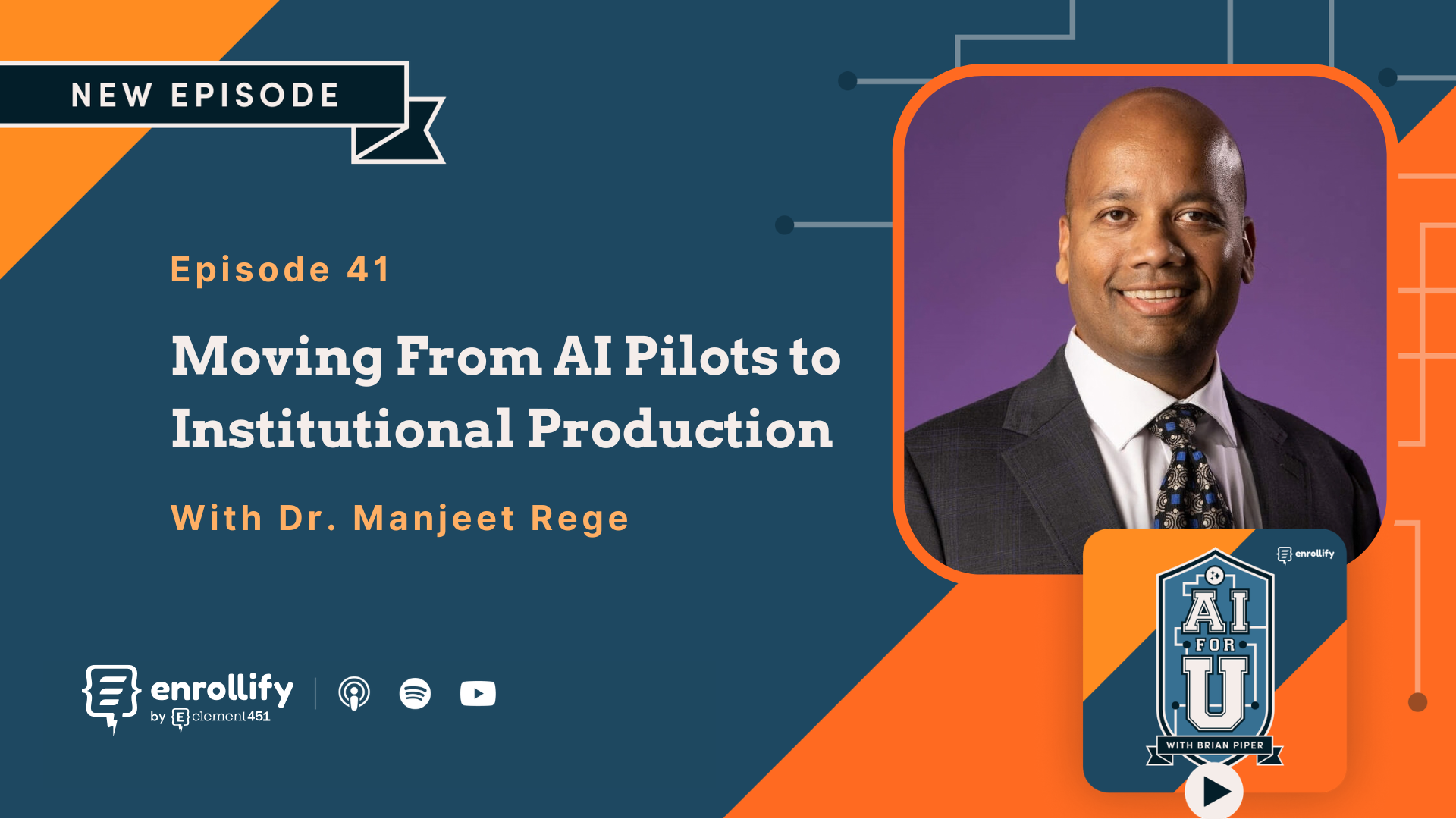
In this episode of AI for U, Brian sits down with Dr. Manjeet Rege, Chair of the Department of Software Engineering and Data Science at the University of St. Thomas. Dr. Rege shares his journey from medical AI research to institutional strategy, arguing that the “age of piloting” is over. He breaks down what a truly operational AI organization looks like, emphasizing the need for product managers, data engineers, and robust governance frameworks. Dr. Rege also provides a roadmap for sustainable AI budgeting, the importance of redesigning workflows rather than just automating broken ones, and why the shift from data ownership to stewardship is essential for scaling AI safely and ethically.
Join us as we discuss:
- [2:42] The AI mindshift from academic research to an institutional strategy
- [10:13] What an operational AI strategy looks like and sustainable budgeting
- [17:09] Advice for schools considering building versus buying AI solutions
- [21:42] Weighing data stewardship against ownership at the enterprise level
Check out these resources we mentioned during the podcast:
- Ethics and Governance of Artificial Intelligence: Frameworks, Risks, and Society by Manjeet Rege and Hemachandran K
To hear this interview and many more like it, subscribe on Apple Podcasts, Spotify, or our website, or search for AI for U with Brian Piper in your favorite podcast player.
Episode Summary
Why AI in Higher Education Must Become an Institutional Strategy
For many universities, AI adoption begins as a small pilot or isolated experiment. But according to Dr. Manjeet Rege, that mindset is quickly becoming outdated. Institutions that continue treating AI as an add-on risk falling behind in a rapidly evolving academic landscape.
Dr. Rege explains that the moment AI influences real-world decisions—such as admissions recommendations or medical predictions—it raises questions about trust, governance, and accountability. Accuracy alone is not enough; institutions must consider how AI fits into real workflows and decision-making systems.
This shift transforms AI from a research experiment into a strategic initiative. Universities that embrace this mindset position themselves to better serve students, support faculty innovation, and remain competitive in an AI-shaped future.
What Operational AI Actually Looks Like on Campus
Moving beyond pilots requires building what Dr. Rege calls an operational AI function. Rather than a research lab or temporary committee, operational AI acts as a delivery engine that integrates artificial intelligence into everyday institutional processes.
Successful programs include roles such as product managers, data engineers, and adoption specialists. These professionals translate institutional needs into AI solutions, maintain reliable data infrastructure, and ensure faculty and staff know how to use new tools effectively.
Monitoring systems are equally important. Institutions must continuously evaluate model performance, address data drift, and ensure that AI tools remain accurate and aligned with institutional goals. This operational approach allows universities to scale AI responsibly while maintaining transparency and accountability.
Why Data Stewardship Is Critical for AI Success
One of the biggest barriers to data analytics in higher education is fragmented data systems. Many universities operate with siloed datasets across departments, making it difficult to leverage AI effectively.
Dr. Rege highlights a critical cultural shift: moving from data ownership to data stewardship. When departments “own” data, they tend to restrict access. But when they act as stewards, they focus on improving data quality, documentation, and responsible sharing.
This shift allows AI systems to operate across institutional boundaries, enabling more accurate insights for enrollment, marketing, and student success initiatives. Ultimately, stewardship transforms data into a shared institutional asset rather than a protected departmental resource.
How Institutions Should Approach AI Budgets and Investment
A common mistake universities make is treating AI as a software purchase rather than a long-term capability. According to Dr. Rege, if your AI budget consists only of subscription fees, you don’t have an AI strategy—you have a purchase order.
Sustainable AI investment includes infrastructure, integration with legacy systems, and personnel who can build and maintain AI solutions. It also includes training programs that ensure faculty and staff can confidently incorporate AI into their workflows.
Risk management and governance are also essential components of AI budgeting. Legal review, compliance monitoring, and continuous improvement initiatives help institutions maintain ethical and responsible AI practices while adapting to rapidly evolving technologies.
The Human–AI–Human Model for Collaboration
Despite concerns about automation, Dr. Rege emphasizes that AI should amplify human capabilities rather than replace them. His Human–AI–Human loop provides a practical framework for integrating AI into higher education workflows.
In this model, humans begin the process by defining goals, context, and strategy. AI then performs the heavy lifting—analyzing data, generating content, or identifying patterns. Finally, humans return to interpret results, make decisions, and take responsibility for outcomes.
This approach works across campus functions. Admissions teams can use AI to analyze application trends, marketers can test messaging variations, and advancement teams can identify donor prospects. In every case, AI accelerates insight while humans maintain the relational and ethical core of the work.
Build vs. Buy: Where Institutions Should Invest
Universities often struggle with whether to build custom AI tools or purchase commercial solutions. Dr. Rege offers a simple framework: buy the foundation, build the differentiation.
Standard services—like transcription tools, general chatbots, or infrastructure platforms—are typically best purchased from vendors. These tools are widely available and don’t define an institution’s identity.
However, institutions should build AI solutions tied to their mission and student experience. Advising models, admissions workflows, and student support systems reflect each institution’s unique philosophy and strategy. These “last-mile” applications are where AI becomes a true competitive advantage.
Connect With Our Host:
Brian Piper
https://www.linkedin.com/in/brianwpiper/
Enrollify is produced by Element451 — the next-generation AI student engagement platform helping institutions create meaningful and personalized interactions with students. Learn more at element451.com.




.svg)
.svg)
