


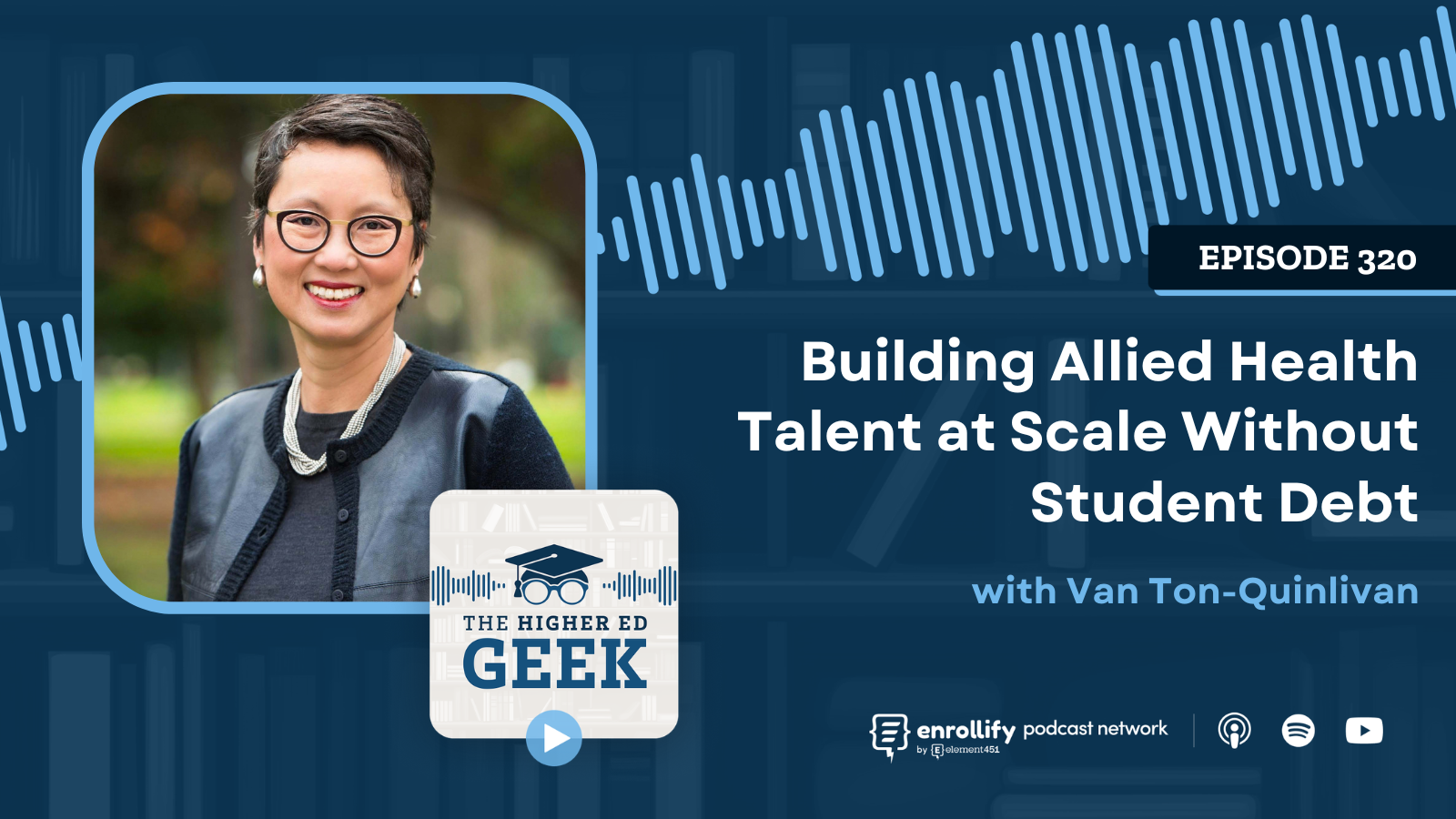




About the Episode
About the Episode:
What does “free tuition” actually mean — and why isn’t it enough?
In this episode, Dustin sits down with Van Ton-Quinlivan, CEO of Futuro Health and host of the WorkforceRx podcast, to unpack how her organization is tackling the healthcare workforce shortage by helping adults earn debt-free credentials in allied health fields. From redesigning incentives around completion (not just enrollment) to supporting adult learners with real-life constraints, this conversation challenges traditional higher ed funding models and offers a bold blueprint for workforce-aligned education.
Key Takeaways
- Free tuition alone isn’t enough. Removing cost barriers helps, but success requires navigation support, flexible learning models, and clear career pathways.
- Workforce-aligned education drives impact. Programs tied directly to workforce shortages—like allied health—create stronger outcomes for learners and employers alike.
- Adult learners need different systems. Flexible delivery, career navigation, and life-support systems are essential for learners balancing jobs, families, and education.
- Funding models shape behavior. Incentivizing completion rather than enrollment can dramatically improve outcomes in workforce education programs.
- Collaboration beats competition. Regional partnerships among colleges, employers, and workforce organizations strengthen training pipelines and scale impact.
Episode Summary
Why Free Tuition Programs Often Fall Short
Free tuition initiatives are frequently framed as the silver bullet for access to higher education. But as Van Ton-Quinlivan explains, the reality is more complex. Simply eliminating tuition doesn’t automatically translate into improved completion rates or career outcomes.
Many students—particularly adult learners—face barriers that go far beyond the cost of classes. Navigating higher education systems, selecting the right program, and balancing family responsibilities can all derail progress. Without intentional support structures, free tuition programs risk becoming another well-intentioned policy that fails to deliver meaningful results.
Another challenge is perception. During Futuro Health’s early research, many prospective learners were skeptical of tuition-free offers. Some even questioned whether “free” programs were legitimate. The takeaway? Accessibility requires not just funding, but thoughtful program design that builds trust and accountability.
How Workforce Development Is Reshaping Higher Education
Futuro Health was created to address a specific workforce crisis: the growing shortage of allied health professionals. These roles—like medical assistants, emergency medical technicians, and radiology technicians—make up roughly 65% of the healthcare workforce, yet training pipelines struggle to keep up with demand.
By partnering with education providers across multiple states, Futuro Health connects learners with programs that lead directly to in-demand healthcare roles. The organization now works with more than 40 education partners across nine states and Washington, D.C., helping adult learners earn credentials without accumulating debt.
This workforce-centered approach reframes the role of higher education. Instead of focusing solely on traditional degree pathways, institutions are increasingly partnering with employers and workforce organizations to build skills-based programs aligned with labor market needs. For enrollment marketers and institutional leaders, this shift represents one of the most important trends in higher education marketing and strategy today.
Designing Student Success Strategies for Adult Learners
A critical insight from Futuro Health’s work is that adult learners require different educational models. The average learner in their programs is 31 years old, often balancing jobs, childcare responsibilities, and other life commitments.
That reality means flexible delivery is essential. Online and hybrid learning models, modular credential programs, and supportive onboarding experiences help adults transition back into education. But just as important is career navigation—helping learners understand which credentials lead to which opportunities.
Many prospective healthcare workers, Van explains, simply don’t know how to move from interest to employment. By guiding learners through the credentialing process and helping them prepare for the realities of healthcare work, Futuro Health increases both program completion and long-term career outcomes.
Why Incentives Matter in Education Systems
One of the most powerful lessons from Futuro Health’s model involves funding incentives. Early in the organization’s development, funding was tied primarily to enrollment numbers. Not surprisingly, the system optimized for getting learners into programs.
Later, funders shifted the model: scholarships would only unlock when learners completed their programs. That single change transformed the entire system.
Suddenly, every stakeholder—from education partners to support staff—became laser-focused on helping learners succeed. Conversations shifted from simply recruiting students to ensuring they were ready for the commitment required to complete a program. According to Van, “institutions behave according to the incentives they’re given.”
Collaboration Is the Future of Workforce Education
Another theme throughout the episode is the importance of collaboration across institutions. Historically, many colleges compete for funding, students, and programs. But that competition can limit innovation and resource sharing.
Van recounts a lesson from her time with the California Community College system: when colleges were incentivized to collaborate regionally rather than compete individually, they were able to coordinate programs more effectively and better serve employer needs.
The same principle applies to workforce development today. Solving complex challenges like healthcare staffing shortages requires alignment between education providers, employers, policymakers, and community organizations. When these stakeholders work together, the impact multiplies.
Preparing the Workforce for an AI-Driven Economy
Looking ahead, Van believes workforce education will face another major shift: the growing impact of artificial intelligence on the labor market.
Historically, workforce structures resembled a pyramid, with large numbers of entry-level workers supporting fewer mid-level and advanced professionals. But automation and AI tools are reshaping that model.
Instead of a pyramid, the workforce may increasingly resemble a diamond, with fewer entry-level roles and greater demand for mid-career expertise. This shift means higher education and workforce programs must focus on helping learners reach valuable skill levels faster.
For higher ed leaders, the challenge is clear: redesign programs that accelerate learning, build real-world experience, and prepare students for rapidly evolving industries.
About the Show: The Higher Ed Geek Podcast explores the impact of edtech on the student experience by speaking with diverse leaders from institutions, companies, and nonprofit organizations. Each week we aim to provide an engaging, fun, and relevant dose of professional development that honors the wide range of work happening all across the higher ed ecosystem. Come geek out with us! The Higher Ed Geek Podcast is hosted by Dustin Ramsdell and is a proud member of the Enrollify Podcast Network.
Connect With Our Host:
Dustin Ramsdell
Enrollify is produced by Element451 — the next-generation AI student engagement platform helping institutions create meaningful and personalized interactions with students. Learn more at element451.com.



.svg)
.svg)
