


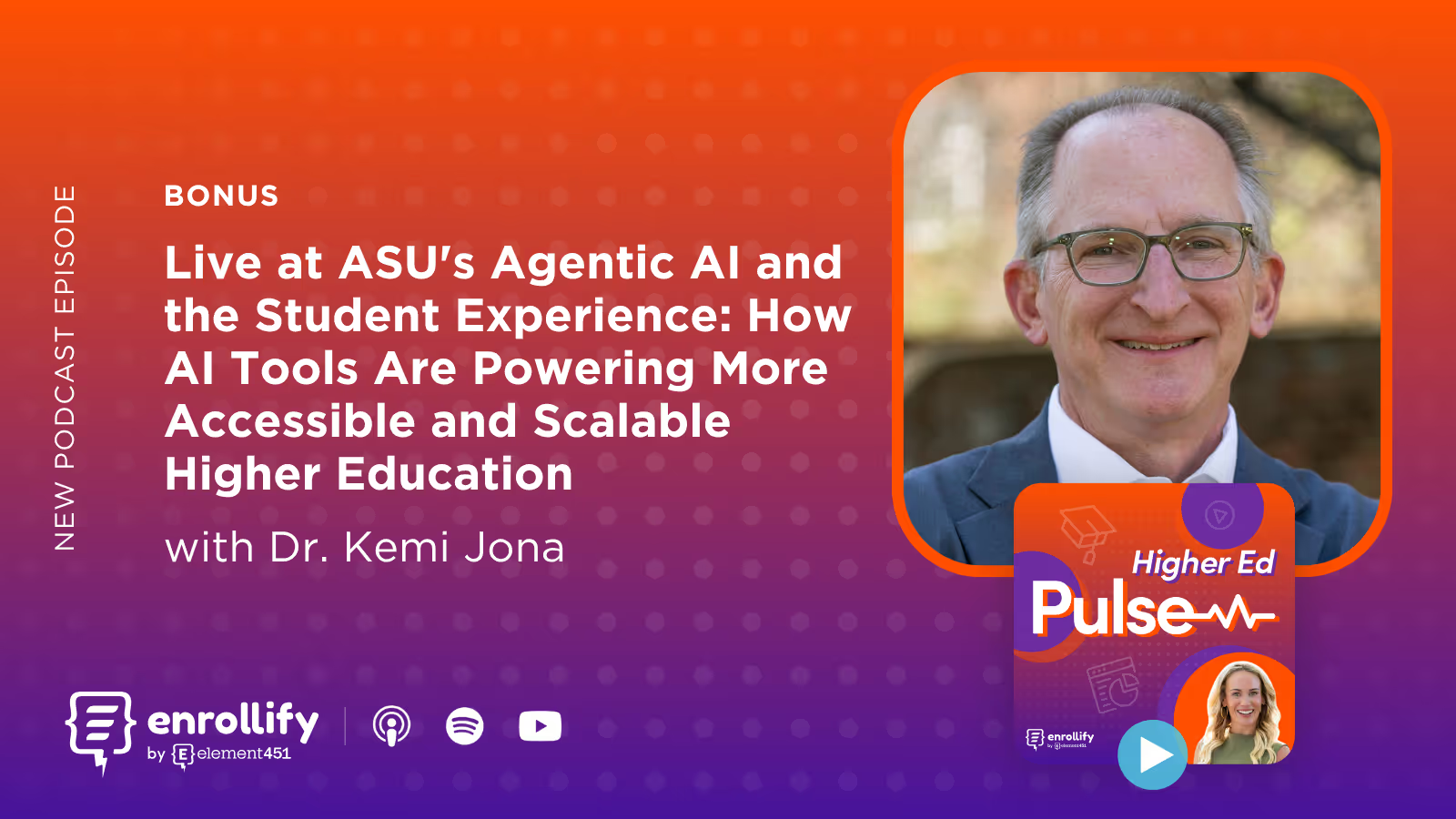




About the Episode
About The Episode:
Kemi Jona joins Ty Fujimura live at the ASU Agentic AI and the Student Experience event to explore the intersection of AI in higher education and workforce development. As the Vice Provost for Online Education and Digital Innovation at the University of Virginia, Jona shares real-world examples of how his team is deploying AI to boost access, streamline course production, and build stronger bridges between higher ed and employers. This candid conversation unpacks both the promise and pitfalls of generative AI and provides a blueprint for institutions eager to innovate responsibly.Key Takeaways
- AI is transforming online course design — UVA cut production costs by 50% using AI video avatars, freeing up resources to improve student experiences.
- AI enhances accessibility — Real-time dubbing in multiple languages makes content more inclusive, especially for international students.
- Workforce partnerships are evolving — Jona calls for a new, collaborative compact between higher ed and employers to co-design AI-ready curricula.
- Adopting AI requires a cautious mindset — Jona emphasizes being "guardedly optimistic" and warns against over-relying on tech at the expense of authentic learning.
- AI in education is more than chatbots — The real gains right now are in "back office" functions like content creation, translation, and workflow automation.
Main Questions Answered in This Episode
What is Kemi Jona’s approach to expanding access to UVA education?
Kemi Jona’s mission at UVA is centered on accessibility. As a public institution, UVA is committed to serving Virginians who might not be able to relocate to Charlottesville. Jona’s team is leveraging online education and learning technologies to extend UVA’s reach without compromising quality. His guiding principle has remained the same across institutions: Use technology to make high-quality education more accessible, whether that means asynchronous learning, affordability, or flexible scheduling.
How is UVA using AI to reduce course production costs?
One of the most compelling use cases Jona shares is UVA’s use of AI-generated video avatars. Instead of requiring professors to sit through long, expensive studio shoots, faculty can now script their lectures, which are then turned into video avatars. This reduces production costs by about 50% and offers enormous flexibility. Updates to videos can be done remotely and quickly, which is particularly useful for keeping course content fresh and globally relevant.
Why is AI-driven video dubbing a game changer for student access?
Jona explains how AI dubbing technology allows videos to be translated into different languages while maintaining perfect lip sync. This is transformative for international students or English language learners, who often struggle to grasp technical or academic content in a second language. Now, institutions can offer localized learning experiences without the former price tag — a task that previously cost thousands per course can now be achieved for mere dollars.
What is Kemi Jona’s stance on AI in education — enthusiastic or cautious?
Jona describes himself as “guardedly optimistic” about AI. While he sees immense promise, especially in improving administrative efficiency and course accessibility, he warns against cognitive offloading — where students use AI to bypass the productive struggle inherent to learning. He argues that learning is like working out: you can’t outsource it. AI should be an augmentation tool, not a replacement for critical thinking and personal effort.
How can higher ed and employers better collaborate in the AI era?
Jona makes a compelling case for moving away from the "throw-over-the-wall" approach — where higher ed delivers graduates and expects employers to figure out the rest. Instead, he advocates for co-designing programs with industry partners. Examples include his prior work with PwC on a modernized accounting degree and GE Aviation on a bachelor’s in advanced manufacturing. The key is meeting in the middle — adapting learning to fit around work shifts and job realities.
What does the future hold for AI in institutional operations?
Jona sees enormous untapped potential in AI streamlining internal university functions. From course development to enrollment workflows, AI can free up budget and staff time that can be reinvested into student support and curricular innovation. He encourages universities to embrace an innovation mindset, experiment with pilot projects, and iterate as they learn. The takeaway? This is an era of exploration, and there’s no one-size-fits-all roadmap.
Enrollify is produced by Element451 — the next-generation AI student engagement platform helping institutions create meaningful and personalized interactions with students. Learn more at element451.com.




.svg)
.svg)
