






About the Episode
Got a story to tell? An innovative idea to share? Fill out our guest nomination form and let's chat!
About The Episode:
Episode prompt:
Create a table with columns [insert column names (identifiers like, text, email, id, date, etc)] and [number] rows.
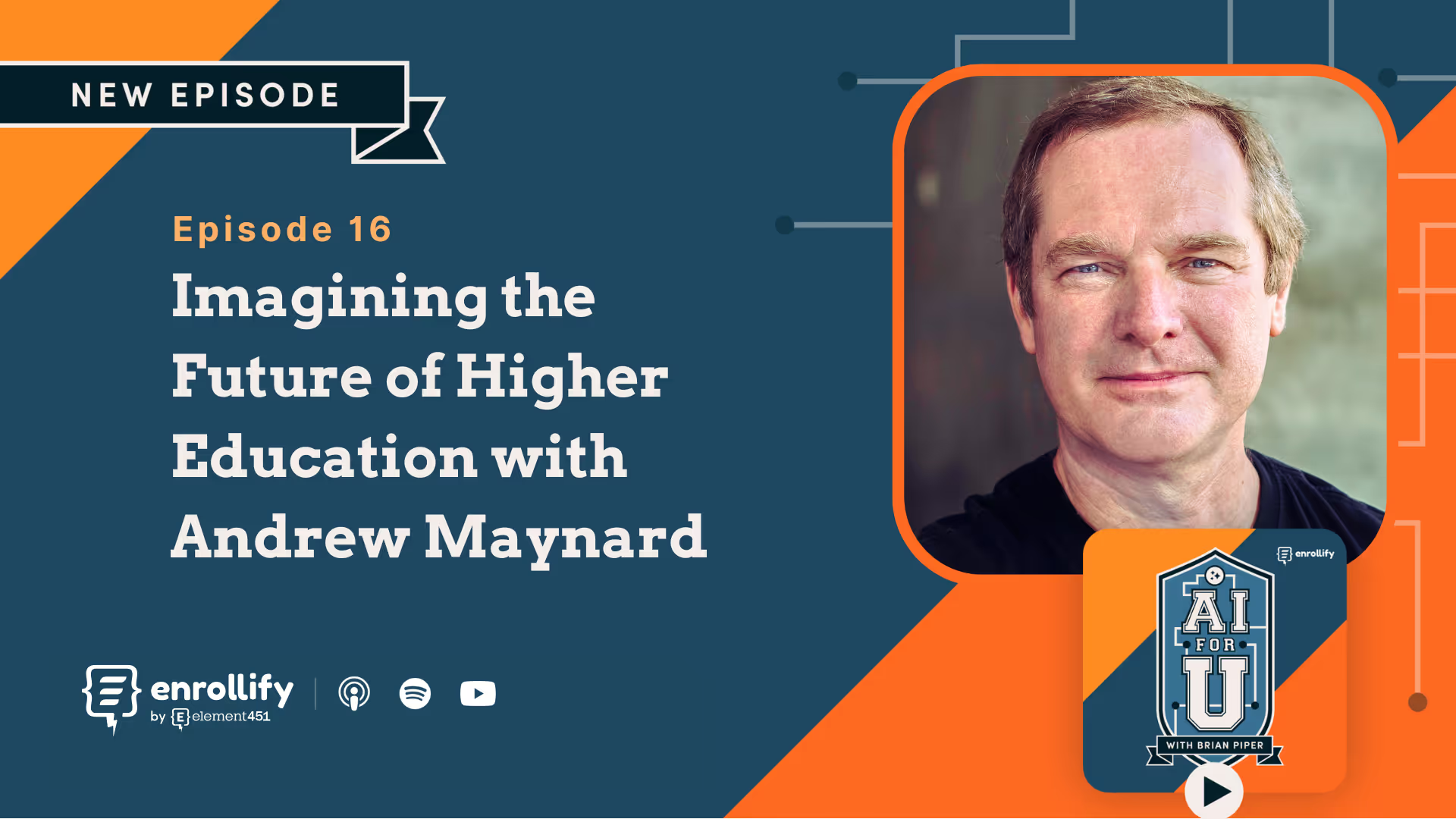
Brian Piper sits down with Andrew Maynard, a leading expert on AI and its implications for higher education. They discuss the rapid evolution of AI, the existential challenges it poses for universities, and how institutions can embrace AI as an opportunity rather than a threat. From AI-driven research advancements to the shifting role of educators, this conversation explores what the future of learning might look like in an AI-powered world.
Key Takeaways
- AI is evolving at an unprecedented pace, requiring institutions to stay agile and continuously learn.
- Higher ed institutions must rethink their role as AI takes over traditional intellectual and scholarly tasks.
- The future of education lies in AI collaboration, not resistance—universities should encourage experimentation.
- AI adoption should be viewed as a change management challenge, not just a technology integration project.
- Institutions that fail to adapt risk irrelevance, as private companies and alternative learning platforms step in.
- AI-powered research and automation will revolutionize discovery and knowledge creation.
AI in Higher Education: Are Universities Falling Behind?
How is AI impacting higher education?
AI is already transforming both teaching and research in higher education. Maynard points out that while some institutions are actively experimenting with AI, many are still struggling to grasp its full implications. Large language models and AI-driven automation are now handling intellectual tasks that were once exclusive to human scholars. The challenge for universities is to rethink their value in a world where AI can generate, analyze, and synthesize knowledge faster than any human.
What should higher ed leaders and marketers do to prepare?
Instead of seeing AI as a threat, institutions need to embrace a culture of experimentation. Maynard encourages universities to shift from a “playpen” approach—where AI exploration is heavily restricted—to a “playground” model, where faculty and staff can freely test AI’s capabilities. He argues that institutions should give their teams the tools, resources, and freedom to explore AI’s potential for marketing, recruitment, and research.
How can institutions integrate AI into marketing and admissions?
Brian Piper, who works in central marketing, notes that AI is often missing from long-term higher ed marketing and admissions planning. Maynard agrees that institutions need to think ahead and accept that AI will fundamentally change their strategies. Instead of focusing solely on efficiency and cost-cutting, universities should use AI to transform how they engage with prospective students, personalize outreach, and create innovative learning experiences.
What are some of the biggest challenges universities face with AI adoption?
One of the biggest barriers to AI integration is institutional inertia. Faculty and administrators may resist AI because they feel overwhelmed, unprepared, or even threatened by its capabilities. Maynard stresses that institutions must meet people where they are, providing clear pathways for faculty and staff to adopt AI at their own pace. Without this shift in mindset, universities risk being left behind as AI-powered alternatives gain traction.
What innovative AI initiatives are happening at Arizona State University (ASU)?
ASU has been a leader in AI adoption, particularly in learning and research. While many institutions panicked over AI-driven student cheating, ASU took a different approach—focusing on how AI could enhance education rather than threaten it. The university has developed AI tools to assist educators in creating syllabi, assessments, and teaching materials. ASU is also exploring AI’s role in accelerating research, from automated lab experiments to AI-driven literature reviews.
Will AI replace universities?
Maynard warns that if universities fail to evolve, they could become “zombified institutions”—still existing but no longer relevant. He notes that private companies and alternative learning platforms like Khan Academy are already filling gaps that traditional universities have ignored. If institutions don’t redefine their role beyond knowledge transfer, they risk being bypassed entirely. The challenge is to provide value in a world where AI gives everyone instant access to high-quality information.
Where is AI heading in the next few years?
AI’s impact will be uneven, with some areas of society changing rapidly while others remain relatively untouched—for now. Maynard predicts that within just a few years, we’ll see AI automating entire research labs, shaping governance decisions, and becoming an integral part of everyday life. Those who fail to adapt will find themselves at a disadvantage, while those who embrace AI will thrive.
How is AI changing Maynard’s own work?
Despite his initial reluctance, Maynard admits that AI is becoming an invaluable tool in his work. He describes how AI-powered research assistants can now provide in-depth analysis in minutes—work that previously required months of effort from human researchers. This, he says, is both exhilarating and unsettling, as it raises profound questions about the future of human expertise.
Connect With Our Host:
Brian Piper
https://www.linkedin.com/in/brianwpiper/
About The Enrollify Podcast Network:
AI for U is a part of the Enrollify Podcast Network. If you like this podcast, chances are you’ll like other Enrollify shows too!
Some of our favorites include Generation AI and Mastering the Next.
Enrollify is produced by Element451 — the next-generation AI student engagement platform helping institutions create meaningful and personalized interactions with students. Learn more at element451.com.
Attend the 2025 Engage Summit!
The Engage Summit is the premier conference for forward-thinking leaders and practitioners dedicated to exploring the transformative power of AI in education.
Explore the strategies and tools to step into the next generation of student engagement, supercharged by AI. You'll leave ready to deliver the most personalized digital engagement experience every step of the way.
👉🏻 Register now to secure your spot in Charlotte, NC, on June 24-25, 2025!





.svg)
.svg)
