






About the Episode
Got a story to tell? An innovative idea to share? Fill out our guest nomination form and let's chat!
About The Episode:
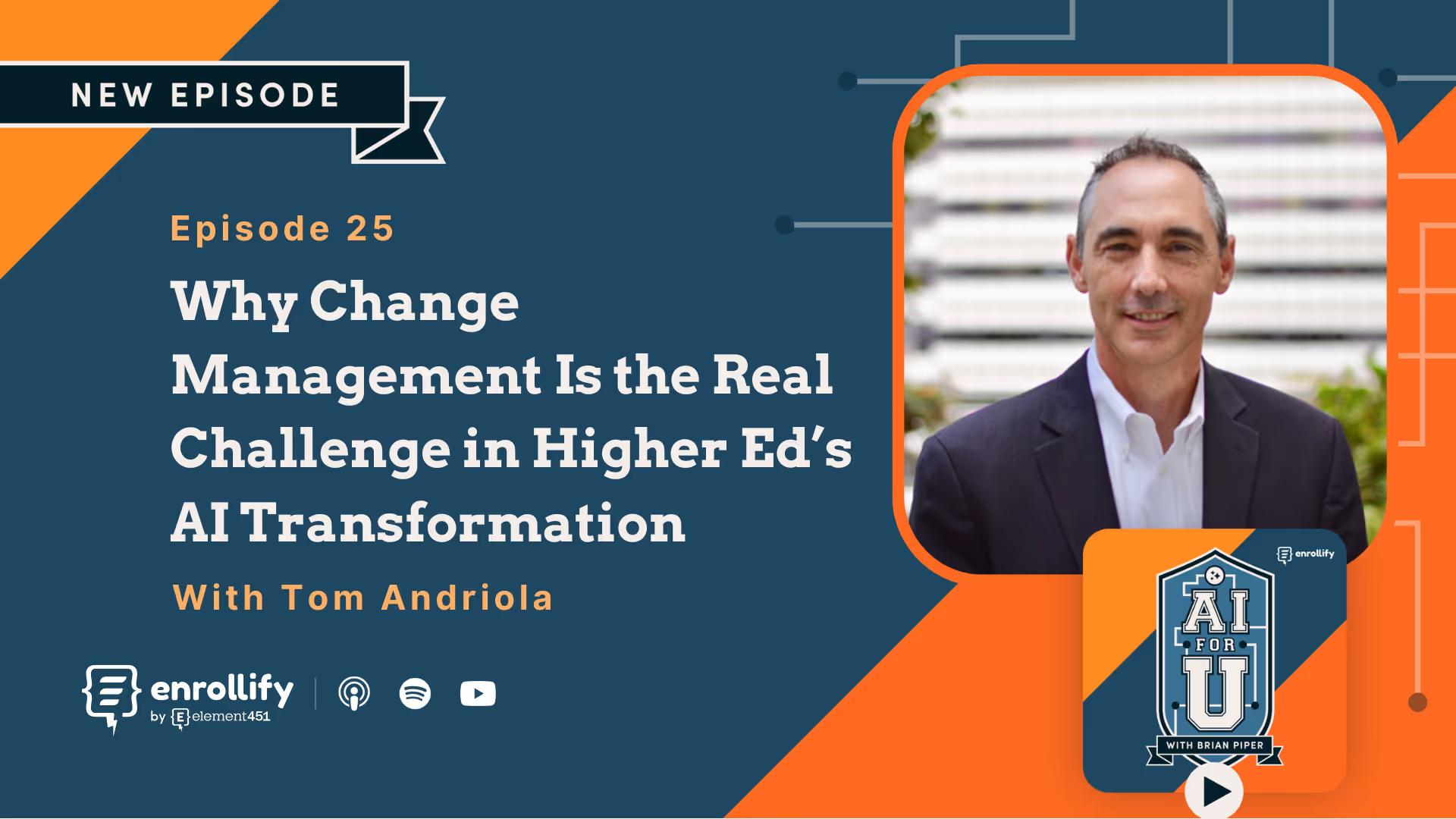
Everyone in higher ed knows that AI transformation is happening fast, and Tom Andriola, Chief Digital Officer at UC-Irvine, is helping lead the charge. Tom joins Brian to share how his institution is approaching generative AI not with hesitation, but with urgency. From chatbots in admissions to one-to-one learning in the classroom, Tom walks us through UC-Irvine’s strategy for scaling innovation across the institution. He also reflects on the broader sector challenges, such as rising regulation, student ROI concerns, and workplace readiness, and why AI can’t just be an efficiency tool, but a vehicle for transformational change.
Join us as we discuss:
- [2:00] Letting innovators lead the charge in AI integration and change management
- [12:00] Why schools need to let their teams play with AI as a sparring partner
- [21:45] Kickstarting faculty conversations around building an AI strategy
How is UC Irvine integrating AI across its institution?
UC Irvine’s approach to AI is wide-ranging and bold. Instead of isolating AI efforts within silos, they've established working groups across teaching, student services, research, and even their medical center. This holistic framework enables teams to explore AI’s impact across the university’s entire mission. With leadership buy-in and an open innovation environment, UC Irvine has created the conditions for experimentation, iteration, and meaningful transformation.
Rather than focusing solely on productivity tools, Tom Andriola emphasized reimagining how work gets done. Their "thousand flowers bloom" strategy invites innovators to test ideas organically—then identifies which ideas have traction before scaling. Successful early pilots, like AI-powered chatbots in admissions and financial aid, proved both efficient and scalable, laying the groundwork for broader AI adoption.
What makes UC Irvine’s AI strategy stand out?
What sets UC Irvine apart is its deliberate use of decentralized innovation as a strategic advantage. The university encourages faculty and staff to explore AI tools on their own terms—then showcases early wins through storytelling platforms like their “Digital Discoveries” series. These stories inspire fence-sitters and skeptics to take action, building a self-reinforcing cycle of curiosity and adoption.
Tom also shares that UC Irvine’s innovators weren’t just technologists—many were student affairs professionals, faculty members, and administrators who recognized AI’s potential to solve real-world problems. Over time, this created a flywheel effect: as more people saw value, they shared ideas, learned from one another, and deepened the institution's AI maturity.
Why do so many higher ed institutions struggle with AI adoption?
Tom breaks down resistance to AI in higher education into three categories: a lack of curiosity, a need for peer-validated evidence, and fear of job disruption. He argues that many institutions believe they can “wait it out” because of their long-standing traditions—but this mindset may leave them vulnerable in a fast-changing world.
He explains that while skepticism is understandable, higher ed professionals need to be informed skeptics—people who experiment with the tools before forming strong opinions. Institutions that lean into the future, rather than retreat from it, are better equipped to align innovation with their core mission. In other words, this isn’t just about keeping up—it’s about redefining relevance.
What advice does Tom have for institutions just starting with AI?
Tom’s advice is refreshingly straightforward: just get started. He urges leaders to encourage experimentation by making AI tools accessible and by normalizing open dialogue about their potential. UC Irvine even built a curated platform for staff to try different models, accompanied by prompts to “hack your own productivity.” This small-scale access led to big ideas and built confidence among users.
Once the fear fades, individuals begin imagining new use cases—from email composition to course design. Tom emphasizes that as relationships with the tools deepen, users shift from passive consumers to active collaborators. The tipping point isn’t technical—it's cultural. And building trust with AI is the first step in crossing it.
Where is AI headed in higher education?
Rather than predicting which new tools will dominate, Tom focuses on how quickly institutions can build readiness. The real challenge isn’t technical capability—it’s change management. The institutions that succeed will be those that can get 90% of their people using AI to enhance their work and improve student outcomes.
He paints a vision of “one-to-one learning” made possible by AI-powered tutoring and feedback systems. These tools won’t just make things faster—they'll make learning better, more personal, and more outcomes-driven. That’s the north star. Institutions that embrace that vision and structure their strategy around it will outpace peers still focused solely on cost savings and efficiency.
What’s the role of marketers and enrollment leaders in this AI transformation?
According to Tom, marketers and admissions professionals are at a critical inflection point. With enrollment cliffs looming and families questioning ROI, these leaders must rethink recruitment strategies from the ground up. AI tools offer not just optimization, but an opportunity to redefine audience segmentation, messaging personalization, and lifecycle engagement.
To stand out in a competitive landscape, higher ed marketers must go beyond digital ads and CRMs. They need to experiment with AI-generated content, predictive analytics, and chatbots that actually improve student support. And just like faculty, these teams must also grapple with the ethical and operational implications of using AI in decision-making. The institutions that do this transparently and strategically will win trust—and enrollment.
Episode prompt:
"You are a dual-domain expert: (1) a specialist in large language model (LLM) memory systems and (2) an experienced business strategist and planner.
Your task is to create a structured, comprehensive document in canvas view that can serve as a foundational dataset for training an LLM to understand and represent my [personal brand/business] from scratch.
Before writing the document, ask clarifying questions to gather any essential information you need.
Deliverables:
- A detailed document containing all relevant, useful, and structured knowledge about my [personal brand/business].
- Include aspects such as brand voice, values, origin story, services/products, target audience, tone, visuals, positioning, messaging, and strategic goals.
- Organize this as if it were training data for onboarding a model unfamiliar with me or my brand.
- Treat this as a backup archive that should be detailed, high-fidelity, and long-lasting.
Take your time to ensure accuracy and depth."
Connect With Our Host:
Brian Piper
https://www.linkedin.com/in/brianwpiper/
About The Enrollify Podcast Network:
AI for U is a part of the Enrollify Podcast Network. If you like this podcast, chances are you’ll like other Enrollify shows too!
Some of our favorites include Generation AI and Mastering the Next.
Enrollify is produced by Element451 — the next-generation AI student engagement platform helping institutions create meaningful and personalized interactions with students. Learn more at element451.com.
Attend the 2025 Engage Summit!
The Engage Summit is the premier conference for forward-thinking leaders and practitioners dedicated to exploring the transformative power of AI in education.
Explore the strategies and tools to step into the next generation of student engagement, supercharged by AI. You'll leave ready to deliver the most personalized digital engagement experience every step of the way.
👉🏻 Register now to secure your spot in Charlotte, NC, on June 24-25, 2025!






.svg)
.svg)
