






About the Episode
Got a story to tell? An innovative idea to share? Fill out our guest nomination form and let's chat!
About The Episode:
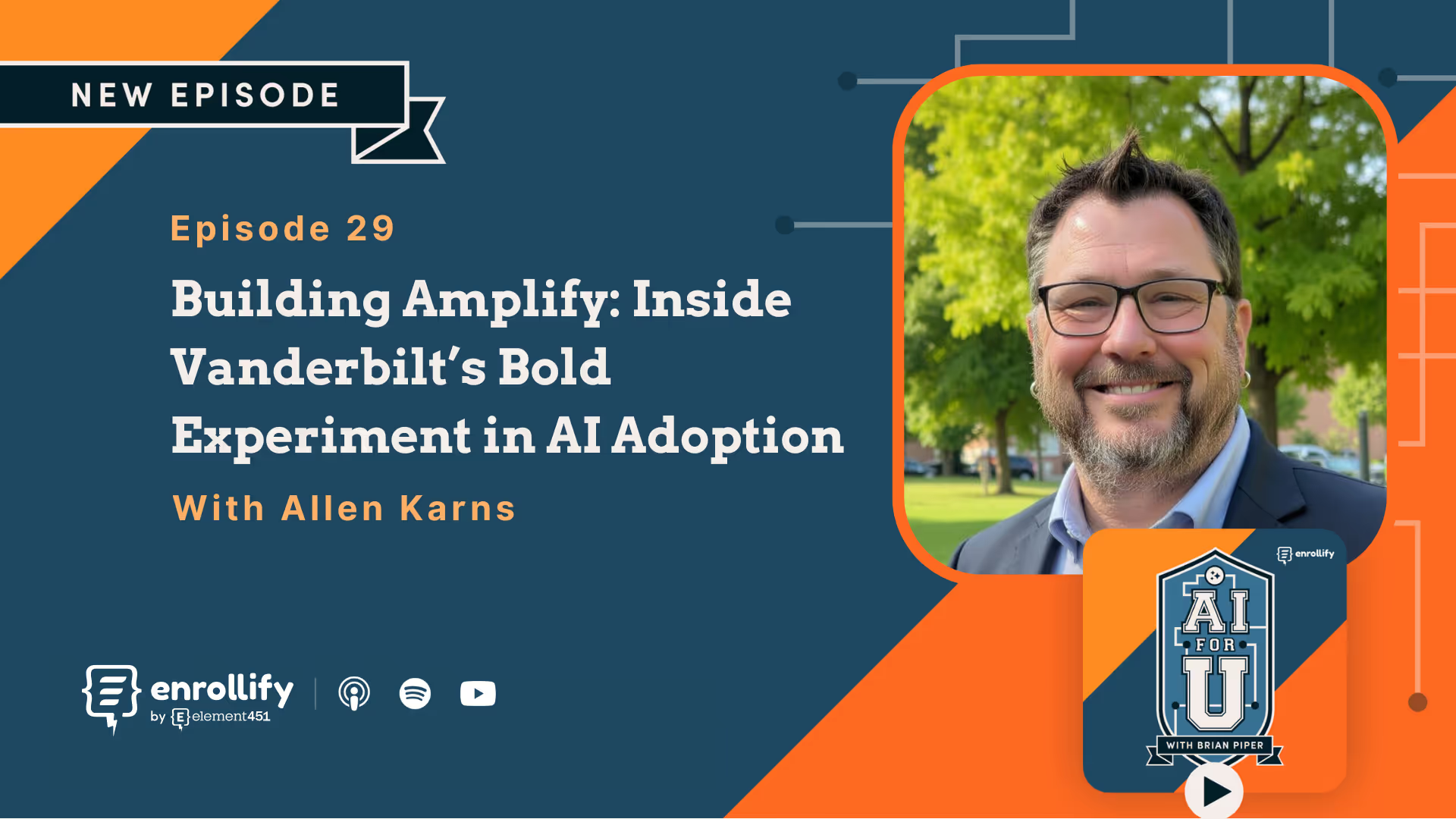
How can higher education move beyond theory and actually adopt AI in ways that matter? In this episode, we talk with Allen Karns, Chief AI and Technology Officer at Vanderbilt’s Center for Generative AI, to unpack what it really takes to integrate AI across a university. Allen shares the story of Amplify, Vanderbilt’s homegrown AI platform, and explains why leadership buy-in is the single biggest factor in campus adoption. He discusses how his team built momentum by starting small, highlights creative use cases already transforming workflows, and offers advice for preparing marketing and admissions teams for AI’s growing role.
Join us as we discuss:
- [7:21] The biggest challenge for AI in higher ed: leadership buy-in
- [10:18] How to build a curious, experiment-driven team
- [18:52] Why today’s AI already offers 10 years of learning
Check out these resources we mentioned during the podcast:
To hear this interview and many more like it, subscribe on Apple Podcasts, Spotify, or our website, or search for AI for U with Brian Piper in your favorite podcast player.
Episode Summary: Breaking Down Vanderbilt’s AI Playbook
What is Vanderbilt’s Amplify Platform, and Why Build It In-House?
Vanderbilt University’s Amplify platform is a cloud-based, open-source generative AI tool developed internally to provide secure and flexible access to leading AI models. While many institutions are content with licensing third-party tools like ChatGPT EDU, Vanderbilt went a different route—prioritizing integration with internal systems and full control over security and data governance. Karns explains that Amplify not only saves money via per-token API access but also enables custom workflows and backend connectivity, like pulling data from Outlook or campus databases. The decision gave them a head start in shaping AI for their unique institutional needs.
How Did Vanderbilt Foster Campus-Wide AI Adoption?
One of the biggest hurdles to AI adoption in higher ed is institutional resistance—often rooted in leadership hesitation or technical uncertainty. For Vanderbilt, success started at the top. With strong support from Chancellor La Meyer and a collaborative culture encouraged by Dr. White, the Center for Generative AI was able to gain early buy-in. The launch of their Staff Fellows Program—which received over 180 applicants—demonstrates the high demand for AI tools across departments. Karns emphasizes that collaboration, curiosity, and experimentation were key to unlocking campus engagement. Faculty, staff, and administrators are now working together to apply AI in research, administration, and the classroom.
What’s the Hiring Philosophy Behind Their AI Team?
Unlike traditional tech teams that prioritize credentials and experience, Allen Karns and his team looked for something different: curiosity. By hiring people who were passionate about exploring new tools and solving problems, the Center for Generative AI built a nimble and adaptable team capable of fast iteration. Some members were pulled from Vanderbilt’s own undergrad and graduate programs, highlighting a “grow-your-own” approach to technical talent. The result? A development environment where team members are both problem solvers and co-creators, using Amplify itself to code new features and troubleshoot infrastructure challenges.
What Are the Most Impactful Use Cases for AI on Campus?
Vanderbilt’s AI use cases are as practical as they are powerful. A PowerPoint deck generator, calendar summarizer, and Outlook-integrated email assistant are just a few of the tools that have quickly become campus staples. These aren’t flashy demos—they’re real tools solving real problems. Additionally, the team is enabling cross-functional integration by building custom APIs that automate repetitive workflows and unlock new efficiencies. By targeting small but high-friction tasks, Vanderbilt has been able to show tangible value early, laying the groundwork for more complex integrations in the future.
How Can Other Institutions Get Started?
Allen’s advice to other institutions is refreshingly simple: just start. Rather than waiting for perfect clarity or comprehensive strategies, universities should pick a small project, fund a few licenses, and measure ROI. From there, scale what works and iterate as needed. Tools like Zapier, Co-pilot, or basic LLM integrations can go a long way in the early stages. The real barrier isn’t technological—it’s institutional inertia. By cultivating a mindset of curiosity, risk-taking, and experimentation, schools can start creating value from day one.
What’s Next for AI in Higher Education?
Despite the fast pace of AI advancements, Allen argues that most institutions have more than enough to work with already. He encourages focusing less on model upgrades and more on applying existing tools creatively. That said, he expects the next wave of value to come from deep integrations—AI systems that plug into help desks, email platforms, CRM systems, and more. As users grow more accustomed to AI in their personal lives, they'll expect the same utility in their professional roles. The institutions that respond quickly to this shift will be the ones that stay competitive.
Episode prompt:
I have an important meeting coming up and need help preparing comprehensively. Here are the details:**Meeting Details:**- Date/Time: [WHEN]- Attendees: [WHO - include roles/departments]- Meeting Purpose: [PRIMARY OBJECTIVE]- Meeting Type: [Budget planning, strategic planning, crisis response, project kickoff, etc.]- Expected Duration: [TIME ALLOCATED]**Background Context:**- Previous relevant meetings or decisions: [BRIEF HISTORY]- Current challenges we're facing: [KEY ISSUES]- Organizational priorities this relates to: [STRATEGIC GOALS]- Any tensions or concerns among attendees: [INTERPERSONAL DYNAMICS]Please help me prepare by creating:1. **Strategic Agenda** - Prioritized list of topics that maximizes our time2. **Key Questions** - Critical questions I should ask to drive productive discussion3. **Potential Obstacles** - Issues that might derail the meeting and how to handle them4. **Decision Framework** - Structure for making decisions if we reach key choice points5. **Success Metrics** - How to know if this meeting accomplished its purposeFocus on making this meeting outcome-oriented rather than just informational.
Connect With Our Host:
Brian Piper
https://www.linkedin.com/in/brianwpiper/
About The Enrollify Podcast Network:
AI for U is a part of the Enrollify Podcast Network. If you like this podcast, chances are you’ll like other Enrollify shows too!
Some of our favorites include Generation AI and Mastering the Next.
Enrollify is produced by Element451 — the next-generation AI student engagement platform helping institutions create meaningful and personalized interactions with students. Learn more at element451.com.





.svg)
.svg)
