






About the Episode
Got a story to tell? An innovative idea to share? Fill out our guest nomination form and let's chat!
About The Episode:
In this episode, we sit down with Mark Lee, Director of Web User Experience and Digital Strategy at Colorado College, to unpack the promises and the pitfalls of bringing AI into higher education. Mark reveals how he treats AI as a coworker instead of a content machine, why fear and resistance remain the biggest roadblocks on campus, and how schools can win buy-in by starting small with low-risk, high-reward use cases. From AI-powered tutors and chatbots boosting student success to the radical shift from SEO to GEO (Generative Engine Optimization), this conversation explores what it takes to truly future-proof higher ed in an AI-driven world.
Join us as we discuss:
- [5:30] Where to start with change management and why tedious tasks matter
- [14:35] AI in student success: virtual TAs and chatbots that improve grades
- [19:51] The “avalanche” analogy and how to stay flexible in an era of disruption
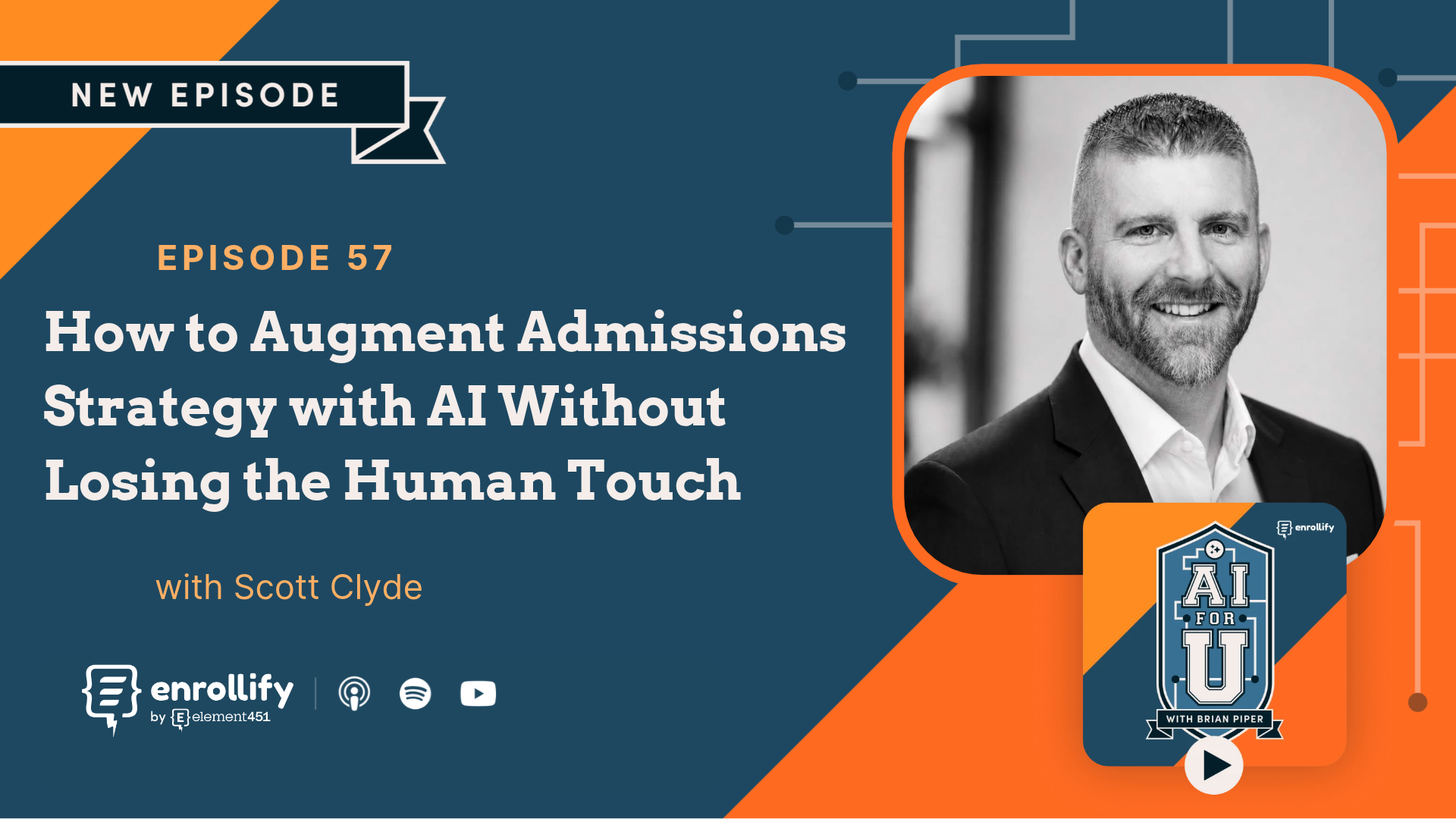
To hear this interview and many more like it, subscribe on Apple Podcasts, Spotify, or our website, or search for AI for U with Brian Piper in your favorite podcast player.
How is Mark Lee using AI in his role at Colorado College?
Mark uses AI as a co-strategist, not a content generator. Working in marketing and communications with a background in web development, he finds AI especially valuable for technical troubleshooting, learning new concepts, and conducting strategic analysis. For example, when facing a new challenge or scenario, Mark will prompt AI with the context and ask, “What am I missing?” or “Where are my assumptions flawed?” This turns AI into a digital devil’s advocate — a powerful way to stress-test ideas.
In his current work, AI is accelerating front-end development tasks like HTML/CSS/JavaScript coding during a major web redesign. Using tools like Claude for agentic coding assistance, he’s producing higher-quality code in a fraction of the time, while still ensuring oversight and human review.
What’s the difference between using AI as a tool vs. a system-level shift?
Mark makes a critical distinction: most institutions view AI as something to “plug into” current systems. But AI isn’t a plug-in. It’s changing the system itself. For example, AI is transforming how search works (think: zero-click results and AI-generated answers), fundamentally altering how users find and engage with content. In that world, content marketing and SEO strategies must evolve from traditional keyword targeting to generative engine optimization (GEO) and broader, cross-platform discoverability.
He compares this AI shift to the early web and social media revolutions — full of promise, but often adopted without ethical foresight. Institutions must move beyond reactive thinking to proactive system design that puts people — especially students — at the center.
What are some of the most promising AI use cases in student success?
Mark is most excited about AI’s potential to enhance human connection, particularly in academic support. He highlights:
- Morehouse College’s AI-powered teaching assistants: Fully customized to individual professors, these 3D virtual assistants offer personalized guidance based on lecture materials, notes, and expertise.
- Georgia State’s chatbot pilots: These bots offer proactive nudges like study tips and assignment reminders. The result? Students in the pilot saw a 5–6% performance boost and overwhelmingly wanted the bots included in future courses.
He believes the first institution to deliver personal AI assistants to every student — helping them navigate academics, campus life, and career exploration — will gain a significant competitive edge.
What should institutions focus on when implementing AI?
Brian and Mark emphasize the importance of starting with human-centered change management. Don’t begin with the flashiest use cases — start with real problems. Identify tasks that are repetitive, time-consuming, and uninspiring for your teams. That’s where AI can drive early wins and foster buy-in.
For example, offloading routine student questions to a chatbot can free up time for deeper, more meaningful interactions. As Mark notes, “Look for the things that make people’s jobs and lives happier.”
Just as important is knowing what not to automate. Tasks that require human nuance, emotional intelligence, or build community shouldn’t be replaced, just enhanced.
How can marketers and admissions leaders prepare for AI’s impact?
Mark offers three key pieces of advice:
- Keep moving: He likens the moment we’re in to being caught in an avalanche — pausing could bury you. Movement, adaptation, and experimentation are your best bets.
- Ask better questions: The shift is from how we do something to what we should be doing and why. AI helps us execute faster, but humans must guide the strategy.
- Re-think SEO: Traditional content strategies centered on organic search traffic are fading. AI summaries, zero-click answers, and platforms like Perplexity and ChatGPT are re-routing content discovery. Optimize for visibility across platforms — not just in Google.
Episode prompt:
You are a strategic advisor and critical thought partner.
I’m going to ask you to help me test a plan I'm developing. Your role is to challenge my thinking, identify blind spots, and push back on assumptions, not to validate or agree with me.
Before you create a response, ask any questions that will create a better output.
**My Initiative/Plan:**
[DESCRIBE YOUR STRATEGY, CAMPAIGN, OR INITIATIVE]
**Context & Background:**
- Institution type: [PUBLIC/PRIVATE, SIZE, LOCATION]
- Target audience: [WHO YOU'RE TRYING TO REACH]
- Primary goals: [WHAT YOU'RE TRYING TO ACHIEVE]
- Timeline: [WHEN THIS NEEDS TO HAPPEN]
- Budget/Resources: [CONSTRAINTS YOU'RE WORKING WITHIN]
- Key stakeholders: [WHO NEEDS TO BUY IN OR BE INVOLVED]
**My Current Thinking:**
[OUTLINE YOUR PROPOSED APPROACH, STRATEGY, OR SOLUTION]
Now, please challenge this plan by addressing:
1. **Assumption Testing**: What assumptions am I making that might be wrong?
2. **Gap Analysis**: What important factors am I not considering?
3. **Risk Assessment**: What could go wrong that I haven't planned for?
4. **Stakeholder Blind Spots**: Whose perspectives might I be missing?
5. **Alternative Approaches**: What completely different strategies might work better?
Be direct and critical—I need honest analysis, not encouragement.
Connect With Our Host:
Brian Piper
https://www.linkedin.com/in/brianwpiper/
About The Enrollify Podcast Network:
AI for U is a part of the Enrollify Podcast Network. If you like this podcast, chances are you’ll like other Enrollify shows too!
Some of our favorites include Generation AI and Mastering the Next.
Enrollify is produced by Element451 — the next-generation AI student engagement platform helping institutions create meaningful and personalized interactions with students. Learn more at element451.com.




.svg)
.svg)
