






About the Episode
The AI Engage Summit is a free, virtual experience built to help higher ed leaders actually do something with AI. Over two afternoons, you’ll hear from peers, see practical demos, and walk away with ideas you can use immediately — no travel required, no cost to attend. If you’re ready to move AI from “interesting” to “impactful,” this is the place to be. Register now, don't miss out.
About The Episode:
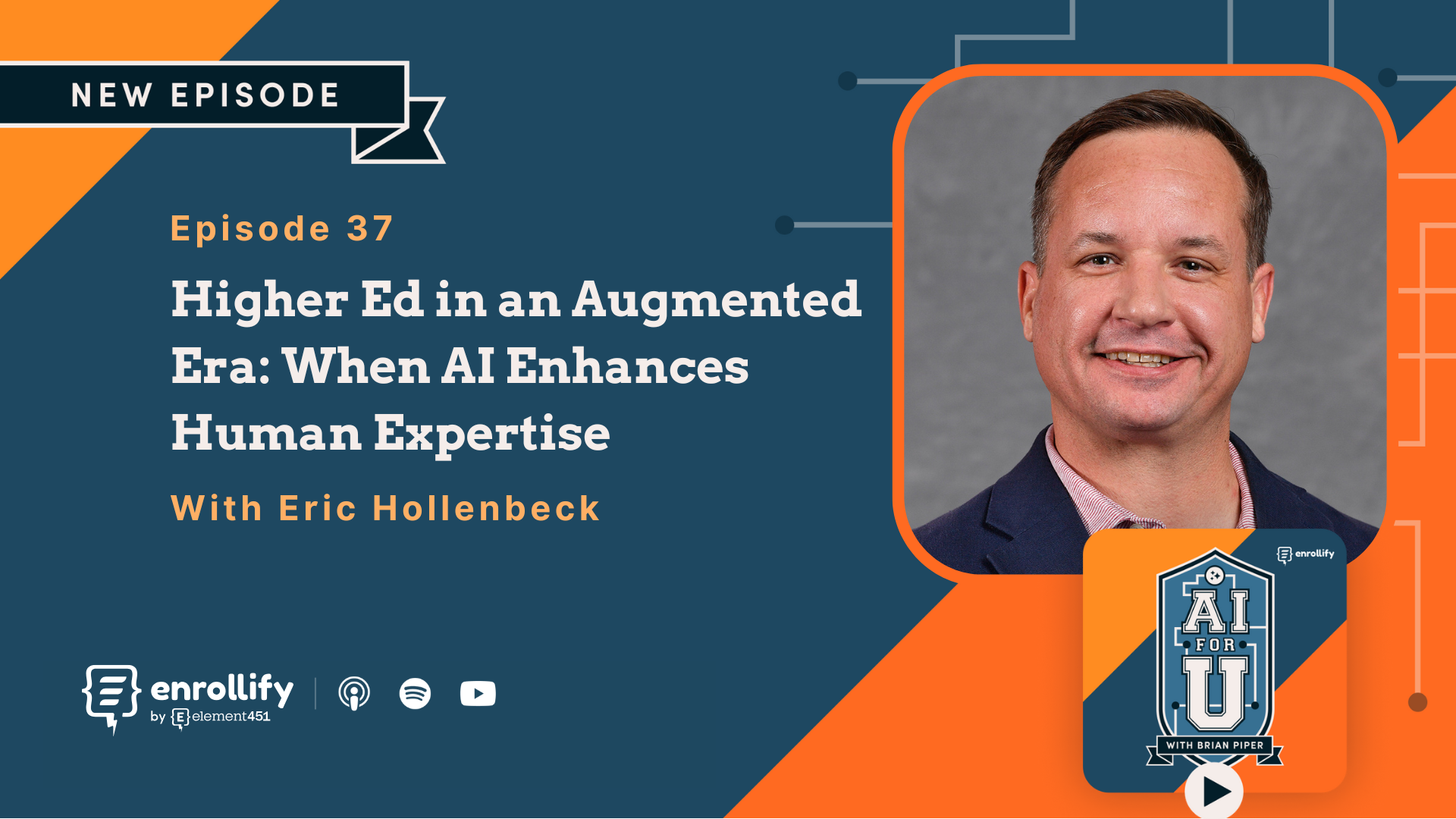
In this conversation, Brian talks with Eric Hollenbeck, Communications Manager for Research at Washington State University - Carson College of Business, to explore how generative AI is becoming a genuine partner in the creative and strategic process. Eric shares why he sees the future not as artificial intelligence but as augmented intelligence. He explains how tools like ChatGPT and Copilot help him analyze data, visualize insights, improve workflows, and communicate more persuasively with leadership and stakeholders. It’s a forward-looking conversation on how AI can elevate the work we do, not replace it.
Join us as we discuss:
- [2:02] How to use AI to overcome creative blocks
- [14:31] What industry leaders expect from AI-ready graduates
- [20:57] Why you should treat AI like you’re supervising an intern
To hear this interview and many more like it, subscribe on Apple Podcasts, Spotify, or our website, or search for AI for U with Brian Piper in your favorite podcast player.
How is AI being used to support creativity and overcome blocks in higher ed marketing?
Eric Hollenbeck uses generative AI tools like ChatGPT and Microsoft Copilot as an integral part of his creative workflow—particularly during early stages of campaign ideation and storytelling. Instead of relying on AI to write polished content, Eric engages in a back-and-forth conversation with the tool to work through creative blocks, develop angles, and identify compelling metaphors. By treating the tool as a brainstorming partner, he finds it easier to break complex projects into smaller, more manageable tasks.
Brian Piper echoes this approach, noting that using AI to interview yourself or serve as a sounding board can unlock ideas you didn’t realize you had. It's not about handing over creative control—it's about co-creating in a way that accelerates insight and sparks innovation. The takeaway? You don’t have to start with the blank page anymore. AI helps you get unstuck faster and focus more energy on refining and elevating your message.
What’s the right mindset for using AI tools effectively?
Eric offers a refreshing mindset shift: treat AI like a student intern or a new employee. Just as you would train a new team member with context, instruction, and feedback, AI tools require similar guidance. This approach helps users realize that prompting isn't a one-and-done task—it's a dialogue that requires iteration, supervision, and clarity. Thinking this way also encourages marketers to better document their own processes, which can reveal inefficiencies or opportunities for improvement.
The process of working with AI often leads to self-discovery. Eric describes how prompting forces him to slow down and reflect on how he's approaching a task, which in turn improves not just the output, but also his own strategic thinking. This insight reinforces AI’s value not only as a productivity tool but as a reflective partner in personal and professional growth.
What’s holding back AI adoption in higher ed?
Despite the obvious benefits, many higher ed professionals remain hesitant about using AI. Eric identifies a key reason: unclear institutional guidelines. Without strong messaging about what's appropriate and ethical, faculty and staff—who generally want to act with integrity—are likely to err on the side of caution and avoid the tools altogether.
The solution? Build responsible use policies and governance structures in parallel with training programs. Higher ed leaders, as well as internal influencers across departments, must champion AI literacy and promote a culture of experimentation. Creating safe spaces to test AI tools in low-stakes environments can go a long way in reducing reluctance.
What do industry expectations reveal about higher ed’s readiness?
One of the most striking statistics from this episode comes from a Carson College of Business survey: 88% of employers believe universities have a duty to train students in AI, but only 9% believe colleges are actually doing it. That gap should serve as a wake-up call for institutions. Industry is not just curious about AI; they are expecting fluency from graduates entering the workforce.
This discrepancy presents both a challenge and an opportunity. Institutions that move quickly to integrate AI education across disciplines—whether through curriculum updates, experiential learning, or staff training—can significantly enhance their value proposition. For enrollment marketers, this is a powerful differentiator that can be built into messaging, recruitment content, and donor communications.
What are the most valuable AI use cases for higher ed marketers and communicators?
Eric believes the most impactful use cases for AI are behind the scenes. He uses AI to support data analysis, performance reporting, and even to help build donor-facing summaries of research impact. Tools that help structure, visualize, and interpret data give communicators a persuasive edge when selling ideas internally or externally.
He’s also intrigued by emerging automation use cases, such as building agents that can autonomously launch prompt sequences or compile data across systems. While creative content generated by AI is becoming saturated and often lacks nuance (what he refers to as “AI slop”), the future lies in smarter backend processes that support strategic decision-making. These are the tools that will transform workflows, not just messaging.
How should newcomers to AI get started?
Eric recommends starting small. Use AI tools on projects that are low-stakes, like planning volunteer events or organizing notes for side projects. This reduces the pressure to "get it right" and helps build muscle memory around prompting. As your comfort grows, you can begin applying the tools to more strategic initiatives.
He also suggests adopting a mindset of curiosity over fear. AI isn't about replacing your expertise—it's about scaling it. When used thoughtfully, these tools can give you more time for the parts of your work that matter most: building relationships, telling authentic stories, and driving results.
Connect With Our Host:
Brian Piper
https://www.linkedin.com/in/brianwpiper/
About The Enrollify Podcast Network:
AI for U is a part of the Enrollify Podcast Network. If you like this podcast, chances are you’ll like other Enrollify shows too!
Some of our favorites include Generation AI and Mastering the Next.
Enrollify is produced by Element451 — the next-generation AI student engagement platform helping institutions create meaningful and personalized interactions with students. Learn more at element451.com.





.svg)
.svg)
