






About the Episode
About the Episode:
In a job market this bleak, more candidates pay for ‘reverse recruiting’
Your AI resume isn’t fooling anyone
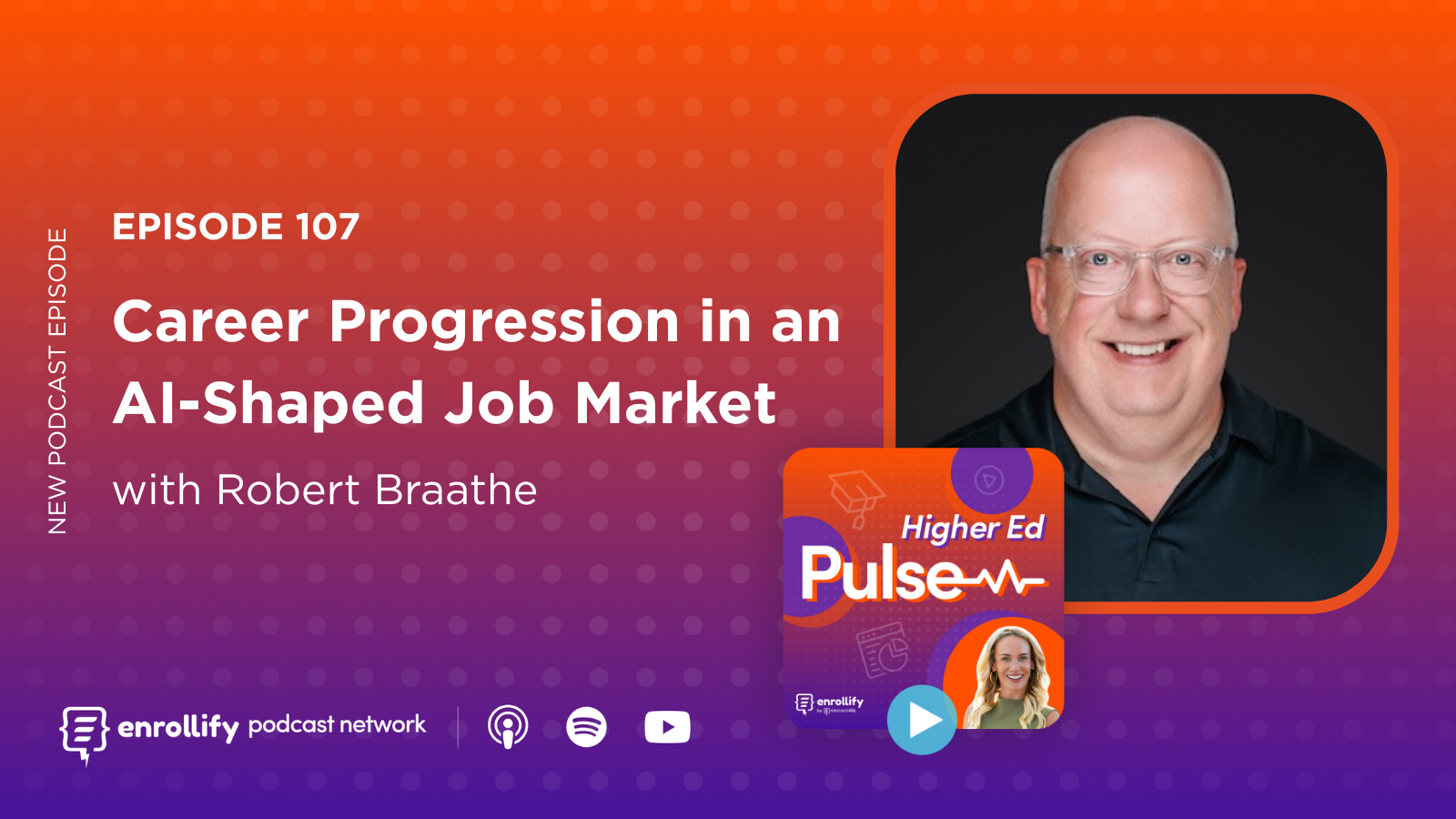
Mallory sits down with career strategist Robert Braathe to unpack the paradox shaping today’s workforce: nearly 80% of professionals don’t feel ready for the job market, while recruiters say they can’t find quality talent. Together, they explore how AI in hiring is reshaping career progression, what networking really means in 2026, and why impact—not titles—drives advancement.
If you work in enrollment marketing or higher education leadership, this episode is a timely reality check on how to build a career in an AI-shaped job market. From beating applicant tracking systems to leveraging human storytelling, this conversation is packed with actionable career strategy insights.
Key Takeaways
- AI in hiring is filtering resumes before humans ever see them—but impact statements can dramatically improve your odds of getting past applicant tracking systems (ATS).
- Recruiters aren’t struggling to find talent—they’re struggling to find clarity. Positioning and confidence gaps are widening the disconnect.
- Generic, AI-generated resumes are easy to spot. Hiring managers are craving specificity, measurable outcomes, and authentic voice.
- Networking in 2026 is about leverage, not volume. Warm introductions and thoughtful outreach outperform cold LinkedIn blasts every time.
- Personal brand equals clarity of mission + measurable results. Titles matter less than demonstrated impact.
- Career acceleration requires visibility in the right rooms, not just more rooms.
- Human skills—communication, creativity, judgment—are becoming premium differentiators in an AI-saturated hiring landscape.
Episode Summary
Is the 2026 Job Market a Confidence Problem or a Competence Problem?
Mallory opens the episode by highlighting a striking paradox: professionals feel unprepared, while recruiters feel underwhelmed. According to Robert, this disconnect is less about competence and more about confidence and positioning. Many candidates have the skills—but they don’t know how to articulate their value in ways that resonate in an AI-filtered hiring process.
On the employer side, expectations are often unclear or unrealistic. Organizations say they want innovation and strategic thinking, yet their job descriptions read like rigid checklists. That mismatch creates frustration on both ends of the hiring funnel.
For higher education professionals navigating enrollment marketing or leadership roles, this insight is critical. The issue isn’t that you lack talent—it’s that your story must clearly communicate the outcomes you’ve delivered.
How Do You Get Past AI Filters and Applicant Tracking Systems?
With AI in higher education and corporate hiring workflows screening resumes before human eyes review them, standing out requires strategic formatting and measurable results. Robert emphasizes the power of “impact statements”—five to seven quantifiable achievements placed prominently near the top of a resume.
Instead of listing responsibilities, candidates should showcase performance indicators in education or business contexts. Did you increase applications by 18%? Improve yield by 12%? Launch a content campaign that boosted engagement by 40%? These are the signals both AI systems and hiring managers prioritize.
Equally important: avoid generic AI jargon. Phrases like “results-driven professional” or “proven track record” dilute credibility. In a market flooded with AI-assisted resumes, specificity wins.
What Actually Accelerates Career Progression?
Moving from director to VP—or VP to C-suite—requires more than strong performance reviews. According to Robert, visibility in the right spaces is a career multiplier. It’s not about attending every event; it’s about being present where strategic conversations happen.
For higher ed leaders, that could mean engaging in higher education conferences, contributing to higher education content marketing conversations, or participating in focused professional communities. Proximity builds opportunity.
Equally powerful is generosity. Sharing resources, making introductions, and paying it forward strengthens your professional network in ways that often return tenfold. In a relationship-driven market, reputation compounds.
What Does Effective Networking Look Like in 2026?
Cold LinkedIn messages rarely create momentum. Instead, Robert suggests using AI thoughtfully to warm up outreach—researching shared interests, identifying mutual connections, and crafting messages that demonstrate value rather than ask for favors.
Networking today isn’t about asking, “Do you know anyone hiring?” It’s about specificity. A stronger approach: “I’m exploring roles in enrollment marketing at X, Y, or Z institutions—do you know someone I could learn from?” Precision signals professionalism.
For professionals in higher education enrollment marketing, this matters deeply. Referrals and personal introductions increasingly help candidates bypass algorithmic filters entirely.
How Should Leaders Think About Personal Brand?
Personal brand isn’t a buzzword—it’s clarity. Robert advises professionals to develop a punchy summary of their mission and measurable impact. What are the two or three themes that define your work? What outcomes consistently follow you?
For higher education marketers, this might mean articulating how you approach SEO for higher education, leverage data analytics in higher education to drive enrollment growth, or craft marketing strategies for student recruitment that outperform benchmarks.
Titles, Robert argues, are secondary. The belief that career progression must always mean a bigger title is outdated. Impact—not hierarchy—is what ultimately defines professional vitality.
What Are Candidates Over-Preparing (and Under-Preparing) for in Interviews?
Candidates often over-prepare to impress and under-prepare to engage. Instead of obsessing over memorized answers, Robert recommends focusing on comfort and curiosity.
One of the biggest missed opportunities? Failing to ask thoughtful questions. Demonstrating curiosity about team dynamics, leadership philosophy, or organizational strategy shows long-term alignment. It shifts the interview from interrogation to conversation.
And in a hiring landscape shaped by AI and automation, authentic dialogue stands out more than ever.
Connect With Our Host:
Mallory Willsea
https://www.linkedin.com/in/mallorywillsea/
https://twitter.com/mallorywillsea
Enrollify is produced by Element451 — the next-generation AI student engagement platform helping institutions create meaningful and personalized interactions with students. Learn more at element451.com.




.svg)
.svg)
