






About the Episode
About The Episode:
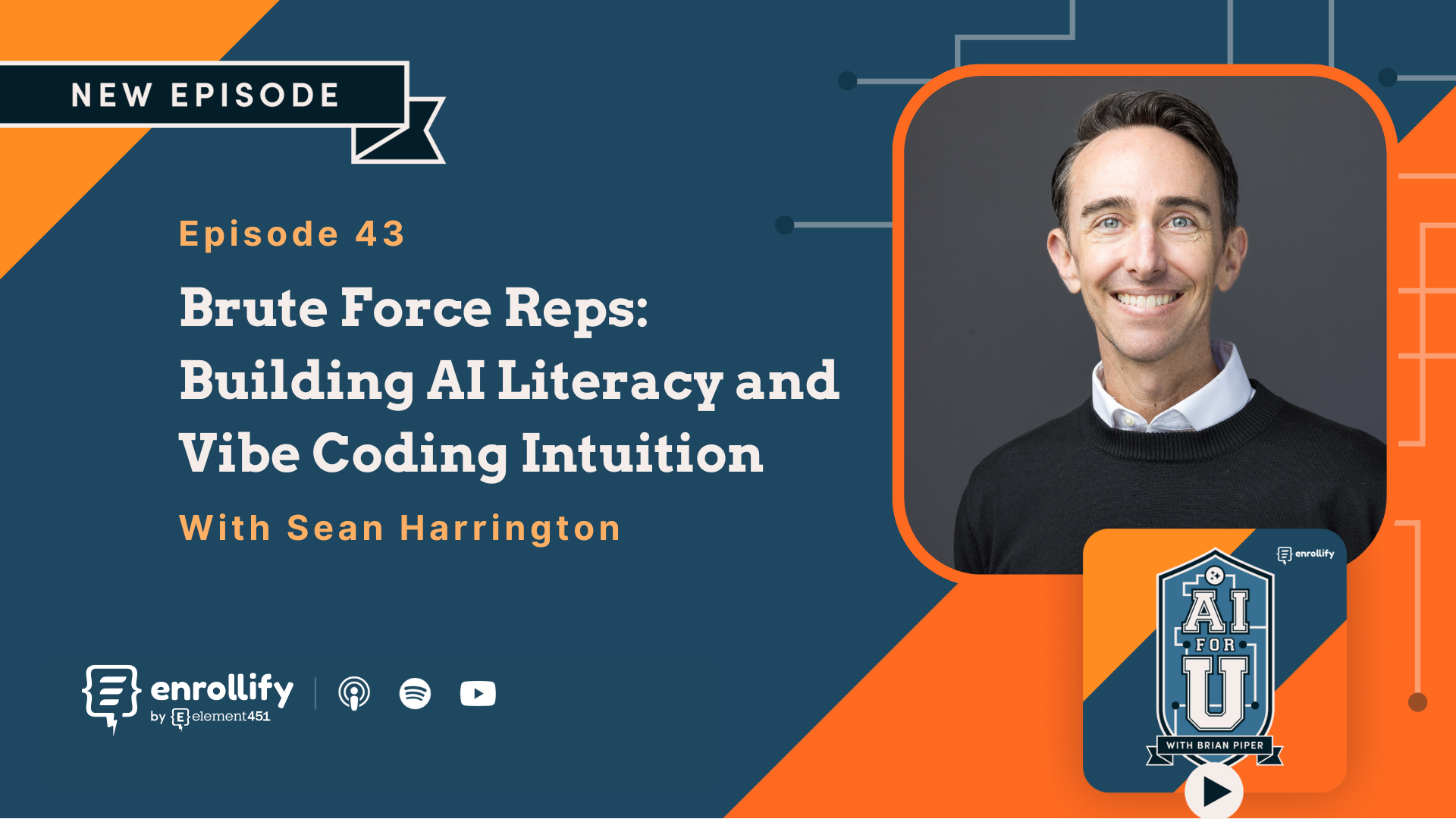
In this episode, host Brian Piper talks with Sean Harrington, Director of AI and Legal Tech Studio at ASU Law, about bridging the gap between risk-averse academia and rapid AI innovation. Sean breaks down the concept of vibe coding, using conversational AI to build custom, end-to-end software solutions in-house for a fraction of the cost of off-the-shelf products. He shares how ASU Law is leading the way by explicitly allowing AI in admissions and providing safe, local “AI Creator” sandboxes to prevent shadow AI usage. Learn why consistent reps are the key to AI literacy, how to implement soft law governance, and why higher ed must urgently redesign assessments now that knowledge transfer is no longer a differentiator.
Join us as we discuss:
- [3:33] Helping legal professionals navigate AI literacy and vibe coding local tools
- [11:10] How ASU openly addresses the use of AI in their admissions process
- [15:34] Curtailing shadow AI use by creating safe spaces for experimentation
- [22:52] Why prompt design should be part of every school’s AI governance
Check out these resources we mentioned during the podcast:
- Contact Sean at Sean.Harrington@ASU.edu
To hear this interview and many more like it, subscribe on Apple Podcasts, Spotify, or our website, or search for AI for U with Brian Piper in your favorite podcast player.
What Is Vibe Coding—and Why It Matters for Higher Education
One of the most compelling ideas from this episode is the concept of “vibe coding”—using conversational AI tools to build custom software tailored to specific institutional needs. Instead of purchasing bloated platforms that only partially solve a problem, teams can now describe their workflow in plain language and generate a working solution in hours. This marks a major shift in how ed tech tools are developed and deployed on campus.
Harrington emphasizes that the real opportunity lies in identifying bottlenecks—those repetitive, manual processes that drain time and energy. Whether it's course scheduling, admissions workflows, or data entry tasks, AI can be leveraged to eliminate friction quickly. The key is reframing the question from “What tool should we buy?” to “What problem are we solving?”
This shift is especially relevant for enrollment marketers and operations teams. With limited budgets and increasing pressure to perform, the ability to rapidly prototype solutions creates a competitive advantage. Institutions that embrace this mindset will move faster—and smarter—than those stuck in traditional procurement cycles.
How AI Is Reshaping Admissions and Student Evaluation
The conversation takes a provocative turn when discussing admissions and assessment. Harrington challenges the very foundation of what institutions are measuring, in a world where AI can assist with writing, research, and knowledge recall. If AI can generate essays, what exactly are admissions teams evaluating?
This raises deeper questions about student success strategies and performance indicators in education. If traditional assignments and take-home assessments are “dead,” as Harrington suggests, institutions must rethink how they measure critical thinking, creativity, and problem-solving. The implication is clear: AI isn’t just a tool—it’s a catalyst for systemic change.
Interestingly, AI may also level the playing field. Historically, students with access to tutors or consultants had an advantage in crafting applications. Now, AI tools provide similar support to anyone with access, potentially increasing equity in the admissions process. This creates both opportunities and challenges for institutions aiming to refine their marketing strategy for student recruitment.
Why AI Literacy and Training Are Non-Negotiable
A recurring theme throughout the episode is the importance of AI literacy. Harrington argues that most people overestimate their ability to use AI effectively, particularly when it comes to prompting. Without proper training, even the most powerful tools produce subpar results.
He advocates for short, frequent, and mandatory training sessions—moving away from outdated annual workshops. These sessions should focus on practical application, giving users real-time feedback and opportunities to iterate. This approach aligns with broader trends in higher education marketing, where agility and continuous learning are becoming essential.
Equally important is creating a culture that rewards experimentation. Institutions should celebrate not only successful use cases but also failures, as these often lead to the most valuable insights. This mindset shift is critical for teams looking to integrate AI into their daily workflows effectively.
The Hidden Risk of Shadow AI in Higher Ed
One of the most urgent challenges discussed is the rise of “shadow AI”—employees using unauthorized tools due to a lack of institutional support. When universities fail to provide robust AI platforms, staff often turn to personal accounts, creating significant data security risks.
Harrington highlights that simply offering a basic AI interface isn’t enough. If institutional tools lag behind frontier models, users will bypass them entirely. This creates a dangerous gap between policy and practice, when dealing with sensitive data like FERPA or HIPAA.
To address this, institutions must invest in tools that match the capabilities of leading AI platforms. This includes features like file integration, custom workflows, and advanced reasoning capabilities. Without this investment, governance efforts will fall short, and shadow AI will continue to grow.
Build vs. Buy: A New Era for Campus Innovation
The traditional “build vs. buy” debate is being redefined by AI. Harrington shares examples of building custom tools in an afternoon—solutions that would have previously required expensive vendors and months of development. This shift opens the door for more agile, cost-effective innovation across campuses.
However, this approach isn’t without challenges. Institutions need skilled individuals who can leverage AI tools effectively, as well as frameworks for deciding when in-house development makes sense. Data security, complexity, and scalability all play a role in this decision-making process.
Looking ahead, Harrington envisions dedicated “vibe coding teams” within universities—groups tasked with rapidly developing custom solutions for specific needs. For enrollment marketers and operations leaders, this represents a powerful opportunity to rethink how technology supports their goals.
Connect With Our Host:
Brian Piper
https://www.linkedin.com/in/brianwpiper/
Enrollify is produced by Element451 — the next-generation AI student engagement platform helping institutions create meaningful and personalized interactions with students. Learn more at element451.com.





.svg)
.svg)
