






About the Episode
About the Episode:
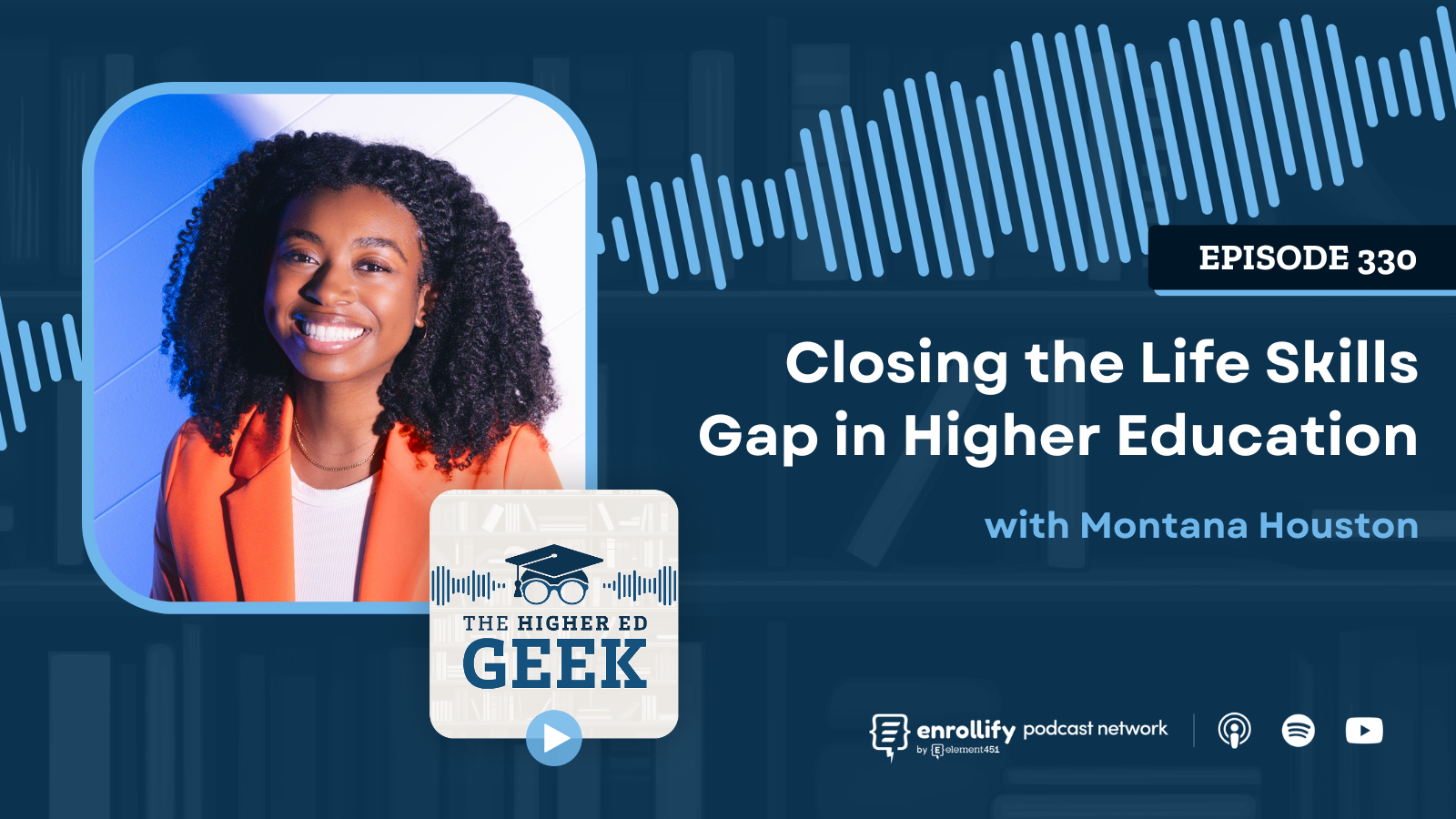
We welcome Montana Houston, founder of rYOUminate, to the show this week to chat about addressing the “hidden curriculum” of higher education—life skills like financial literacy, career readiness, and self-advocacy that many students are expected to know but are rarely taught. They explore how gaps in infrastructure and capacity have left institutions struggling to deliver this support at scale, and how personalized, tech-enabled solutions can help bridge the divide.
Throughout the conversation, Rachel explains why she believes liberal arts institutions are uniquely positioned to lead in the age of artificial intelligence. She discusses how small, residential college environments foster the kind of face-to-face dialogue, critical thinking, collaboration, and embodied learning experiences that AI cannot replicate. Rachel and Dustin unpack the growing importance of human-centered education, experiential learning, and intellectual curiosity in a world increasingly shaped by automation, algorithms, and AI-powered systems.
A major focus of the episode is Agnes Scott College’s intentional approach to universal AI instruction for first-year students. Rachel shares how the institution embedded AI fluency directly into required first-year coursework, ensuring every student develops a foundational understanding of AI ethics, bias, historical context, and professional implications regardless of their major. Rather than treating AI education as optional or reserved for technical disciplines, Agnes Scott is positioning AI literacy as a core component of a modern liberal arts education.
Rachel also introduces a compelling metaphor that frames AI tools as “unreliable narrators,” encouraging students to approach AI-generated outputs with the same critical reading skills they would use when analyzing literature. She explains why students must learn to recognize bias, rhetorical patterns, inaccuracies, and embedded assumptions within AI systems instead of blindly accepting outputs as objective truth. The conversation highlights how critical reading, skepticism, and interpretation are becoming essential workforce and life skills in an AI-driven world.
The episode also explores the intersection of AI fluency and experiential learning. Rachel details Agnes Scott’s innovative efforts to universalize study abroad opportunities, workplace immersion experiences, and interdisciplinary learning experiences during students’ first and second years. By removing barriers to participation and integrating high-impact learning experiences into the curriculum early, the college aims to democratize access to career exploration, global learning, and intellectual discovery. Dustin and Rachel discuss how experiential learning, liberal arts education, and AI literacy can work together to prepare students for a rapidly evolving future of work.
Closing out the conversation, Rachel challenges higher education leaders to rethink long-standing assumptions about selectivity, access, and institutional value in the age of AI. She argues that democratized access to information and emerging technologies should push colleges and universities to move away from gatekeeping mentalities and toward more inclusive, access-oriented educational models. The discussion ultimately reframes AI not as a threat to higher education, but as an opportunity for institutions to rethink how they cultivate curiosity, critical thinking, community, and human connection.
Key Takeaways:
- AI fluency should focus on critical thinking, interpretation, and understanding how AI systems shape meaning — not just technical proficiency.
- Liberal arts colleges are uniquely positioned to lead conversations around human-centered AI education and ethical technology use.
- Students should approach AI-generated content with skepticism and analytical reading skills similar to evaluating an unreliable narrator in literature.
- Universal AI instruction embedded into first-year curriculum helps democratize access to AI literacy across disciplines.
- Experiential learning opportunities like study abroad, workplace immersion, and interdisciplinary coursework remain essential in an AI-driven world.
- Higher education institutions should use this moment to rethink gatekeeping, access, and the purpose of modern education.
About the Show: The Higher Ed Geek Podcast explores the impact of edtech on the student experience by speaking with diverse leaders from institutions, companies, and nonprofit organizations. Each week we aim to provide an engaging, fun, and relevant dose of professional development that honors the wide range of work happening all across the higher ed ecosystem. Come geek out with us! The Higher Ed Geek Podcast is hosted by Dustin Ramsdell and is a proud member of the Enrollify Podcast Network.
Connect With Our Host:
Dustin Ramsdell
Enrollify is produced by Element451 — the next-generation AI student engagement platform helping institutions create meaningful and personalized interactions with students. Learn more at element451.com.


.svg)
.svg)
