






About the Episode
Got a story to tell? An innovative idea to share? Fill out our guest nomination form and let's chat!
About the Episode:
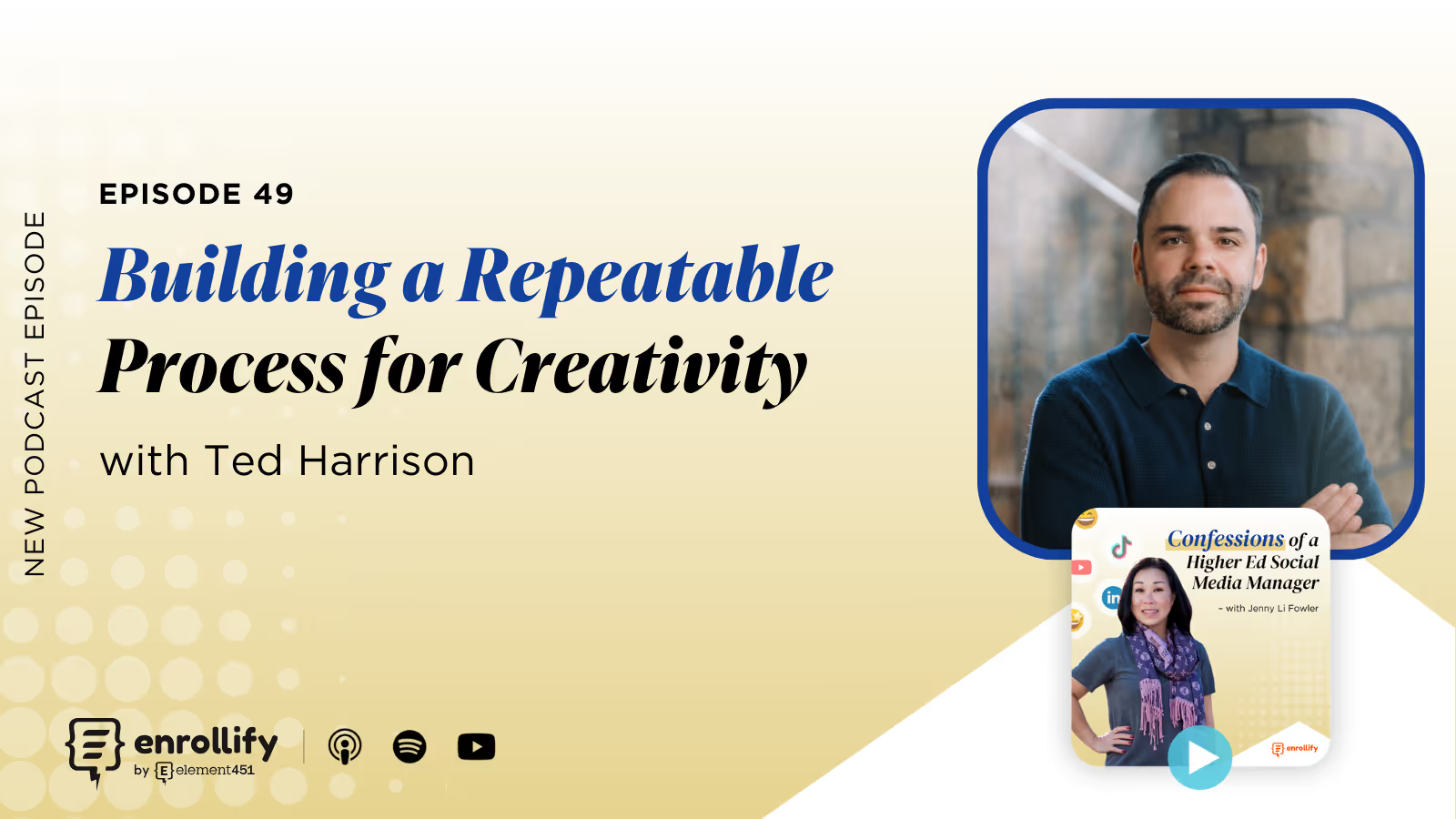
In this episode of Confessions of a Higher Ed Social Media Manager, host Jenny Li Fowler sits down with Ted Harrison, Founder and CEO of neuemotion and former Head of Advertiser Production at Twitter (yes, real Twitter). Ted brings a refreshing take on creativity in social media, debunking the myth that inspiration strikes like lightning. Instead, he shares how creative consistency is a skill—one that can be systematized, scaled, and repeated. Whether you're a burned-out content creator or a higher ed social media manager in a creative rut, this episode is full of insights that will reignite your spark.
Key Takeaways
- Creativity isn’t magic—it’s a repeatable process: Learn how to apply structure to your creative work using frameworks like the “Imperfect Distillation Method.”
- Creativity can be taught and scaled: Discover why creativity is a learned skill and how even data-driven professionals can become creative thinkers.
- Constraints fuel creativity: Using defined "guardrails" like budget, audience, and goals actually helps you generate better ideas, not limit them.
- Virality is intentional: You can't make something go viral, but you can design for it using attention frameworks rooted in psychology and human behavior.
- Context and location matter: Great social media content isn’t just about the message—it’s about when, where, and how it shows up in the feed.
- Creatives should think like entrepreneurs: Aligning creativity with business goals ensures long-term relevance, value, and impact.
- Attention is earned through rhythm and surprise: Something as simple as moving text placement in a video can increase view times by 28%.
Episode Summary
What Is the Real Secret Behind Consistent Creativity?
If you think brilliant ideas strike like lightning, think again. Ted Harrison challenges the myth of spontaneous genius and introduces a systemized approach to creativity. His “Imperfect Distillation Method” helps creatives differentiate between a fleeting concept and a real idea—the kind you can take action on. This method involves asking seven clarifying questions (like “Do I have the resources to pull this off?” and “Can I explain this in under 50 words?”), which help refine raw thoughts into executable strategies. For higher ed marketers constantly stuck on the content treadmill, this practical framework offers a lifeline.
Ted also makes a compelling argument for setting guardrails—not as limitations, but as creativity accelerators. Whether it’s budget, platform, audience, or format, constraints actually make the creative process more efficient and scalable. For social media managers juggling multiple deadlines and limited resources, Ted’s process provides both a roadmap and permission to not rely on sudden inspiration to do great work.
How Do You Stay Creative When You’re Burnt Out?
Jenny and Ted explore the daily grind of higher ed social media management, where creativity is expected on-demand. The reality? Most social media managers are always on—brainstorming campaigns, editing content, responding to comments—and creative burnout is real. Ted’s antidote? Create your “map” before you build your “world.” Just like fantasy authors (think J.R.R. Tolkien or C.S. Lewis), setting boundaries first allows you to navigate creative challenges with more ease.
He also talks about building habits that prioritize idea development over “eureka moments.” Dedicating 30 minutes a day to refining concepts, asking smart questions, and documenting your thought process creates muscle memory for creativity. Jenny likens this process to becoming your own brainstorming partner—and we love that metaphor. It's not about waiting for your creative muse to show up; it's about inviting her to your scheduled work session.
This method also lends itself to team scalability. If you can document your idea-generation process, you can train others on it. For higher ed marketers leading small but mighty teams, that’s a game-changer.
Can Creativity and Business Goals Actually Coexist?
Absolutely, and Ted makes a strong case for why they should. Through his book, Entrepreneurial Creativity, he introduces the concept of the “entrepreneurial creative”—someone who understands that creativity must have a bottom line. In higher education, where social media efforts are often tied to measurable outcomes like enrollment, engagement, or brand affinity, creativity must be aligned with strategic goals.
Ted cites a staggering stat: only about 20% of people with creative degrees are still working creatively by age 25. Why? Because most creatives aren’t taught how to speak the language of business. His mission is to bridge that gap—to empower creatives to thrive in professional environments by learning how to connect ideas to outcomes.
Jenny echoes this in her own experience. As her role has evolved, she’s had to shift from being a creative “doer” to a strategic thinker. Ted’s framework allows for both. It's not about abandoning creativity—it's about evolving it so that it continues to make a meaningful impact.
How Do You Design Content That Grabs—and Keeps—Attention?
Ted's background at Twitter (and yes, he was there when it was still Twitter) gave him an inside look at what really drives attention. One core insight: attention is a neurological response to context and location. Our brains crave clarity and pattern—but also surprise. That’s why moving captions around on a video can increase view time by 28%. It's about continuously re-engaging the viewer’s attention, not just grabbing it once at the top.
For higher ed marketers aiming to boost engagement, Ted recommends thinking about attention in terms of levers. Push the context lever by asking: “Why should this matter to my audience right now?” Pull the location lever by considering where your message shows up and how it’s visually delivered.
And remember: virality is not about luck, it’s about design. The content that spreads often taps into universal human truths, emotions, or shared experiences. For universities trying to connect with prospective students, parents, or alumni, that emotional resonance is the key to cutting through the digital noise.
About the Show: Confessions of a Higher Ed Social Media Manager covers the do's, don'ts, and dynamics of the complex and challenging social media ecosystem. We analyze the successes and failures of those in the higher education social space — what went right, what went wrong, and what are the lessons learned. We’ll share actionable steps so you can push past the pitfalls others have faced. No matter if you're on a team of 20 or a team of one, we've got you covered. Confessions of a Higher Ed Social Media Manager is hosted by Jenny Li Fowler and is a proud member of the Enrollify Podcast Network.
Connect With Our Host:
https://twitter.com/TheJennyLi
About The Enrollify Podcast Network:
Confessions of a Higher Ed Social Media Manager is a part of the Enrollify Podcast Network. If you like this podcast, chances are you’ll like other Enrollify shows, too!
Some of our favorites include Higher Ed Pulse and Confessions of a Higher Ed CMO.
Enrollify is produced by Element451 — the next-generation AI student engagement platform helping institutions create meaningful and personalized interactions with students. Learn more at element451.com.
Register for the AI Engage Summit — Oct 15–16, 2025
👉 Join us online from 12–4 PM ET each day for two afternoons of AI insights and training. Free to attend with on-demand access included. Register now.







.svg)
.svg)
