






About the Episode
The AI Engage Summit is a free, virtual experience built to help higher ed leaders actually do something with AI. Over two afternoons, you’ll hear from peers, see practical demos, and walk away with ideas you can use immediately — no travel required, no cost to attend. If you’re ready to move AI from “interesting” to “impactful,” this is the place to be. Register now, don't miss out.
About the Episode:
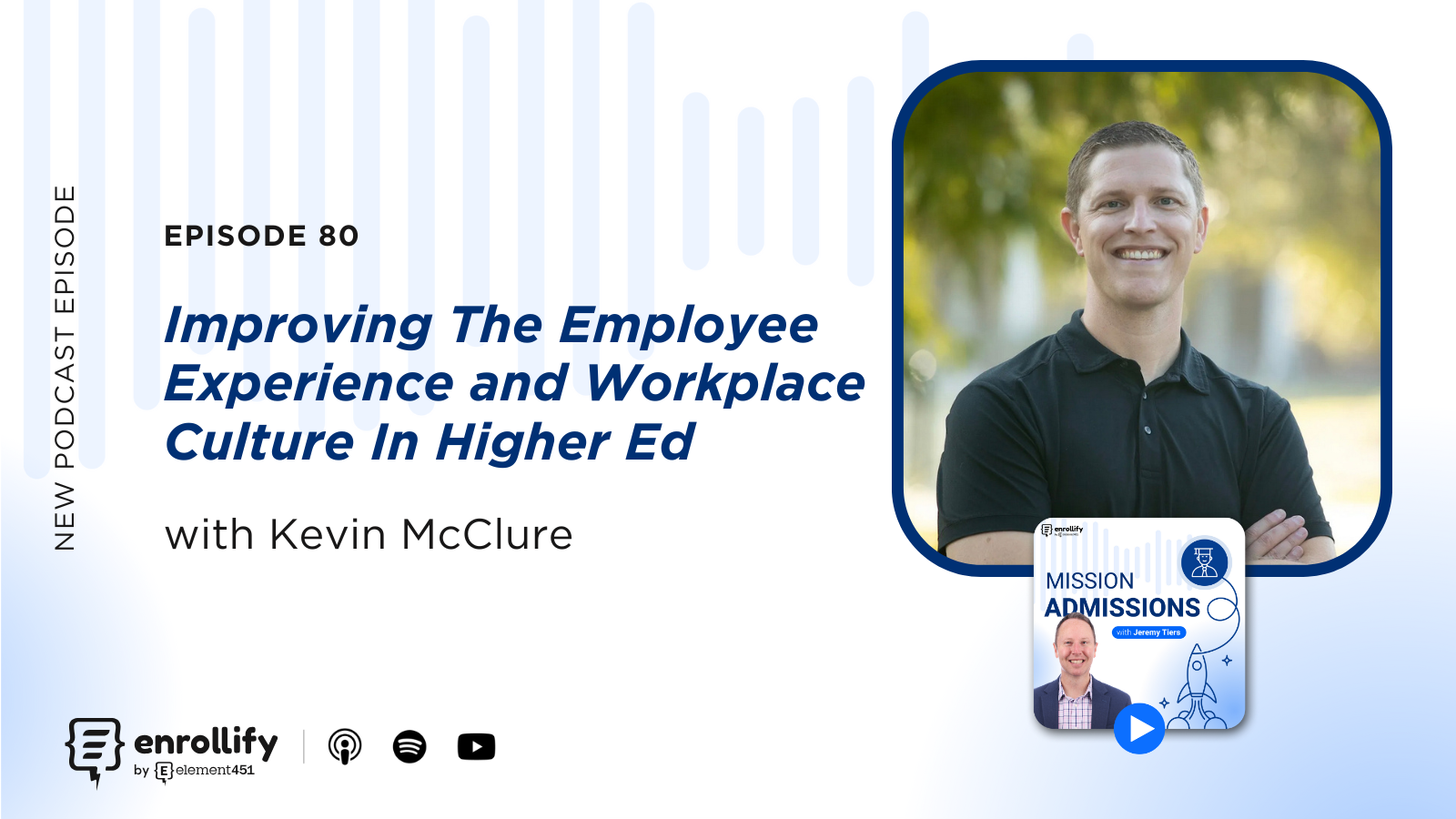
In this episode of Mission Admissions, host Jeremy Tiers chats with Dr. Kevin McClure about the employee experience in Higher Ed - why it needs to be a higher priority for most colleges and universities, and how leaders can start to make transformational change.
Whether you're a VP of enrollment, department chair, or an aspiring leader in higher ed, this episode offers a provocative and practical roadmap for making employee experience a strategic priority.
Key Takeaways
- Why employee experience remains a low priority in most institutional strategic plans—despite its direct impact on student success
- How outdated organizational structures and "do more with less" mindsets are fueling burnout and turnover in higher ed
- The connection between performance indicators in education and toxic work cultures—and why it's time to rethink what success looks like
- How to measure and improve employee engagement beyond anonymous surveys and one-off appreciation days
- The real root causes of burnout—and why value-driven professionals are especially at risk
- Why transformational change is so hard in higher ed—and what to do about it
- Practical steps for leaders to make employee well-being a priority even if the institution doesn’t
- Why The Caring University was written—and why every campus leader should read it
Episode Summary
Why Isn’t Employee Experience a Strategic Priority in Higher Ed?
Jeremy opens the episode with a bold question: why is the employee experience so often absent from campus strategic plans? Dr. McClure points to a long-standing tradition in higher ed that prioritizes academic excellence, financial sustainability, and the student experience—while taking the labor behind those outcomes for granted. Over time, employees have been treated as tools to achieve goals, not as stakeholders in need of support.
Dr. McClure argues that the burnout epidemic and turnover trends—especially post-COVID—are signs of this systemic neglect. And while the student experience is undeniably important, ignoring the well-being of those responsible for delivering that experience ultimately undermines the institution’s mission. His message is clear: you can’t deliver exceptional student success strategies if your staff is chronically overworked and under-supported.
What’s Fueling Burnout in Higher Ed?
The conversation then shifts to burnout—its origins, evolution, and why it’s especially prevalent in service-based professions like education. Kevin explains how burnout isn’t just about stress; it’s about the prolonged inability to recover from it. The real danger lies in how higher ed professionals—driven by deeply held values—push through exhaustion for the sake of students, only to crash later.
Jeremy and Kevin discuss how higher ed org structures frequently assign multiple full-time roles to a single staff member, compounding the issue. And because burnout often stems from institutional design—rather than individual failure—it’s a problem leaders must take ownership of solving.
How Do Institutional Choices Worsen Burnout?
Dr. McClure emphasizes that much of the burnout and low morale on campuses is self-inflicted. Higher ed institutions frequently chase prestige, rankings, or aspirational goals without assessing the true human cost. He shares examples of institutions pursuing high-status affiliations, like AAU membership, without clear ROI—at the expense of their employees.
He encourages leaders to re-evaluate how they make strategic choices: Are you creating more stress than value? Are goals being pursued at the cost of your people? Kevin’s advice: be ruthlessly clear on what your unit can take on, and resist the pressure to do everything all at once.
Why Is Higher Ed So Resistant to Change?
Is higher ed bad at change? Maybe not. As Kevin puts it, “We’re changing all the time—but not always in the right direction.” The problem, he says, is that change is often reactive, top-down, and lacking a compelling “why.” Leaders frequently skip the crucial step of helping staff understand the purpose behind a shift—resulting in resistance or confusion.
True cultural change—especially the kind that improves employee experience—requires institutions to hire or empower people specifically to lead that transformation. As Jeremy notes, the Fortune 500 world already has roles like Chief Experience Officer. Higher ed needs to catch up.
What Can Leaders Do to Prioritize Employee Experience?
Even if your institution hasn’t made employee well-being a formal goal, you still have agency as a leader. Kevin outlines three key first steps:
- Clarify your personal “why”—understand and communicate why investing in people matters to you as a leader.
- Gather meaningful feedback—move beyond hallway chats to pulse surveys, exit interviews, and anonymous listening efforts that actually surface problems.
- Close the loop—employees need to see that their input leads to action. Transparency and follow-through are crucial to rebuilding trust.
As Jeremy adds, something as simple as never canceling a one-on-one can send a powerful message. When leaders show up consistently, they create space for honest dialogue—and ultimately stronger teams.
What Are Some Small but Powerful Changes Leaders Can Make?
Wrapping up, Kevin shares the impact of making the invisible visible. Small shifts—like making space for feedback, acknowledging what's not working, or transparently advocating for your team—can transform culture. He emphasizes that leaders should focus on what they can control, even if the institution isn’t fully aligned yet.
The big takeaway? Culture change doesn’t always start at the top—it often begins with mid-level leaders modeling what’s possible. If you’re managing people, you have the power (and responsibility) to lead differently.
Connect With Our Host:
Jeremy Tiers
https://twitter.com/CoachTiers





.svg)
.svg)
