


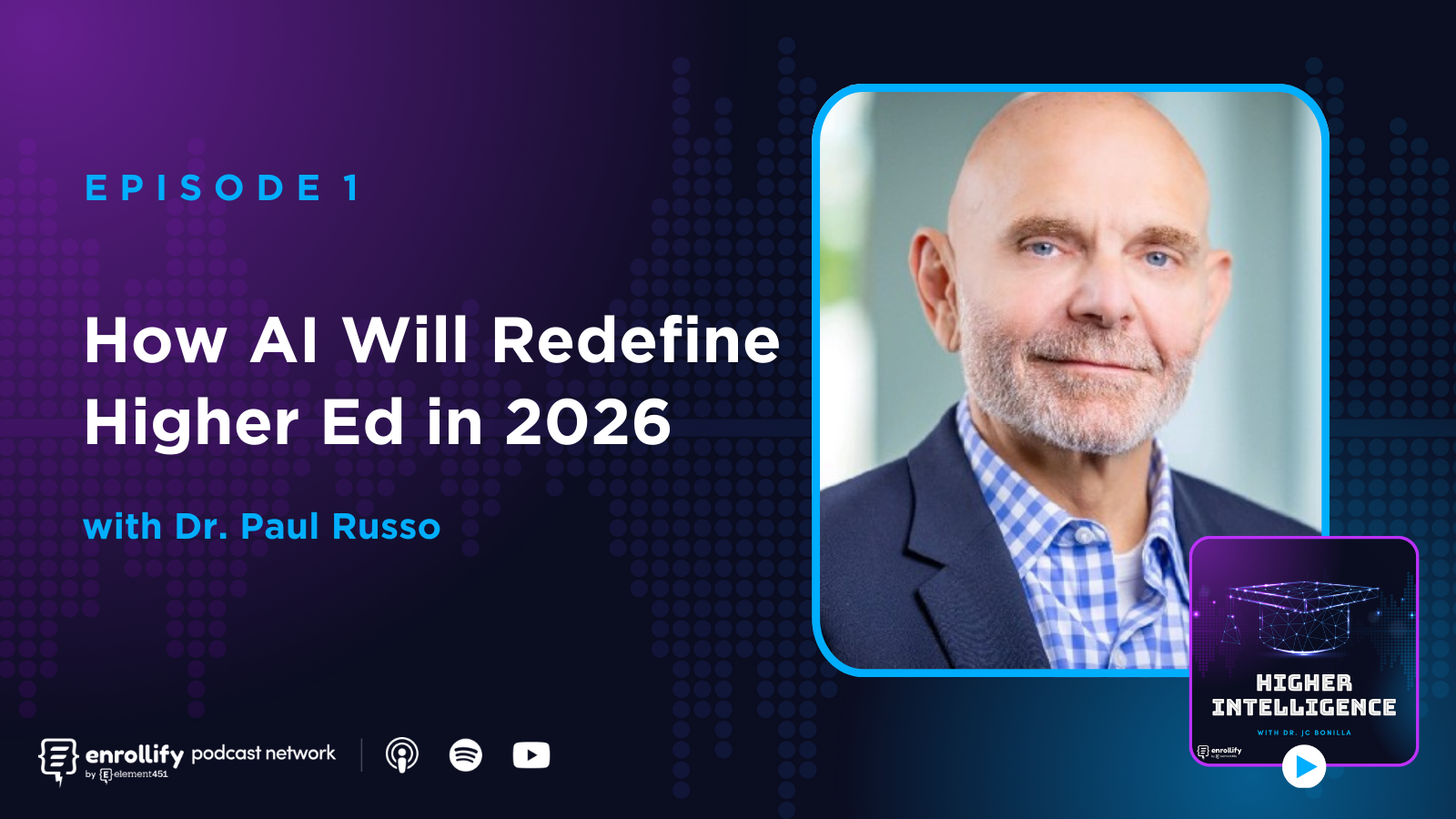




About the Episode
The AI Engage Summit is a free, virtual experience built to help higher ed leaders actually do something with AI. Over two afternoons, you’ll hear from peers, see practical demos, and walk away with ideas you can use immediately — no travel required, no cost to attend. If you’re ready to move AI from “interesting” to “impactful,” this is the place to be. Register now, don't miss out.
About the Episode:
JC Bonilla sits down with Dr. Paul Russo, Vice Provost and Founding Dean of the Katz School of Science and Health at Yeshiva University. Together, they break down AI trends reshaping the future of higher education. From autonomous agents and ambient AI to data infrastructure and institutional readiness, this episode unpacks what’s hype and what’s real — and what campus leaders should be doing now to avoid getting left behind.
If you care about AI in higher education and how emerging tech is driving deep operational and pedagogical change, this is the episode for you.
Key Takeaways
- AI agents are already handling up to 80% of repetitive student service tasks — and satisfaction rates are comparable to human interactions.
- Data infrastructure is the fuel for effective AI; without clean, contextual data, AI tools can't deliver real value.
- Institutions that start integrating AI now will gain compounding advantages over laggards — potentially locking in long-term competitive edges.
- AI literacy is no longer optional; it’s a strategic imperative for both faculty and staff across the institution.
- The shift from “intentional computing” to “ambient AI” — always-on, always-listening tech — is coming faster than most campuses are prepared for.
- Higher ed leaders need to define who owns AI strategy on campus, or risk a chaotic, siloed approach to implementation.
Episode Summary
What is "Agentic AI" and Why Should Higher Ed Care?
The first big prediction explored in this episode is the rise of AI agents — not just chatbots, but autonomous systems capable of executing multi-step tasks with little or no human oversight. From automating procurement to triaging student advising queries, AI agents are already being used to scale operations without compromising on responsiveness. According to JC and Paul, the sweet spot lies in freeing up staff from repetitive tasks so they can focus on high-touch student engagement — a perfect example of human-AI collaboration.
FAQ: What’s the difference between a chatbot and an AI agent?
AI agents use memory, planning, tool usage, and goal orientation — they can do more than respond. They take action, learn, and adapt.
How Important Is Data Infrastructure in AI Implementation?
Prediction #2 is all about context engineering. You can’t have intelligent agents without clean, accessible, and well-integrated data. Most campuses operate with fragmented systems — SIS, CRM, LMS — that don’t communicate. JC likens it to buying a Ferrari and fueling it with tap water. Dr. Russo adds that strategic leadership is critical: before you fix the data problem, someone has to own the AI strategy across departments.
FAQ: What data do I need for AI to work effectively?
At minimum: identity context, behavioral patterns, historical trends, and institutional policies. AI needs a 360-view to act intelligently.
Is "Ambient AI" the Next Leap — and Should Campuses Be Concerned?
Prediction #4 veers into the experimental with ambient AI — always-on, wearable tech that senses and assists without being prompted. Think: smart pendants or AI earbuds proactively offering help. While it’s not mainstream in higher ed yet, JC believes this tech is closer than we think. Paul voices concern about privacy and comfort, questioning whether students and staff are ready for a world of 24/7 monitoring.
FAQ: Will ambient AI invade my privacy?
This tech raises ethical questions, especially around consent and data storage. It's coming — but regulation and trust will determine how it's received.
Will Early Adopters Pull Ahead... Permanently?
Prediction #5 centers on AI maturity as a strategic differentiator. Institutions that begin now will not only improve efficiency but also shape how learning and operations are reimagined. JC warns that the gap between early adopters and laggards may soon become permanent. Paul agrees — but encourages universities to start small: pick two or three high-impact areas and build from there.
FAQ: What’s the risk of waiting on AI implementation?
Losing relevance. Prospective students are interacting with AI daily; if your campus doesn’t meet those expectations, they’ll notice.
What’s the New Standard for AI Literacy?
Prediction #6 is perhaps the most urgent: AI literacy will soon be table stakes. Not just for IT teams — but for every administrator, faculty member, and staffer. Paul outlines four layers of literacy: functional (tool use), critical (understanding output), ethical (knowing where the data comes from), and strategic (deciding when and how to use AI). In short: everyone will need to be more tech-curious — or risk being left behind.
FAQ: What skills should my staff have in an AI-native campus?
Comfort with AI tools, ability to assess outputs, understanding of privacy laws, and openness to change — across all departments.
From redefining student support to transforming how campuses operate, AI is no longer a futuristic concept — it's the new reality in higher education. The big takeaway from this episode? You don’t need to boil the ocean, but you do need to start somewhere. Whether that’s automating admissions FAQs, unifying your data, or training your staff in AI tools, now’s the time to act.
Connect With Our Host:
Enrollify is produced by Element451 — the next-generation AI student engagement platform helping institutions create meaningful and personalized interactions with students. Learn more at element451.com.




.svg)
.svg)
