


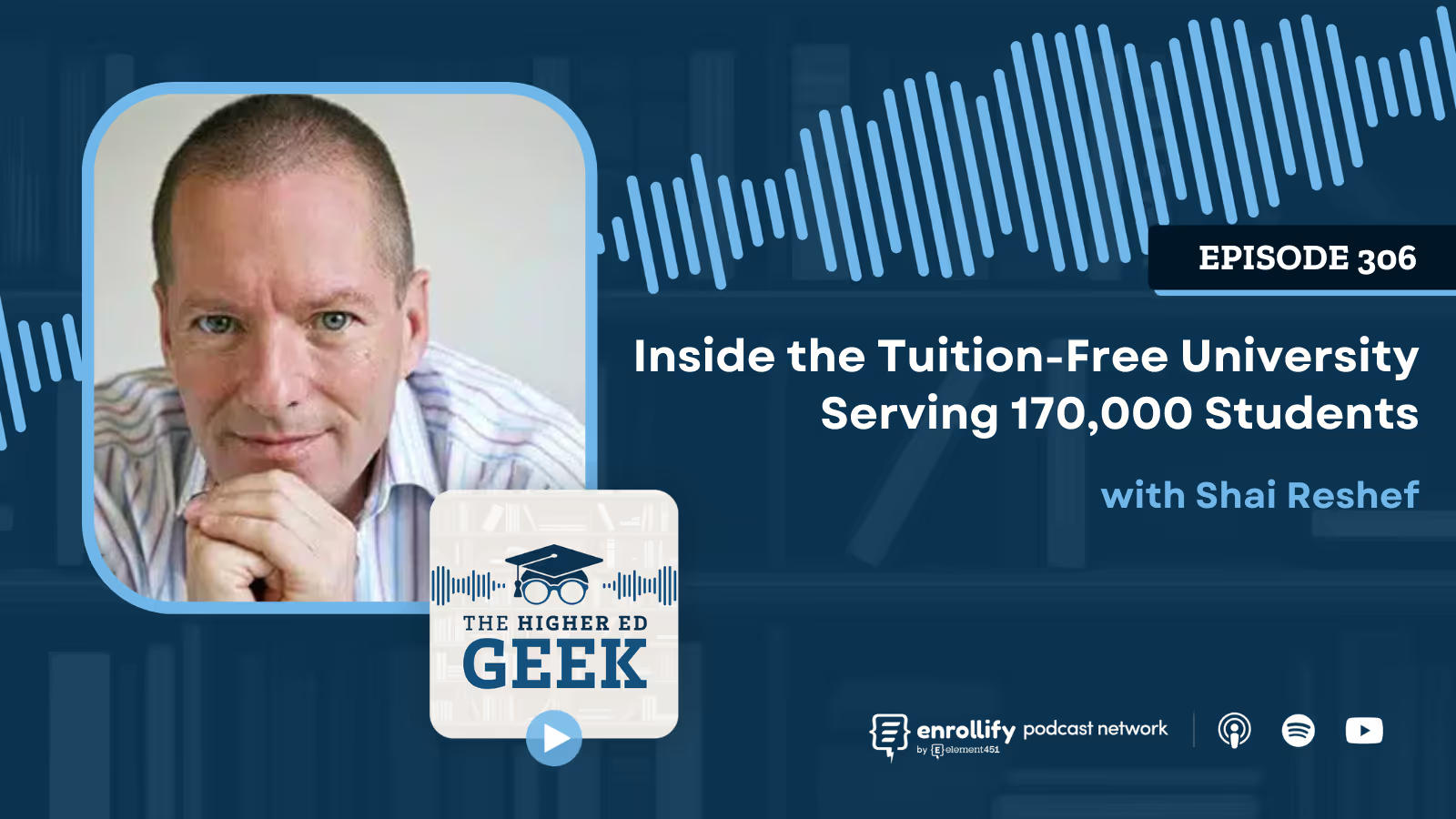




About the Episode
Got a story to tell? An innovative idea to share? Fill out our guest nomination form and let's chat!
About the Episode:
Shai Reshef, founder of University of the People, joins Dustin to share how his radically accessible, tuition-free, accredited online university is scaling globally and rewriting the rules of what college can be. From refugee learners in conflict zones to first-generation students from all over the world, University of the People is serving 170,000+ students with a bold vision: higher ed should be affordable, flexible, and job-relevant.
This episode is a masterclass in educational innovation, AI integration, and mission-driven leadership.
Key Takeaways
- University of the People is the world’s first tuition-free, non-profit, accredited online university—serving over 170,000 students across 200+ countries and territories.
- Access and affordability are at the core of their mission, with a focus on serving marginalized populations including refugees, first-generation students, and underserved women.
- AI in higher education is transforming both academic and administrative functions—from personalized learning pathways to predictive analytics for student success.
- Online learning has gained widespread legitimacy post-COVID, and Shai argues it's now essential to rethink outdated delivery models.
- The institution’s modular approach with stackable certificates and degrees offers flexible, job-ready pathways aligned with market needs.
- Higher ed leaders must adapt to changing student expectations and economic realities, or risk irrelevance.
- University of the People is a proof-of-concept for how to scale quality, affordable higher education globally—and Reshef calls on others to replicate and innovate.
Episode Summary
What is the University of the People and why does it matter?
Founded in 2009 by Shai Reshef, University of the People (UoPeople) is the first non-profit, tuition-free, accredited online university. With a mission to democratize higher education, UoPeople provides access to learners who are otherwise shut out—whether due to financial, geographic, or political barriers. Today, the university boasts 170,000 students globally and over 47,000 volunteers, all while being fully accredited by WASC, the same accreditor for Stanford, UCLA, and Berkeley.
This episode dives into the origin story of UoPeople, highlighting Reshef's transition from a for-profit education entrepreneur to a mission-driven education reformer. Reshef saw the untapped potential of open-source technology, open educational resources, and global faculty collaboration as tools to radically reimagine access to higher education. His realization: everything that makes higher ed expensive can now be offered affordably—or even freely—with the right model.
How has the online learning landscape evolved since COVID?
COVID-19 was a global accelerator for online education, and University of the People was uniquely positioned for the moment. As traditional universities scrambled to transition online, UoPeople had already refined its model for over a decade. The pandemic validated the viability—and necessity—of high-quality, accessible online education. Reshef notes that today, nearly every student in the U.S. takes at least one online course, and many institutions now offer entire degree programs online.
Reshef emphasizes that online learning offers clear advantages: flexibility, personalization, and accessibility. Students can study at their own pace, rewatch lectures, and tailor their experience to their learning style. Yet, the broader higher ed sector still struggles to adapt. Reshef urges institutions to evolve their delivery models, pricing structures, and degree offerings if they want to remain relevant in a landscape that now values adaptability and access over tradition.
What role is AI playing in improving student outcomes?
Artificial intelligence in higher education is a game-changer, according to Reshef. At UoPeople, AI is already enhancing the entire student journey—from enrollment and academic advising to course development and risk mitigation. One standout application is AI-powered student success strategies: the university uses predictive analytics to identify at-risk students and intervene before it's too late. This helps reduce attrition and optimize learning outcomes.
On the academic front, AI enables the creation of personalized learning pathways. Different learners have different needs—some prefer video, others reading, others interactive engagement. AI can tailor content delivery to match these preferences. Additionally, it can surface content aligned with a learner’s interests, making the learning experience more engaging. Importantly, Reshef doesn’t believe AI will replace instructors; rather, it will free up faculty to focus on the work that only humans can do—empathy, mentorship, and nuanced feedback.
How is UoPeople adapting to changing learner needs?
To meet the evolving expectations of today’s students, UoPeople is moving toward more modular and stackable credentials. Students can begin by earning certificates that make them immediately employable, and later stack these into associate’s or bachelor’s degrees if they choose. This flexible, job-aligned approach helps learners enter the workforce faster while still building toward long-term educational goals.
The institution also continues to expand its reach to vulnerable populations. Currently, it serves over 34,000 refugees and internally displaced persons, and 5,400 Afghan women studying from home under oppressive regimes. The impact stories are powerful: students moving from refugee camps to international careers, or from online classrooms in Afghanistan to PhD programs at Carnegie Mellon. This is education as empowerment—at scale.
What advice does Shai Reshef have for higher ed leaders?
Reshef’s advice to students is simple: pursue higher education whenever and however you can—especially if cost or flexibility is a barrier. For higher ed institutions, his message is more urgent: face the reality that the traditional model is unsustainable for the vast majority. Rather than doubling down on marketing outdated offerings, innovate your programs, rethink your pricing, and lean into scalable solutions.
He encourages institutions to view AI not as a threat but as a tool for enhancing the human side of education. It’s not about replacing faculty or advisors—it’s about equipping them to serve more students better. Ultimately, Reshef sees University of the People as a proof of concept—and he wants others to replicate the model in their own way. The world needs more affordable, accessible education options, and the tools to build them are already here.
About the Show: The Higher Ed Geek Podcast explores the impact of edtech on the student experience by speaking with diverse leaders from institutions, companies, and nonprofit organizations. Each week we aim to provide an engaging, fun, and relevant dose of professional development that honors the wide range of work happening all across the higher ed ecosystem. Come geek out with us! The Higher Ed Geek Podcast is hosted by Dustin Ramsdell and is a proud member of the Enrollify Podcast Network.
Connect With Our Host:
Dustin Ramsdell
About The Enrollify Podcast Network:
The Higher Ed Geek is a part of the Enrollify Podcast Network. If you like this podcast, chances are you’ll like other Enrollify shows too!
Some of our favorites include Generation AI.
Enrollify is produced by Element451 — the next-generation AI student engagement platform helping institutions create meaningful and personalized interactions with students. Learn more at element451.com.



.svg)
.svg)
