


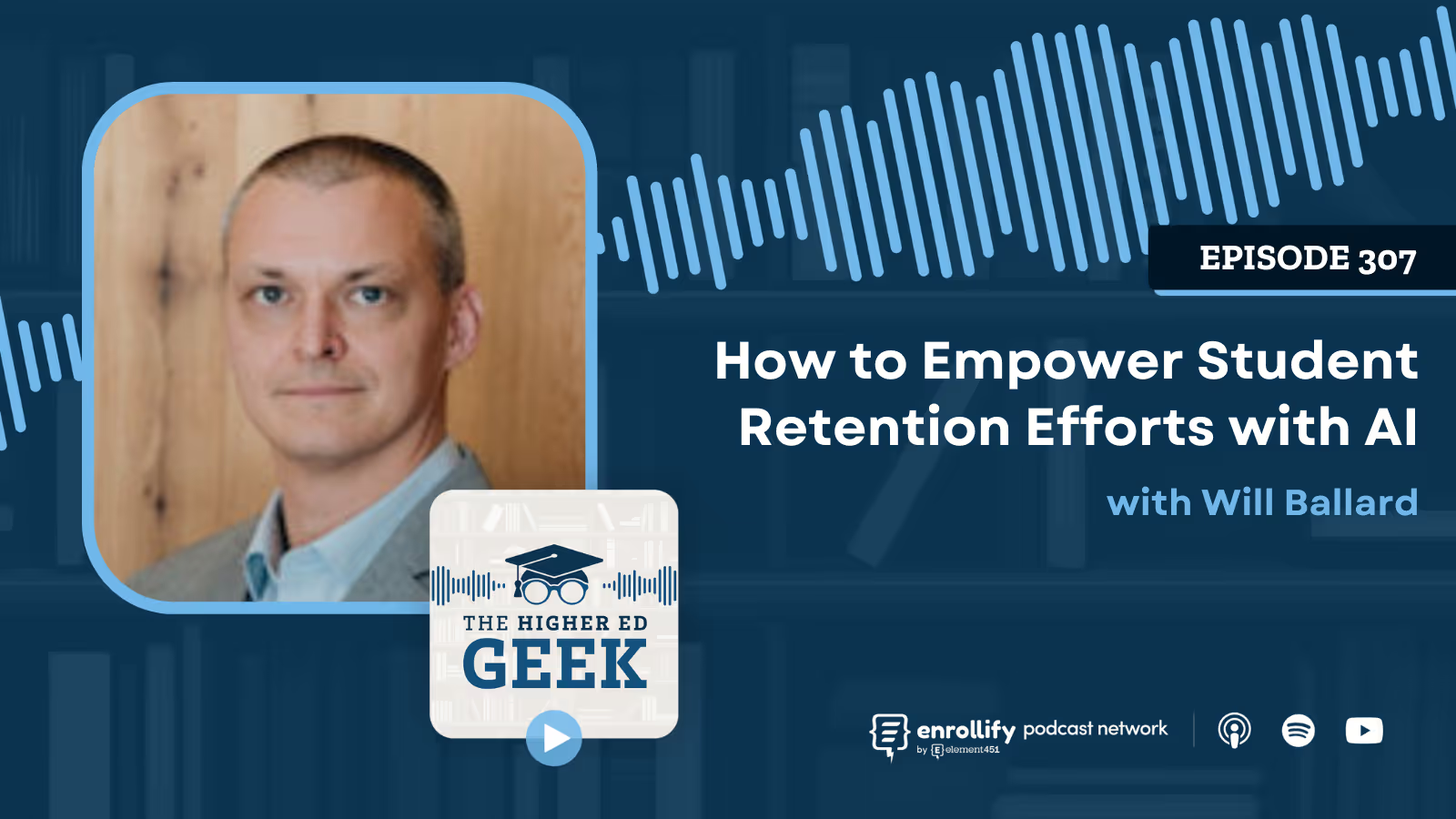




About the Episode
Got a story to tell? An innovative idea to share? Fill out our guest nomination form and let's chat!
About the Episode:
What if your student success team had AI-powered tools that could prep meeting notes, flag at-risk students in real time, and prove the ROI of your campus programs—all without needing “perfect” data? In this episode, Civitas Learning CEO Will Ballard breaks down how their platform makes this possible.
From demystifying data integration to showcasing real-world use cases of predictive and generative AI, Will shares a refreshingly honest and technical take on what higher ed institutions can (and should) be doing right now to increase student retention and graduation outcomes.
Key Takeaways
- AI in higher education is no longer futuristic—it’s essential. Institutions must leverage predictive and assistive AI to improve student outcomes and drive proactive interventions.
- Clean data isn't a prerequisite for success. Civitas Learning proves that actionable insights can be derived even from imperfect data sets.
- Daily data updates enable real-time engagement, allowing advisors to spot and respond to student needs before it's too late.
- Three categories of AI matter most in student success: predictive AI (early risk identification), assistive AI (streamlining advisor workflows), and agentic AI (automating backend prep and reporting).
- Unified data dashboards and AI-powered meeting prep save advisors significant time, allowing them to focus more on human connection than admin work.
- Real impact measurement through initiative analysis helps institutions assess which student success programs are delivering ROI.
- Change management and cultural shifts are just as important as technology when implementing new tools—Civitas offers support for both.
- AI isn't here to replace humans—it's here to help them be more human in their work.
Episode Summary: AI, Data, and the Future of Student Support
How is AI Being Used to Improve Student Success?
Will Ballard outlines the three core areas where artificial intelligence is driving real transformation in higher education: predictive AI, assistive AI, and agentic AI. Predictive AI helps institutions identify which students are at risk of dropping out—early enough to intervene. Assistive AI enables advisors to automate things like note-taking and meeting prep, using tools that transcribe and summarize in-person conversations in real time. And agentic AI is essentially your new assistant—it automates routine tasks like gathering student data across multiple systems before advising meetings, so staff can spend less time toggling and more time connecting.
What makes this especially compelling is that Civitas isn’t jumping on the AI bandwagon—they’ve been building tools with AI at the core for over a decade. Their platform doesn’t just spot a problem—it helps prevent it.
Do You Need “Clean Data” to Get Started with Predictive Analytics?
Spoiler alert: no, you don’t. Will passionately debunks one of the most common myths in higher ed tech—that you need perfectly clean data before you can start using it effectively. He argues that what most institutions think of as “dirty” data is often just “difficult to use” data, and that AI is remarkably good at making sense of messiness.
In fact, Civitas has built proprietary systems that normalize, validate, and clean incoming data so that institutions can start driving outcomes today, not six months from now. Will even draws a compelling comparison to LLMs like ChatGPT, which were trained on the internet—arguably the messiest data source of all—and yet still produce meaningful insights.
What’s the Real Value of Frequent Data Updates?
One of the big differentiators with Civitas is their daily data refresh cycle, compared to traditional IR departments that often pull data once a term. Will emphasizes that frequency is everything—especially if your goal is early intervention. If a student logs out and doesn’t engage for several days, that’s a signal. If they miss key assignments or disengage from discussion boards, that’s a risk. Advisors need that information in real time to be truly proactive, not reactive.
Will also points out that Civitas builds custom AI models for each institution. There’s no “one-size-fits-all” national model; every campus has its own culture, metrics, and student demographics. Civitas taps into the unique history and trends at your school to generate highly accurate predictions.
How Does AI Help (Not Replace) Advisors?
There’s a growing fear in some corners of higher ed that AI could make student support roles obsolete. Will addresses this head-on: “AI is not replacing humans. It’s helping you be more human.” Instead of spending 30 minutes prepping for a 30-minute meeting, advisors can let the AI do the heavy lifting—pulling transcripts, LMS activity, case notes, and more into a summary view. This frees up advisors to actually listen, connect, and respond to student needs in the moment.
Civitas’ assistive tools also automate standardized meeting notes, so compliance and data entry don't burden advisors during face-to-face time with students. The result? Greater efficiency, less burnout, and more meaningful student support.
How Can Institutions Measure the ROI of Student Success Programs?
Through a powerful feature called Initiative Analysis, Civitas helps institutions measure whether specific student success programs—like tutoring labs or free meal initiatives—actually move the needle on persistence, GPA, or graduation rates. This feature allows schools to simulate controlled trials by comparing program participants with statistically similar peers who didn’t engage.
The insights are invaluable. For leaders facing tough budget decisions, knowing what programs drive real outcomes (and which ones don’t) can reshape where time and money are invested. This kind of impact measurement also helps prove the value of student success teams to executive leadership and board members.
About the Show: The Higher Ed Geek Podcast explores the impact of edtech on the student experience by speaking with diverse leaders from institutions, companies, and nonprofit organizations. Each week we aim to provide an engaging, fun, and relevant dose of professional development that honors the wide range of work happening all across the higher ed ecosystem. Come geek out with us! The Higher Ed Geek Podcast is hosted by Dustin Ramsdell and is a proud member of the Enrollify Podcast Network.
Connect With Our Host:
Dustin Ramsdell
About The Enrollify Podcast Network:
The Higher Ed Geek is a part of the Enrollify Podcast Network. If you like this podcast, chances are you’ll like other Enrollify shows too!
Some of our favorites include Generation AI.
Enrollify is produced by Element451 — the next-generation AI student engagement platform helping institutions create meaningful and personalized interactions with students. Learn more at element451.com.


.svg)
.svg)
