






About the Episode
The AI Engage Summit is a free, virtual experience built to help higher ed leaders actually do something with AI. Over two afternoons, you’ll hear from peers, see practical demos, and walk away with ideas you can use immediately — no travel required, no cost to attend. If you’re ready to move AI from “interesting” to “impactful,” this is the place to be. Register now, don't miss out.
About the Episode:
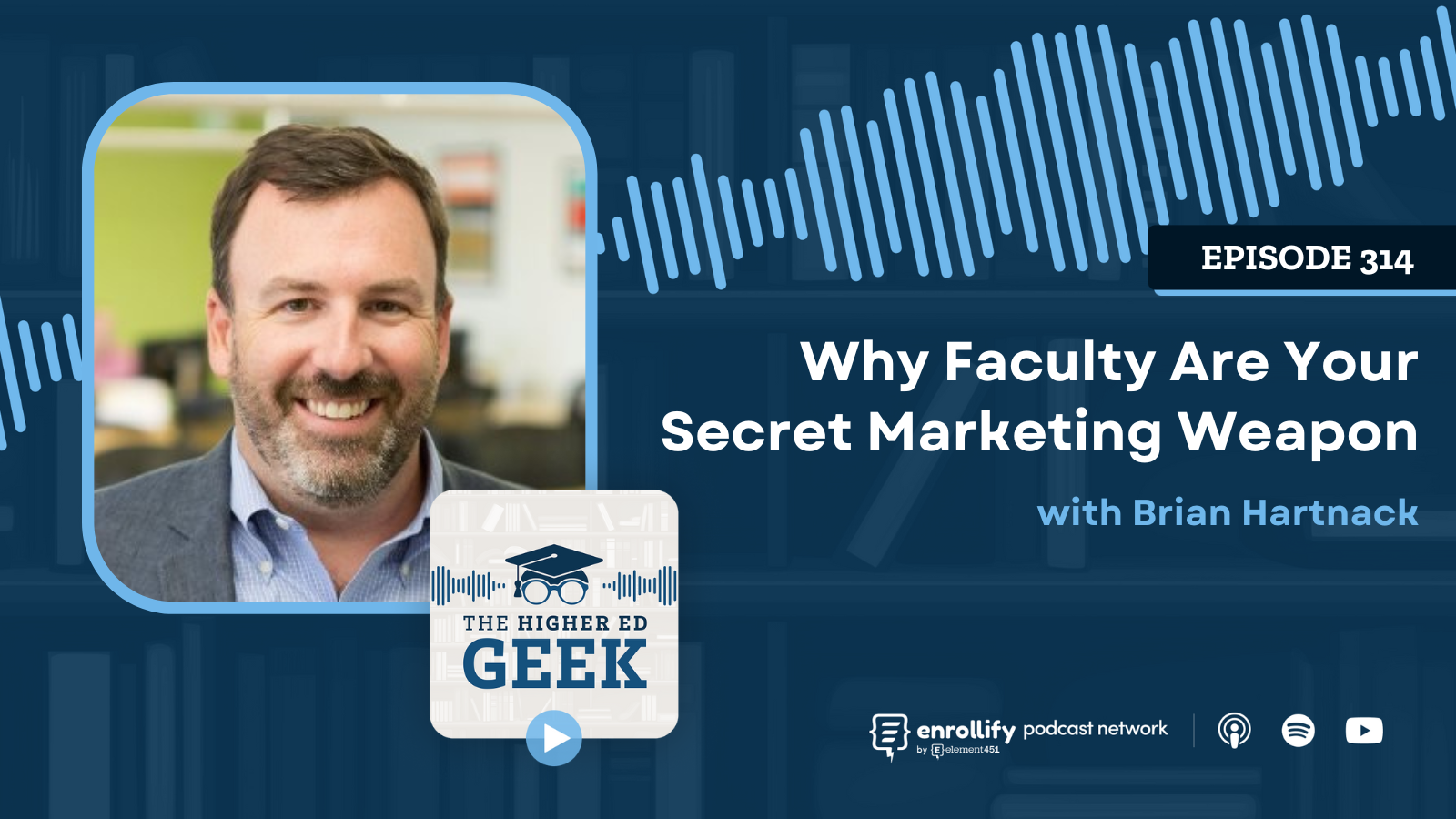
In this week’s episode, Dustin sits down with Brian Hartnack, Founder and CEO of Archer Education, for a rich conversation about the evolution of digital marketing and enrollment management in higher ed. Brian shares the origin story behind Archer, his thoughts on the shifting landscape of online education, and what institutions should really be doing right now to stay competitive in an AI-powered world. This isn’t just a history lesson—it’s a roadmap for modern marketing leaders in higher education.
Key Takeaways
- Faculty can (and should) be your marketing MVPs — Thought leadership and media engagement amplify brand authority online.
- Organic website traffic is declining — AI search tools are reshaping how prospective students find institutions.
- Academic thought leadership is SEO 2.0 — Publishing faculty expertise online boosts brand visibility and trust with both humans and AI.
- AI readiness starts with data integrity — Unifying SIS, CRM, and LMS data is essential for effective AI implementation in enrollment.
- Strategic partnerships beat cookie-cutter solutions — Institutions need flexible, long-term collaboration to grow sustainably.
- AI tools are only as good as your foundation — Point solutions fail without clean, interoperable data systems to support them.
- Digital enrollment requires human insight + AI assistance — The future is about blending personalization with automation at scale.
Episode Summary
Why are faculty your secret marketing weapon?
As Brian Harnack points out, most institutions severely underutilize one of their most credible, authentic, and influential assets: faculty. Faculty not only carry deep subject-matter expertise—they're also the source of institutional reputation and the reason students choose specific programs. But too often, their knowledge stays locked in lecture halls or journals.
Brian urges higher ed marketers to think beyond traditional tactics and lean into academic thought leadership. This means getting faculty featured in mainstream media, industry publications, podcasts, and even institutional blogs. These appearances not only elevate the institution’s reputation—they also feed AI algorithms the signals they need to trust and recommend your school.
But it doesn’t stop at PR. Institutions need a plan to amplify faculty content: repurpose it on social media, embed it in program pages, link it in admissions emails, and push it out through SEO-optimized content. This creates a web-wide footprint that reinforces your credibility across every platform and touchpoint. In the age of generative search, that kind of authority is priceless.
What’s happening to organic search traffic—and how should institutions respond?
In the past year alone, Brian says, many institutions have seen a 25% drop in organic web traffic. The culprit? Generative AI tools like ChatGPT and Google’s AI overviews, which are answering prospective students’ questions without sending them to a school’s website.
While this may sound alarming, it’s actually an invitation for higher ed marketers to evolve. As AI engines begin surfacing content differently, the rules of SEO are shifting from keyword stuffing and backlinking to knowledge graph mastery and semantic authority. That’s where faculty come in.
Brian explains that tools like LLMs (large language models) rely heavily on citations from credible sources, especially earned media. Institutions that highlight and distribute faculty thought leadership are more likely to show up in AI-generated answers—keeping them in front of prospective students, even when they don’t visit the .edu site directly.
Translation? It’s time to think beyond traditional SEO. Your institution’s digital authority depends on how well you showcase what your experts know and how you connect that knowledge to the broader web.
What’s the current challenge with AI tools in higher ed—and how do you fix it?
If you’ve dabbled in AI tools for enrollment, you’re not alone. But Brian issues a word of caution: most point solutions don’t work the way marketers hope. Why? Because they operate in isolation. A chatbot might gather useful data, but if it doesn’t integrate with your CRM or SIS, it creates more fragmentation—not more insight.
The real barrier to effective AI in higher education isn’t the technology—it’s data interoperability. Institutions have spent decades building separate systems for enrollment, learning, and communications. Now, those systems need to talk to each other. That requires a strategy known as master data management: creating a unified, deduplicated, and accurate view of each student across platforms.
With this foundation in place, institutions can deploy AI in powerful ways. Brian paints a compelling picture: a prospective student chats with an AI assistant, books a call with an advisor, and receives personalized nudges—all with full context, carried across each interaction. That’s not just automation—it’s meaningful, scalable personalization.
Without this foundation, however, AI tools are little more than shiny distractions. Institutions must invest in clean, real-time data flow before expecting big returns from generative tech.
How should higher ed leaders approach enrollment strategy in 2026?
As Brian reflects on Archer Education’s 20-year evolution, one theme stands out: customization and flexibility win over one-size-fits-all models. Unlike traditional OPMs, Archer has built long-term, tailored partnerships that allow institutions to scale, pivot, and even take functions back in-house as needed. It’s a student-centered, institution-first mindset—and it’s one that today’s enrollment leaders should emulate.
Looking ahead, Brian emphasizes the urgency of AI readiness. Institutions that treat this as a future problem will find themselves lagging behind more agile competitors. But those that invest in data unification and operational alignment now will be well-positioned to lead on both student experience and efficiency.
AI isn’t about replacing human connection—it’s about enhancing it. Done right, it creates capacity for enrollment teams to focus on what matters most: building relationships, offering guidance, and helping students succeed. That’s the kind of marketing that doesn’t just attract—it retains.
About the Show: The Higher Ed Geek Podcast explores the impact of edtech on the student experience by speaking with diverse leaders from institutions, companies, and nonprofit organizations. Each week we aim to provide an engaging, fun, and relevant dose of professional development that honors the wide range of work happening all across the higher ed ecosystem. Come geek out with us! The Higher Ed Geek Podcast is hosted by Dustin Ramsdell and is a proud member of the Enrollify Podcast Network.
Connect With Our Host:
Dustin Ramsdell
Enrollify is produced by Element451 — the next-generation AI student engagement platform helping institutions create meaningful and personalized interactions with students. Learn more at element451.com.




.svg)
.svg)
