






About the Episode
About the Episode:
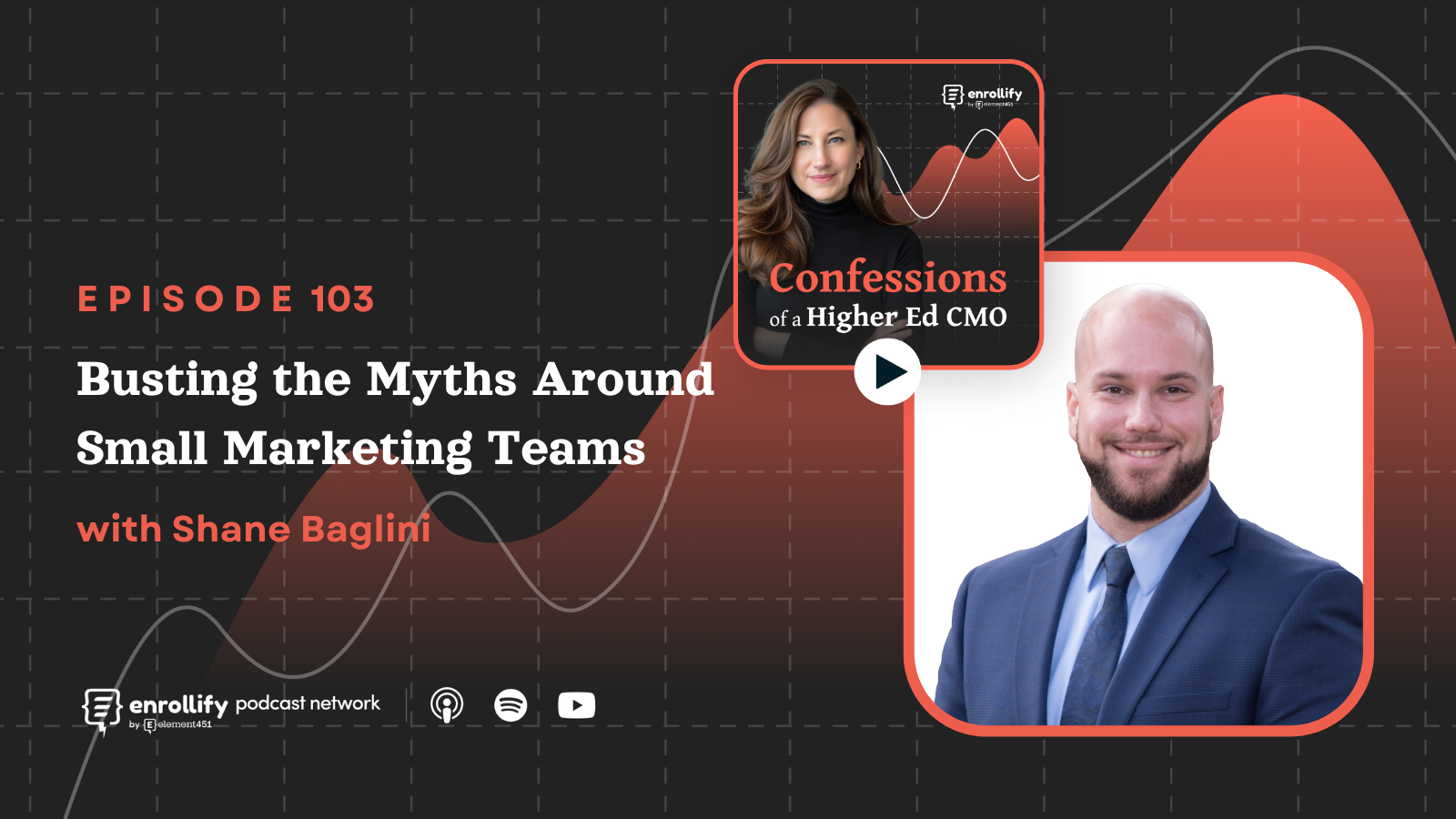
Jaime Hunt sits down with Shane Baglini, Executive Director of Marketing and Branding at William & Mary, to unpack one of higher ed’s most persistent myths: that marketers from small institutions are somehow less qualified than their counterparts at large universities. This episode dives into how working in under-resourced environments actually sharpens leadership, fuels innovation, and builds resilience. Together, Jaime and Shane challenge outdated hiring biases and offer a compelling case for why “small shop” experience is a competitive advantage in enrollment marketing.
Key Takeaways
- Small teams build big leadership skills: Limited resources force marketers to prioritize, innovate, and lead with urgency—core traits for senior leadership roles.
- Constraints fuel creativity in enrollment marketing: Tight budgets and lean teams often produce more innovative, high-impact campaigns than resource-heavy environments.
- Misperceptions hurt hiring in higher ed marketing: Talent from smaller institutions is often overlooked despite delivering measurable enrollment growth and campaign success.
- Urgency is a superpower: Professionals from small shops bring a results-driven mindset that combats complacency in larger institutions.
- Relationship-building is essential for success: Strong internal partnerships and executive presence are often developed faster in smaller, more interconnected environments.
- Strategic prioritization beats doing everything: Knowing what not to do is just as critical as execution in high-performing marketing teams.
- Career growth requires visibility: Building a professional network and engaging in higher education conferences or podcasts can elevate your profile beyond institutional size.
Episode Summary
Why Small Teams Create Stronger Marketing Leaders
Working in a small marketing shop isn’t a limitation—it’s a leadership accelerator. Shane Baglini explains that when you’re operating with minimal staff and budget, you’re forced to wear multiple hats and make high-stakes decisions daily. That kind of environment builds adaptability, resilience, and a deep understanding of how every function connects to enrollment outcomes.
Jaime Hunt reinforces this idea by reflecting on her own experience managing a small but highly innovative team. With limited financial resources, her team had to rely heavily on creativity and strategic thinking, especially in owned and earned media. This constant need to “figure it out” becomes a training ground for future marketing leaders.
In larger institutions, roles are often more specialized, which can limit exposure to the full scope of marketing operations. Small teams, on the other hand, provide a holistic experience—making professionals more prepared to lead integrated marketing strategies at scale.
The Biggest Myth in Higher Education Marketing Hiring
One of the most provocative moments in the episode centers on a common hiring bias: the belief that candidates from smaller institutions lack the experience needed for larger roles. Shane calls this assumption “literally the opposite of reality,” arguing that if someone can drive enrollment growth with minimal resources, they can likely do even more with a larger team and budget.
This misconception is particularly problematic in enrollment marketing, where results—not institutional prestige—should be the primary metric of success. Jaime and Shane both share personal stories of being overlooked for roles due to this bias, despite proven track records of impact.
The takeaway here is clear: hiring managers need to rethink how they evaluate talent. Instead of focusing on institutional size, they should prioritize outcomes, leadership ability, and strategic thinking—all of which are often sharpened in smaller environments.
How Constraints Drive Innovation in Enrollment Marketing
Constraints aren’t just challenges—they’re catalysts for innovation. Shane shares an example of cutting a $300,000 external contract and redistributing those funds to build internal capabilities, implement new tools, and improve campaign performance. This decision unlocked new creative possibilities and increased overall efficiency.
Jaime adds that small teams often get to own the most creative work, from brand development to campaign execution, rather than outsourcing it. This not only improves job satisfaction but also leads to more authentic and cohesive brand storytelling.
In the context of trends in higher education marketing, this highlights a critical shift: innovation doesn’t require massive budgets—it requires clarity, prioritization, and a willingness to rethink traditional approaches.
Preventing Burnout While Driving Results
Burnout is a real challenge for small marketing teams, especially when the pressure to meet enrollment goals is constant. Shane emphasizes the importance of building team culture through small but meaningful actions—like informal check-ins, team outings, and moments to disconnect from work.
Jaime highlights another powerful lever: gratitude. Recognition from leadership and campus partners can significantly boost morale and help teams feel valued, even during high-pressure periods.
Ultimately, sustainable success in enrollment marketing requires balancing performance with people. Teams that feel supported and appreciated are more likely to stay engaged, creative, and productive over the long term.
Turning Small-Shop Experience into Career Growth
For early-career professionals, Shane offers practical advice: take ownership, build relationships, and seek visibility beyond your institution. Being reliable and consistently delivering results will naturally position you as a leader within your organization.
He also stresses the importance of financial literacy and cross-functional collaboration—skills that are often easier to develop in smaller institutions where access to leadership is more direct. These experiences become powerful differentiators when pursuing larger roles.
Engaging with the broader higher ed community—through higher education podcasts, networking, and conferences—can further amplify your impact. As Shane notes, building a professional brand is essential when institutional name recognition alone isn’t enough to open doors.
Connect With Our Host:
Jaime Hunt
https://twitter.com/JaimeHuntIMC
Enrollify is produced by Element451 — the next-generation AI student engagement platform helping institutions create meaningful and personalized interactions with students. Learn more at element451.com.







.svg)
.svg)
