






About the Episode
About the Episode:
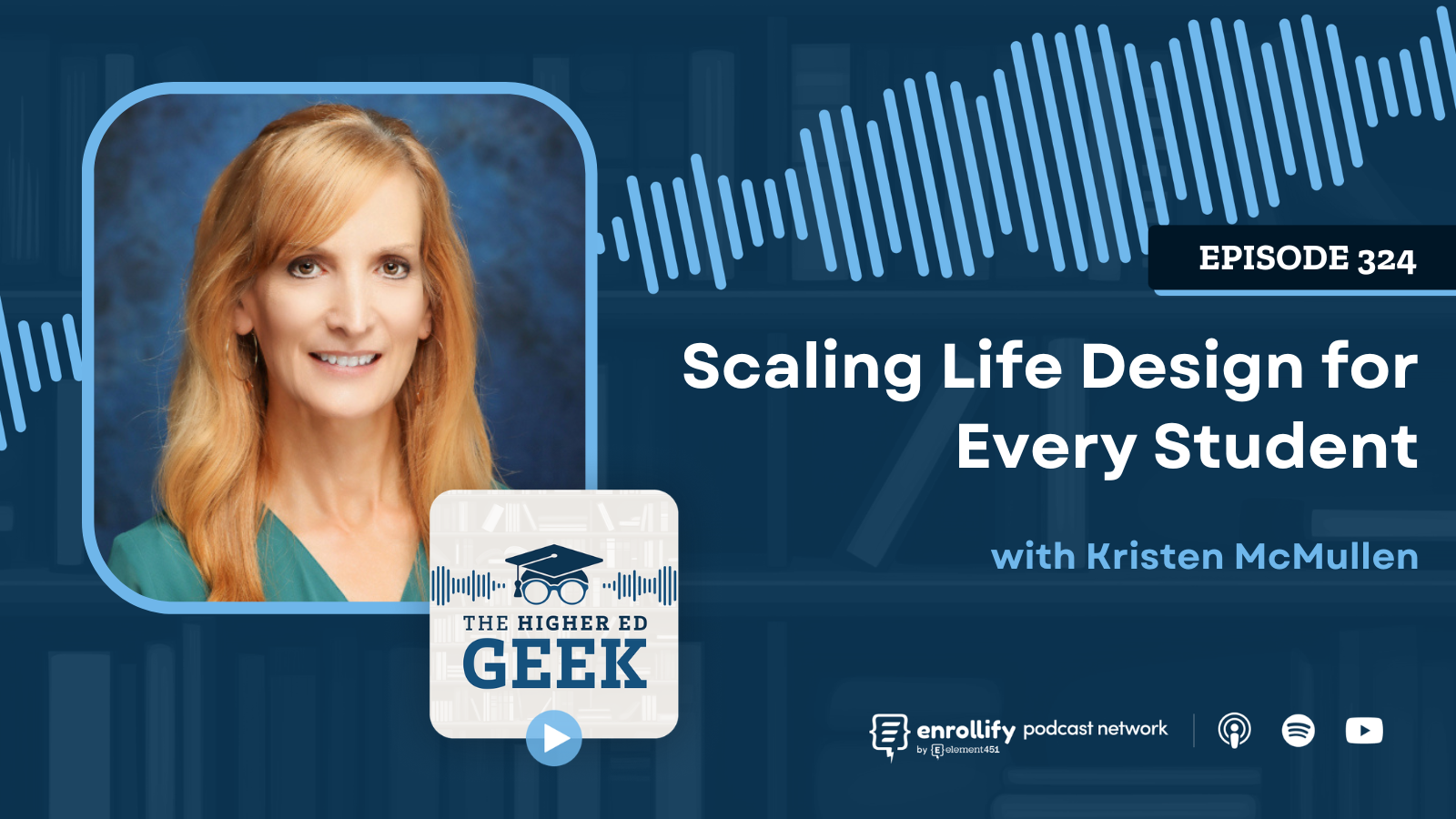
For this episode, Dustin speaks with Kristen McMullen to explore how the “Designing Your Life” framework is being embedded at the College of Charleston to help students navigate uncertainty, make intentional decisions, and align their education with their goals and values. Kristen explains how the design thinking approach—centered on curiosity, experimentation, and action—empowers students to prototype career paths, build confidence, and reduce anxiety about the future.
Key Takeaways
- The “Designing Your Life” framework helps students navigate uncertainty through structured experimentation and reflection
- Embedding life design across the institution strengthens student success strategies and improves retention
- Early and continuous career exploration reduces anxiety and increases confidence in decision-making
- Cross-campus collaboration is essential for scaling impactful initiatives in higher education
- Personalized, experiential learning is becoming a key differentiator in higher education content marketing
- AI and digital tools can enhance life design by supporting goal-setting, accountability, and exploration
- Institutions that prioritize holistic development gain a competitive edge in enrollment marketing
- Building a culture—not just a program—is critical for long-term success
Episode Summary
What Is the Designing Your Life Framework in Higher Education?
The Designing Your Life framework, originally developed at Stanford, applies design thinking principles to personal and career development. Kristen explains that instead of asking students to “figure it all out,” the model encourages them to prototype different paths, test ideas, and iterate based on real experiences. This approach aligns closely with evolving student success strategies, where exploration replaces pressure.
At its core, the framework includes steps like empathizing (understanding yourself), defining goals, ideating possibilities, prototyping experiences, and testing outcomes. Rather than committing to a single path—like law school—students are encouraged to explore through smaller, lower-risk actions such as job shadowing or informational interviews. This reduces decision paralysis and builds confidence.
What makes this model powerful is its adaptability. Kristen emphasizes that it’s not just for college students—it’s relevant across life stages. However, embedding it into the college experience creates a structured environment where students can safely explore their future while building critical life skills.
How Is the College of Charleston Scaling Life Design Across Campus?
What started as a small pilot course quickly evolved into a campus-wide initiative. After seeing measurable improvements in student confidence, self-efficacy, and reduced career anxiety, the College of Charleston committed to scaling the program institution-wide. This move reflects a broader shift in trends in higher education marketing, where student outcomes and experiences take center stage.
Kristen highlights the importance of institutional buy-in. Without leadership support, initiatives like this often remain siloed and short-lived. By securing commitment from senior leadership, the program was able to expand into first-year experiences, academic programs, and co-curricular activities. This ensures that life design isn’t a one-time intervention—it’s a continuous journey.
The result is a cultural transformation. Faculty, staff, and even administrators are being trained as life design coaches, creating a distributed model of support. This ecosystem approach ensures that students encounter consistent messaging and guidance throughout their college experience, reinforcing both engagement and retention.
Why Does Early Career Exploration Matter More Than Ever?
One of the most compelling aspects of this episode is the emphasis on starting early. Kristen shares how integrating life design into first-year programs helps students challenge assumptions and explore possibilities before they feel locked into a path. This proactive approach is essential for modern enrollment marketing strategies that promise outcomes, not just education.
Students today face immense pressure to choose the “right” career path, often without enough exposure to real-world options. By encouraging experimentation—through mentorship, internships, and conversations—life design reduces anxiety and empowers students to make informed decisions. This aligns with the growing demand for data-driven education market research and career alignment.
Additionally, early exploration leads to more intentional academic choices. Students begin to see how their coursework connects to their goals, which increases engagement and motivation. This connection between academics and outcomes is a key driver of both student satisfaction and institutional success.
How Can Institutions Create a Culture of Life Design?
Scaling life design requires more than just programming—it demands a cultural shift. Kristen describes building an “ecosystem” where every department, from admissions to career services, plays a role in supporting student development. This collaborative approach breaks down silos and enhances the overall student experience.
Training faculty and staff as certified life design coaches is a cornerstone of this strategy. By empowering a wide range of campus stakeholders, the institution ensures that students receive consistent guidance regardless of where they seek support. This model also amplifies the impact of existing ed tech tools and resources.
Importantly, this culture extends beyond campus. Partnerships with alumni and industry professionals provide students with real-world insights and mentorship opportunities. These connections help bridge the gap between education and employment, reinforcing the value of a degree in today’s competitive landscape.
What Role Do AI and EdTech Tools Play in Life Design?
Technology plays a supporting—but powerful—role in scaling life design initiatives. Kristen explains how tools like mentoring platforms, LinkedIn Learning, and AI-powered coaching features help students stay accountable and explore opportunities. These innovations highlight the growing importance of AI in higher education.
AI tools can assist students in ideation, planning, and even accountability. For example, students can use AI to generate career pathways, identify skill gaps, and create action plans. This integration of technology enhances the efficiency and personalization of the life design process.
However, Kristen emphasizes that technology should complement—not replace—the human element. At its core, life design is about conversation, reflection, and connection. When paired with the right ed tech tools, institutions can scale these experiences without losing their impact.
About the Show: The Higher Ed Geek Podcast explores the impact of edtech on the student experience by speaking with diverse leaders from institutions, companies, and nonprofit organizations. Each week we aim to provide an engaging, fun, and relevant dose of professional development that honors the wide range of work happening all across the higher ed ecosystem. Come geek out with us! The Higher Ed Geek Podcast is hosted by Dustin Ramsdell and is a proud member of the Enrollify Podcast Network.
Connect With Our Host:
Dustin Ramsdell
Enrollify is produced by Element451 — the next-generation AI student engagement platform helping institutions create meaningful and personalized interactions with students. Learn more at element451.com.



.svg)
.svg)
