


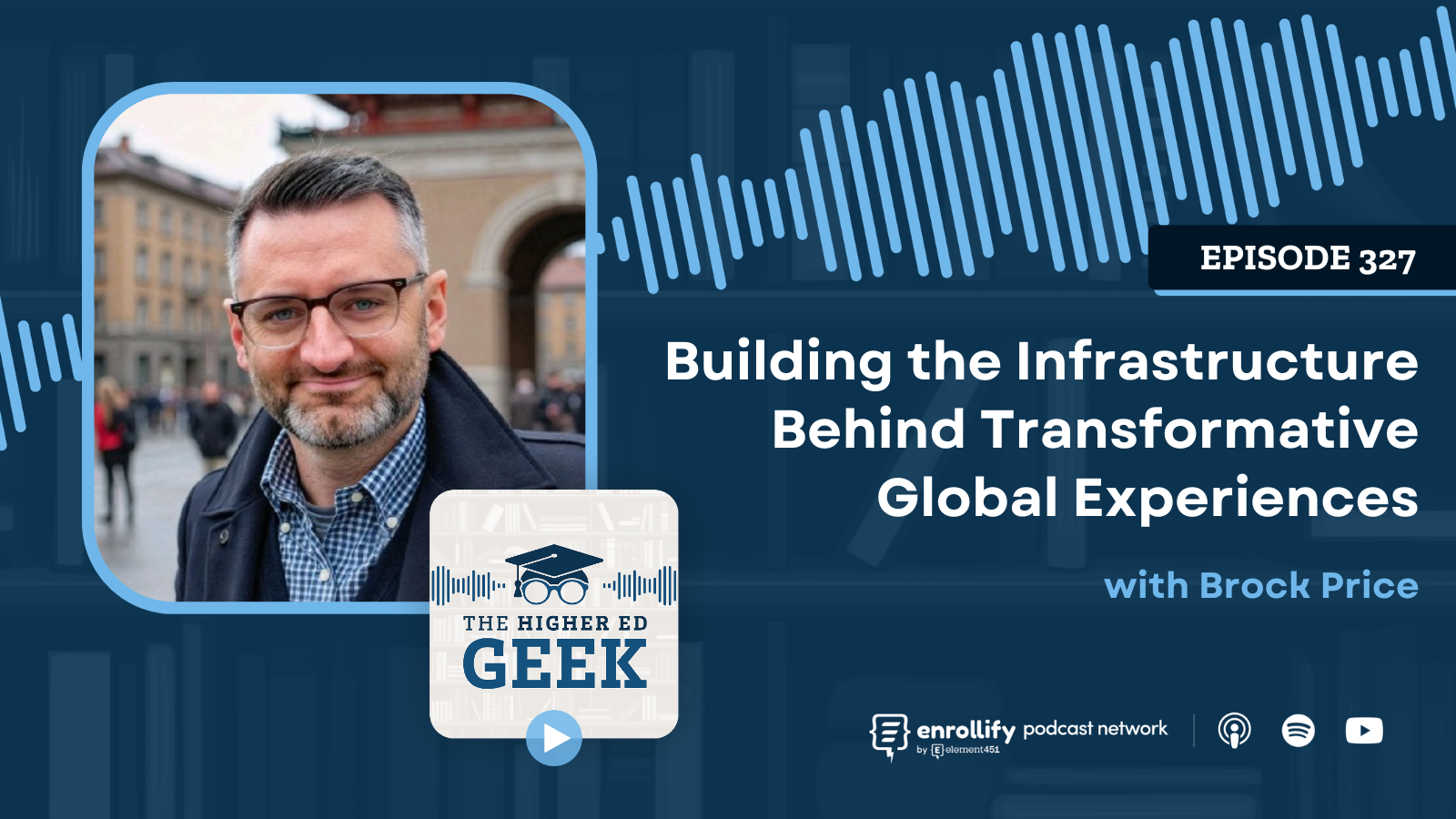




About the Episode
About the Episode:
In this episode, Dustin speaks with Brock Price of Terra Dotta about the evolving landscape of global education and the growing complexity behind study abroad and international student programs. They explore how institutions can better support these experiences through smarter systems, improved data visibility, and more coordinated, campus-wide strategies.
The conversation highlights why global engagement remains a critical part of higher education—driving student growth, institutional value, and cross-cultural understanding—while emphasizing the need to reduce administrative burden so staff can focus on the human impact of the work.
Key Takeaways
- Digital platforms are reshaping global education operations by reducing administrative burden and improving efficiency across study abroad and international student services
- Data analytics in higher education enables better decision-making, from risk management to enrollment strategy and global partnerships
- Global engagement is no longer siloed—it impacts enrollment marketing, retention, and institutional reputation
- Student success strategies must include global experiences, which foster cross-cultural competency and personal growth
- Automation frees up staff to focus on high-impact work, like advising and student support, instead of manual processes
- Risk management and compliance expectations are rising, making centralized systems essential
- Global education participation is expanding, with more diverse program formats like short-term, virtual, and domestic experiences
How Has Global Education Evolved in Higher Ed?
Global education has stayed true to its core mission—helping students engage with different cultures and perspectives—but the way institutions deliver these experiences has changed dramatically. What was once managed through spreadsheets and paper forms has evolved into a complex ecosystem requiring coordination across multiple departments and stakeholders. The scale and expectations have increased, placing additional strain on already lean teams.
Today’s study abroad and international programs are more diverse than ever. Institutions now offer short-term programs, virtual exchanges, internships, and domestic “study away” opportunities, broadening access to global learning. This expansion reflects a shift toward inclusivity and flexibility, allowing more students to participate regardless of financial or academic constraints.
At the same time, the operational demands have intensified. Compliance, risk management, and real-time communication expectations have grown significantly. As Brock Price explains, institutions must now balance meaningful student experiences with heightened accountability and oversight.
Why Is Global Engagement More Important Than Ever?
Global engagement plays a critical role in shaping well-rounded graduates who can navigate an increasingly interconnected—and sometimes divided—world. Students who participate in global experiences gain not only cultural awareness but also a deeper understanding of themselves. These outcomes align directly with modern student success strategies, which emphasize holistic development beyond the classroom.
There’s also a strong economic and enrollment-driven case for global education. International students contribute billions to the U.S. economy and support hundreds of thousands of jobs. For institutions, this translates into tuition revenue, community impact, and long-term sustainability. Global engagement is no longer a “nice-to-have”—it’s a strategic priority.
Additionally, geopolitical shifts and changing student mobility patterns make global strategy more complex. Institutions must adapt quickly to visa changes, international competition, and shifting student preferences. This makes education market research and data-informed planning more essential than ever.
How Do Digital Platforms Improve Efficiency and Outcomes?
Digital platforms are revolutionizing how institutions manage global programs by eliminating time-consuming administrative work. Tasks that once took weeks—like processing student registrations or tracking compliance—can now be completed in days or even hours. This shift allows staff to redirect their energy toward high-impact activities like advising and student engagement.
Centralization is another major benefit. Instead of relying on disconnected spreadsheets and siloed systems, institutions can use integrated platforms to manage study abroad, international students, partnerships, and travel risk in one place. This not only improves efficiency but also enhances data accuracy and accessibility across departments.
Perhaps most importantly, these platforms unlock the power of data analytics in higher education. Leaders can access real-time dashboards, track participation trends, and make informed decisions about program growth and resource allocation. As a result, institutions can better align their global initiatives with broader enrollment marketing and retention goals.
What Challenges Do Institutions Face Without Digital Transformation?
Without modern systems, institutions risk inefficiencies that can directly impact student experiences and outcomes. Manual processes increase the likelihood of errors, delays, and missed compliance deadlines—some of which can have serious consequences for international students. In extreme cases, something “falling through the cracks” could affect a student’s ability to remain enrolled.
Siloed operations also limit an institution’s ability to scale. When departments don’t share data or collaborate effectively, opportunities for growth and innovation are lost. This fragmentation can hinder everything from partnership development to marketing strategy for student recruitment.
Finally, the lack of actionable data makes it difficult for leaders to justify investments or measure success. Without clear insights, institutions struggle to optimize programs or demonstrate ROI. Digital transformation isn’t just about efficiency—it’s about enabling smarter, more strategic decision-making.
What Should Higher Ed Leaders Do Next?
Brock Price emphasizes that global engagement must be treated as a campus-wide priority, not just the responsibility of one office. Collaboration across departments—admissions, financial aid, IT, and academic units—is essential for building scalable and sustainable programs. Breaking down silos is a critical first step.
Investment in both people and technology is equally important. While digital platforms can drive efficiency, they are most effective when paired with well-supported teams. Institutions that prioritize global education and equip their staff with the right tools are better positioned to succeed.
Leaders should also look outward for inspiration. Engaging with organizations like NAFSA or the Forum on Education Abroad allows institutions to learn from peers, adopt best practices, and stay ahead of industry trends. In a rapidly evolving landscape, collaboration and continuous learning are key.
About the Show: The Higher Ed Geek Podcast explores the impact of edtech on the student experience by speaking with diverse leaders from institutions, companies, and nonprofit organizations. Each week we aim to provide an engaging, fun, and relevant dose of professional development that honors the wide range of work happening all across the higher ed ecosystem. Come geek out with us! The Higher Ed Geek Podcast is hosted by Dustin Ramsdell and is a proud member of the Enrollify Podcast Network.
Connect With Our Host:
Dustin Ramsdell
Enrollify is produced by Element451 — the next-generation AI student engagement platform helping institutions create meaningful and personalized interactions with students. Learn more at element451.com.






.svg)
.svg)
