






About the Episode
About The Episode:
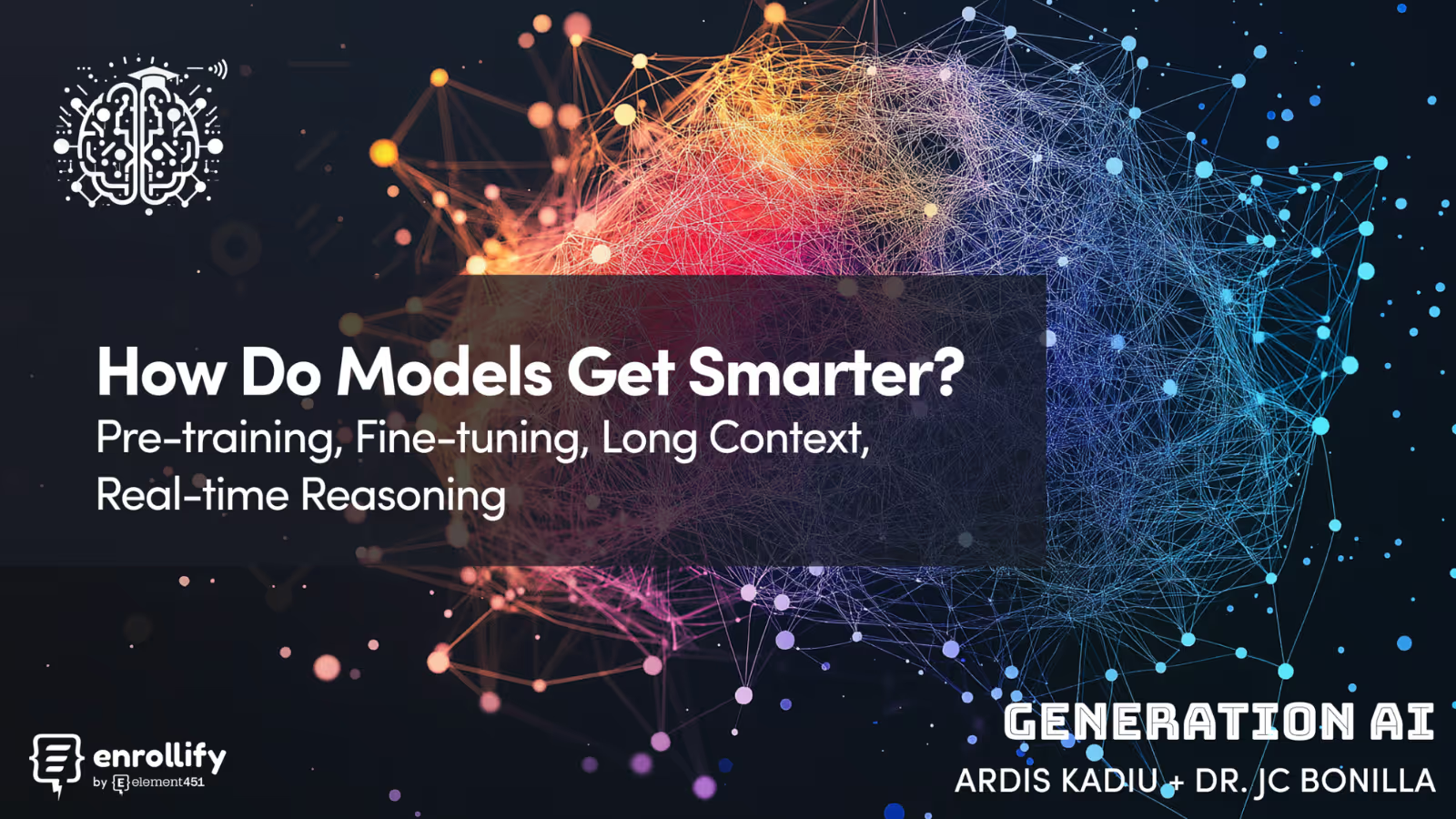
In this episode of Generation AI, hosts Ardis Kadiu and JC Bonilla explore the intricate world of AI scaling in higher education. They break down the concept of scaling, from its foundational components to its implications for AI development and implementation. Drawing on real-world examples, they delve into the triad of model size, data, and computational power, and discuss challenges like data scarcity, computational limits, and diminishing returns. The episode also offers insights into how industry leaders like OpenAI, Google, and Meta are tackling these roadblocks.
Key Takeaways
- AI Scaling Defined: Scaling in AI refers to how efficiently and effectively models can accomplish tasks of increasing complexity, measured by speed and intelligence.
- The Triad of AI Scaling: Model size, data quality, and computational power are the key elements driving AI advancements.
- Challenges in AI Scaling:
- Data scarcity, particularly for high-quality, domain-specific datasets.
- Skyrocketing computational costs and energy requirements.
- Diminishing returns as larger models yield less exponential improvement.
- Mitigation Strategies: Techniques like synthetic data generation, hyperparameter tuning, and reasoning-focused models address scaling challenges.
- Future of AI Models: Companies are shifting focus from generalist models to domain-specific and reasoning-oriented solutions.
Episode Summary
What Does AI Scaling Mean?
AI scaling refers to how effectively artificial intelligence can solve increasingly complex tasks. Hosts Ardis Kadu and JC Bonilla explain this through a lens of "smartness"—can a model achieve in minutes, hours, or days what humans might take weeks to accomplish? Scaling doesn’t just mean faster; it also means smarter. For example, GPT-4 is 10 times more capable than GPT-3.5 in many areas, but the diminishing returns of scaling larger models have prompted researchers to rethink strategies.
What Are the Key Challenges in Scaling AI?
The conversation explores three primary challenges in scaling AI:
- Data Scarcity: High-quality training data is increasingly hard to source. While earlier models relied on vast amounts of freely available online data, this resource has been largely exhausted. Additionally, domain-specific datasets, like those in healthcare or education, are often inaccessible or proprietary.
- Computational Costs: Training large models costs hundreds of millions—and soon billions—of dollars. Companies face challenges balancing the need for immense computing power with energy efficiency and sustainability.
- Diminishing Returns: As models grow, they require exponentially more computational resources to achieve only incremental improvements in performance. This raises questions about whether scaling efforts are sustainable.
How Are Companies Tackling Scaling Challenges?
The podcast highlights how leading tech companies are approaching these roadblocks:
- OpenAI: Focuses on reasoning-based models and test-time compute, allowing AI to think dynamically during task execution.
- Google: Invests in multimodal capabilities and domain-specific applications, such as its advancements in protein folding and specialized coding models.
- Meta: Explores alternative architectures and world models, aiming to overcome the limitations of transformer-based AI systems.
- XAI (Elon Musk's Initiative): Prioritizes "truth-seeking" AI and first-principles problem-solving.
What Role Do Mitigation Strategies Play?
To address the challenges of scaling, companies and researchers are leveraging innovative strategies, including:
- Synthetic Data Generation: Creating artificial datasets to fill gaps in training data.
- Hyperparameter Tuning: Optimizing how models learn to improve efficiency.
- Reasoning-Based Models: Enhancing AI’s ability to think and adapt dynamically during real-time tasks.
The hosts share how these approaches are unlocking new possibilities for AI in higher education. For instance, at Element, reasoning-focused AI is being used to identify fraudulent applications by analyzing behavioral patterns and contextual data.
What Does the Future Hold for AI Scaling?
The episode closes with a discussion of where AI is headed. The hosts emphasize that while scaling generalist models may slow, there’s growing momentum around domain-specific applications and reasoning engines. These advancements could revolutionize fields like marketing attribution, student engagement, and personalized learning in higher education.
Connect With Our Co-Hosts:
Ardis Kadiu
About The Enrollify Podcast Network:
Generation AI is a part of the Enrollify Podcast Network. If you like this podcast, chances are you’ll like other Enrollify shows too! Some of our favorites include The EduData Podcast and Visionary Voices: The College President’s Playbook.
Enrollify is produced by Element451 — the next-generation AI student engagement platform helping institutions create meaningful and personalized interactions with students. Learn more at element451.com.





.svg)
.svg)
