






About the Episode
About the Episode:
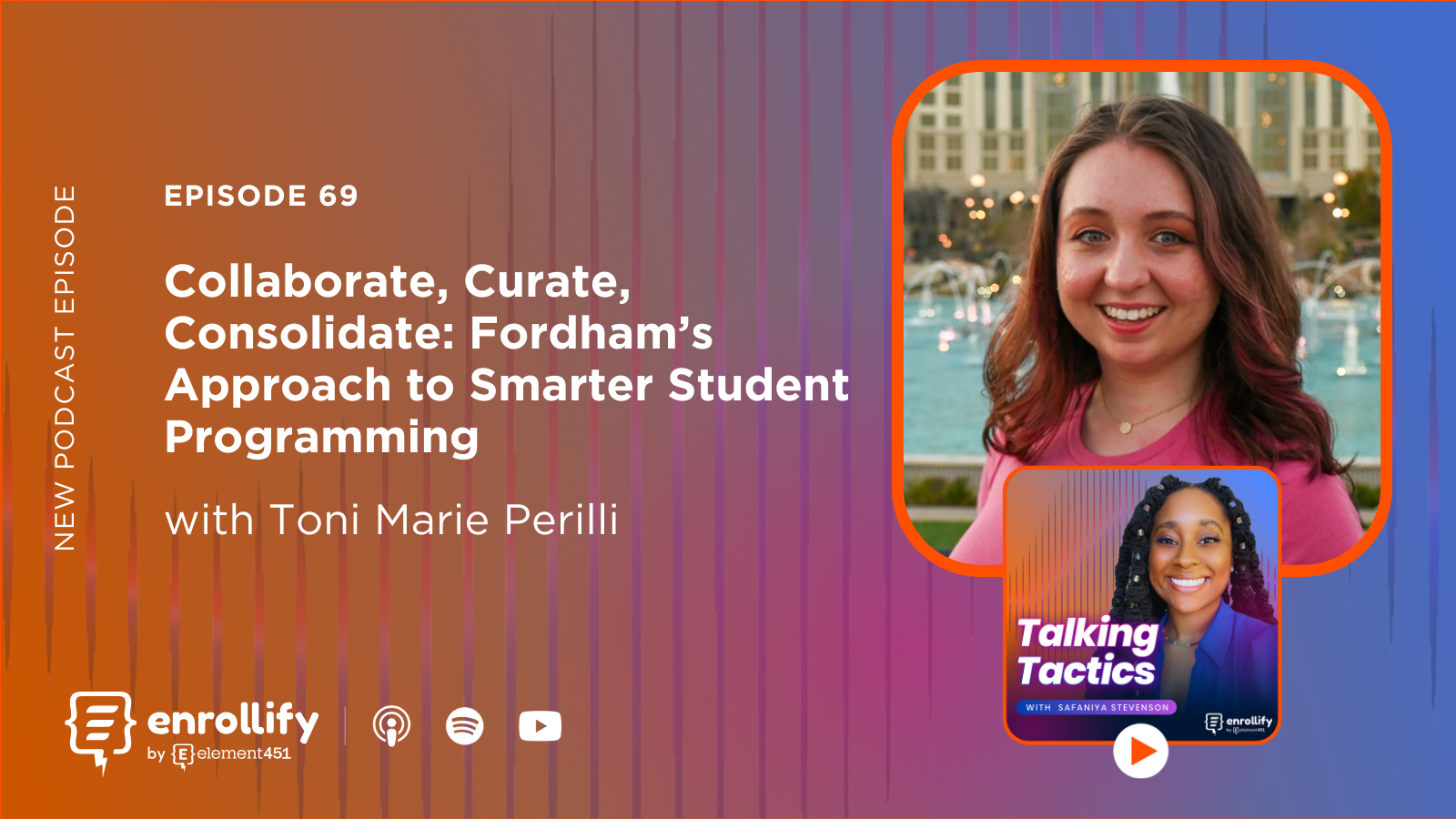
Are too many emails and events actually hurting student engagement at your university? In this episode of Talking Tactics, Safaniya Stevenson chats with Toni Marie Perilli from Fordham University about how over-programming can overwhelm students and what her team did to fix it. From segmented newsletters to centralized program planning, Toni shares actionable strategies to get students opening, clicking, and showing up.
Key Takeaways
- Overprogramming can reduce student engagement — Too many events, too little coordination, and mass email blasts can overwhelm students, leading them to tune out.
- Segmenting your audience is a game-changer — Fordham implemented five unique student interest clusters to target communications and saw click rates double or triple.
- Curated over personalized — When tech limitations prevent true personalization, curated content clusters can mimic that effect—and drive results.
- Internal collaboration is just as crucial as external communication — Fordham moved from siloed planning docs to a centralized event tracker, enhancing internal transparency and programming efficiency.
- Improved comms = improved partnerships — Clear, segmented communication doesn’t just benefit students—it keeps employer partners coming back and strengthens long-term relationships.
- Metrics matter, but so does perception — Changing how students perceive the relevance of your communications can have as much impact as the actual content.
Are Your Events Getting Lost in the Noise? Here's Why.
Fordham University found themselves stuck in a common trap: trying to do everything for everyone—and ultimately connecting with no one. As Toni Marie Perilli shares, the Career Center was running countless programs across two campuses with employer visits, panels, and student group partnerships happening simultaneously. The problem? Students were being hit with multiple email blasts a day, often with irrelevant or redundant information. Over time, they learned to ignore them altogether.
This episode zooms in on the dangers of overprogramming and overcommunication in higher education. The team’s initial marketing efforts—while abundant—were chaotic and siloed, leading to an ineffective and overwhelming student experience. It wasn’t that the offerings weren’t valuable; they just weren’t reaching students in a way that felt personalized, timely, or manageable.
So, how do you fix that? You start by asking a bigger question: How are students actually experiencing your content? Toni Marie and her team found that less really could be more when it comes to event communications.
How Fordham’s Career Center Rethought Segmentation
Without the tech stack to enable deep personalization, Toni Marie’s team leaned into smart curation instead. They reimagined student email communications by creating five interest-based segments tied to major groupings and career paths:
- Exploration/Discovery (undeclared students, faculty/staff)
- Business, Finance, Accounting
- STEM and Pre-Health
- Arts, Communication, and Media
- Humanities
Using these clusters, they tailored weekly emails to deliver curated content—without drowning students in irrelevant info. The team linked Handshake events via RSS feeds to reduce manual work and used student workers to help assemble and review each newsletter.
The result? Email open rates hovered in the 80% range, even later in the semester. Click rates doubled or tripled. And most importantly, the feedback from students began to shift from “There’s nothing for me here” to “How can I get more involved?”
This subtle shift in strategy reframed students’ perceptions of the Career Center’s relevance—driving up both engagement and participation.
Connect With Our Host:
Enrollify is produced by Element451 — the next-generation AI student engagement platform helping institutions create meaningful and personalized interactions with students. Learn more at element451.com.


.svg)
.svg)
