






About the Episode
About The Episode:
Higher education’s reputation is being shaped by a familiar set of headlines: rising costs, political pressure, campus conflict, layoffs, and closures. It’s the story we keep hearing, and it’s loud.
But in this episode, we ask: is that the story most people actually believe?
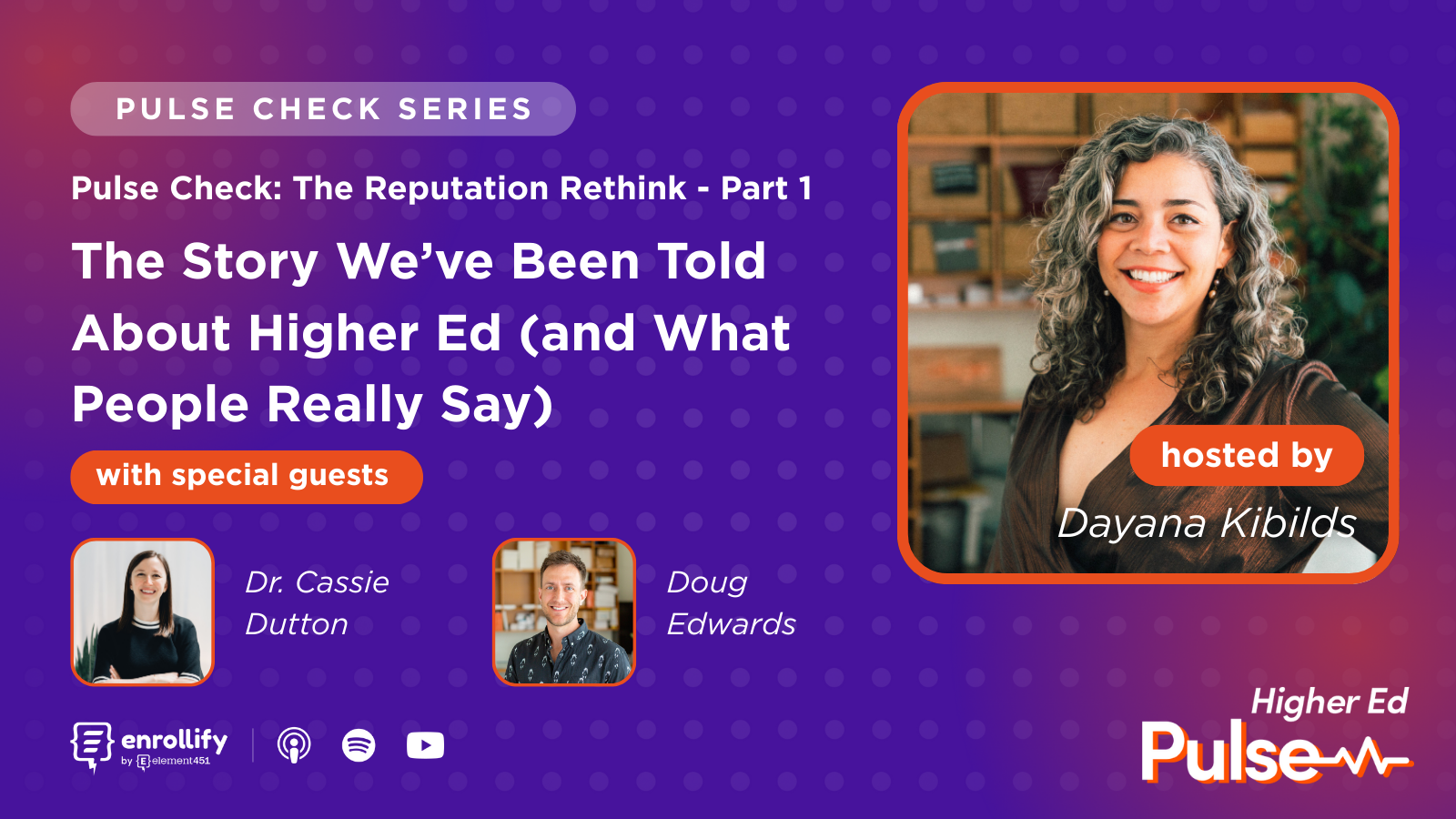
In the first episode of this five-part Pulse Check series, host Day Kibilds is joined by Doug Edwards, Chief Strategy Officer at Ologie, and Dr. Cassie Dutton, Research Director at Ologie, to introduce The Reputation Rethink, Ologie’s national study on public perception of higher education.
Together, they define what “reputation” really means in this research, explain who was included and why, and share the study’s most encouraging (and challenging) insight: people believe colleges and universities contribute real value to society beyond educating students, but they struggle to see that impact in their everyday lives. This episode sets the foundation for the five specific areas institutions can address to close that gap and reconnect with the public.
Key Takeaways
- 77% of Americans believe colleges and universities provide important contributions to society — but many can’t actually see those contributions.
- Eight in ten people say higher ed needs at least some tweaking, and 25% believe it needs a complete overhaul, especially among rural and conservative audiences.
- Publics want fewer research studies and more research stories—told in plain, relatable, and visible ways.
- 60% of people don’t believe taxpayer dollars are being spent in ways that align with their values, indicating an urgent need for better financial transparency.
- Local communities often feel ignored in favor of national or global reputation-building efforts.
- Alumni feel underserved, especially in a competitive job market and with rising student debt.
- People want institutions to be places for ideas, not ideologies—a clear call for campuses to foster curiosity and dialogue over partisanship.
Episode Summary
What Is “The Reputation Rethink,” and Why Now?
The episode opens with Day Kibilds introducing The Reputation Rethink, a national research initiative by branding agency Ologie that seeks to dig deeper than headlines about “college value.” This isn’t another “Is college worth it?” study. Instead, it’s a bold look at how Americans perceive colleges and universities—especially institutions in their own backyards—and what marketers can do to close the perception gap.
Doug Edwards and Dr. Cassie Dutton explain how higher ed lives in a dual narrative. On one hand, U.S. colleges are seen globally as prestigious and life-changing. On the other, they're viewed domestically as out-of-touch, overly expensive, and politically fraught. This study aims to unpack that contradiction—not just through data, but through strategic storytelling.
Who Was Surveyed and How?
Cassie Dutton walks us through the research methodology: a combination of broad quantitative surveying of U.S. adults and targeted qualitative focus groups. The groups were split by political orientation and age to avoid partisan debates and focus on real perceptions. From liberals to conservatives, urban dwellers to rural residents, the voices collected show that political bias isn't the only reason people question higher ed’s role—it’s more often about visibility and communication.
The research explored themes like institutional impact, transparency, value, and relevance—and most importantly, what people wish they saw more of from colleges and universities.
What Do People Think Colleges Are Doing Well?
Here’s the good news: most people believe colleges contribute meaningfully to society, especially through research, medical advancements, and STEM innovation. But they also say they rarely see those contributions in action.
Doug highlights a critical takeaway: we need to make the invisible visible. Higher ed’s impact exists beyond classrooms—through medical breakthroughs, arts and culture, community programming—but if the public doesn’t see it, it might as well not exist.
What Needs “Tweaking”? (Or, in some cases, Overhauling?)
Even with strong baseline trust in higher ed’s contributions, a substantial portion of Americans want change. Cassie shares that about 25% of respondents think higher ed needs a total overhaul, with conservative and rural groups especially critical. So, what needs to change?
- Research Communication
People value research—but they want it translated. The public isn’t asking for whitepapers—they’re asking for stories. Think: accessible storytelling, video content, infographics, and real-world applications of research that make them say, “Oh! That’s how it impacts me.” - Financial Transparency
With just 40% of people believing their tax dollars are being used effectively in higher ed, trust is shaky. Multi-billion-dollar fundraising campaigns, high-profile coaching contracts, and constant campus construction don’t help. The solution? Communicate where money comes from and where it goes in ways that are digestible and visual. - Local Impact
National prestige might bring in dollars and rankings, but many locals feel left out. Community members want to see tangible ways colleges support their neighborhoods—through open facilities, youth camps, local vendor partnerships, and public events. If people in your zip code don’t feel connected to your institution, your reputation is vulnerable. - Alumni Support and Career Outcomes
As Doug points out, alumni are among the most valuable audiences higher ed serves—and yet, they often feel like an afterthought. With rising student debt and shaky job markets, graduates want more than nostalgia: they want career services, networking, mentorship, and tangible ROI after they graduate. - Political Neutrality and Safe Dialogue Spaces
The final insight hits at a core tension: people across the political spectrum want colleges to be spaces for learning, not political indoctrination. The public wants to see campuses that prioritize critical thinking and respectful dialogue over ideological alignment. It’s less about being apolitical and more about being inclusive of ideas.
Resources Mentioned in This Episode
The Reputation Rethink (Ologie Research Report)
Download the full report and explore the findings and recommendations.Day’s Blog about the Report
Read more commentary and thoughts from Day about the research findings from The Reputation Rethink.
Enrollify is produced by Element451 — the next-generation AI student engagement platform helping institutions create meaningful and personalized interactions with students. Learn more at element451.com.


.svg)
.svg)
