






About the Episode
About The Episode:
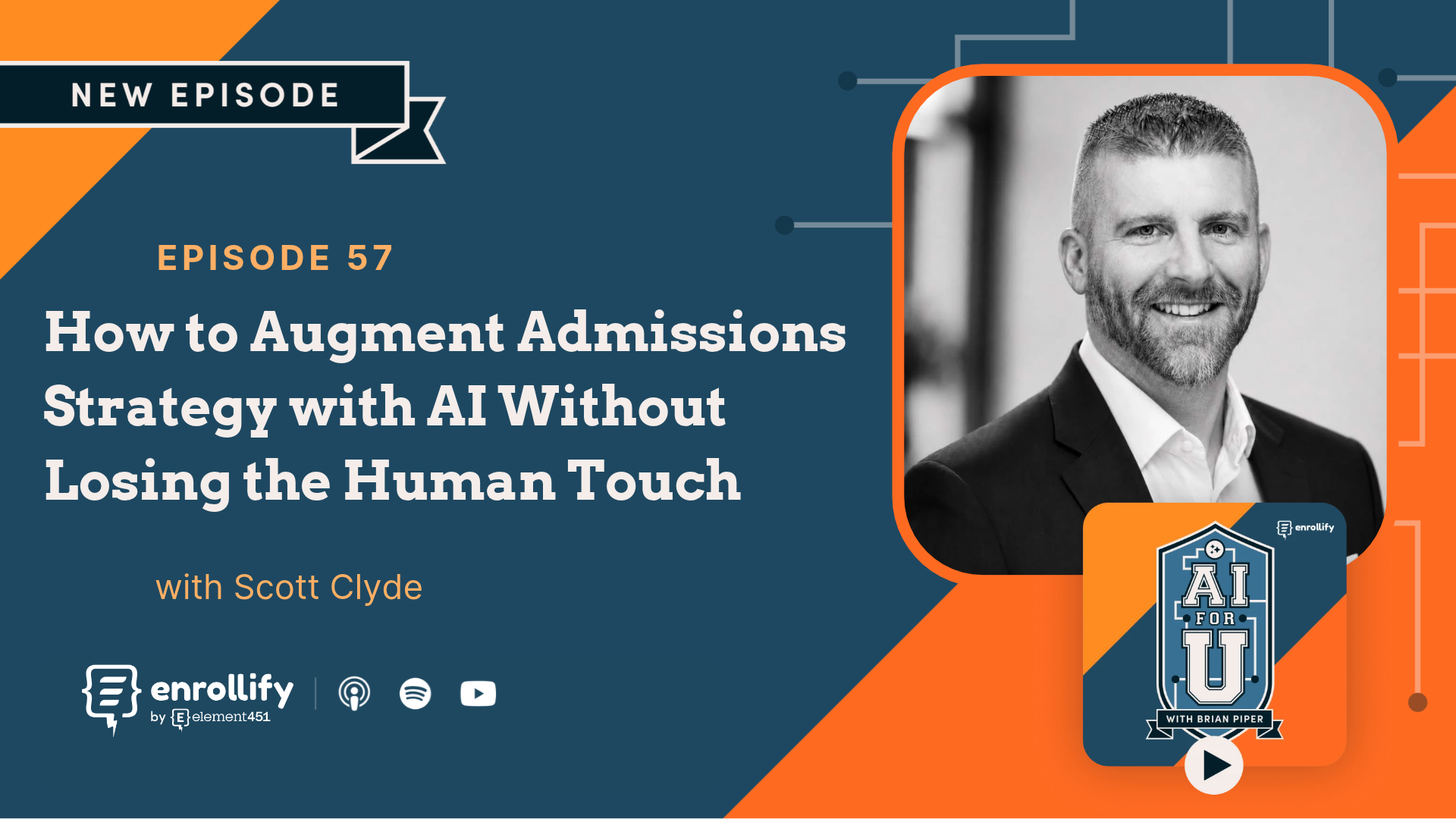
Scott Cline sits down with Dr. John Haller, former VP of Enrollment Management at the University of Miami and current higher education consultant, to unpack how AI agents are being used across college admissions offices. From streamlining essay reviews to decoding enrollment trends and anticipating student persistence, this episode tackles the promise and pitfalls of using AI in higher ed. If you're a higher ed leader wrestling with how (or whether) to integrate AI into admissions and marketing, this episode offers a refreshingly honest, behind-the-scenes perspective.
Key Takeaways
- AI is already reshaping enrollment marketing and admissions operations — from predictive modeling to content development, institutions are experimenting with AI agents to boost efficiency and scalability.
- Institutions are hesitant to talk openly about their AI use — fearing it could spark an "AI arms race" or erode trust with students and families.
- Responsible, transparent use of AI is critical — tools should enhance, not replace, human judgment and care in the student experience.
- High schools and colleges are both struggling to set AI guardrails — collaboration is key to bridging the divide and building trust across the student journey.
- Personalization still matters — AI can support, but not replace, authentic relationship-building during the college search and admissions process.
- Leadership conversations about AI must be proactive and cross-functional — including marketing, athletics, academic affairs, and student success to ensure responsible use across the institution.
Episode Summary: FAQs on AI Agents and Enrollment in Higher Ed
Where is AI currently being used in college admissions?
Dr. Haller highlights that AI is already actively used in enrollment marketing, content creation, and FAQ automation. At some institutions, like the University of Miami during his tenure, AI was explored to analyze admissions essays for predictive markers of retention — going beyond simple grammar checks to look for emotional or thematic cues linked to student success. Other schools are experimenting with AI to calculate GPAs from transcripts, especially when data formats are standardized across in-state applicants.
In marketing and communication, AI agents are also helping teams scale personalization, especially when staffing is lean. The key, says Haller, is using AI as a tool — not a crutch — to make meaningful engagement more efficient, not less human.
Is AI dehumanizing the admissions process?
It’s a concern — but not an inevitability. Haller emphasizes that AI must be used as an assistive tool, not a replacement for human reviewers. The goal should be to streamline the technical parts of admissions (like processing large volumes of applications), freeing up staff to focus on what matters most: the human-to-human connection.
With over 50,000 applications at Miami and limited part-time readers, AI could help tackle volume without compromising empathy — if used wisely. The risk, however, is that students and families may perceive AI involvement as cold or impersonal, especially in a high-stakes process like college admissions. Transparency and intentional design are crucial here.
Why are colleges reluctant to talk openly about AI use?
One of the episode's most compelling insights is the unspoken fear among institutions: that admitting AI use in admissions could spark competitive disadvantage or ethical scrutiny. This fear creates a paradox — everyone is using AI in some form, but no one wants to be the first to say it out loud.
Dr. Haller shares how universities can break this cycle by forming interdepartmental AI committees and fostering cross-campus transparency. At Miami, he helped lead a group that included athletics, healthcare, marketing, and admissions to openly share AI use cases and establish best practices. This kind of proactive leadership fosters institutional alignment and builds internal trust before engaging external stakeholders.
How are high schools and colleges both navigating the AI landscape?
Interestingly, both ends of the pipeline — high school teachers and college admissions officers — are facing similar AI anxieties. There's been a swing from “lock it down” to “lean into it,” especially as AI tools become embedded in everything from classroom assignments to personal statement writing.
But this dual use raises questions: if students use AI to write essays, and colleges use AI to read them, where’s the authenticity? Haller suggests that some schools are even returning to handwritten blue book exams to recapture a sense of personal accountability. Ultimately, both sides need to establish ethical guardrails and communicate openly to align expectations and practices.
Can AI help students find the “right fit” college?
Surprisingly — yes, if used thoughtfully. In a powerful anecdote, Haller shares his experience helping his own son navigate the college search process. Early efforts using AI-based tools fell flat — the prompts were too broad, and the results too generic. But by pairing human-centered conversations with targeted AI prompts, they were able to generate a more meaningful list of colleges aligned with his son’s values, interests, and goals.
This example underscores an important theme: AI doesn’t replace active listening or relationship-building. Instead, it can enhance them — if used with care and context.
What should institutional leaders be doing right now about AI in admissions?
Haller’s recommendations are practical and actionable:
- Audit your current processes — Look for bottlenecks in marketing, application review, or transcript evaluation where AI could meaningfully improve efficiency.
- Embrace open dialogue — Don’t silo AI conversations. Create cross-functional teams to explore responsible applications and share learnings.
- Design with students in mind — Ensure your use of AI supports student trust and success. AI should empower students, not confuse or alienate them.
Ultimately, he argues, the institutions that lean into AI with transparency, responsibility, and collaboration will be better positioned to thrive in an increasingly competitive and skeptical marketplace.
Register for the AI Engage Summit — Oct 15–16, 2025
👉 Join us online from 12–4 PM ET each day for two afternoons of AI insights and training. Free to attend with on-demand access included. Register now.




.svg)
.svg)
