


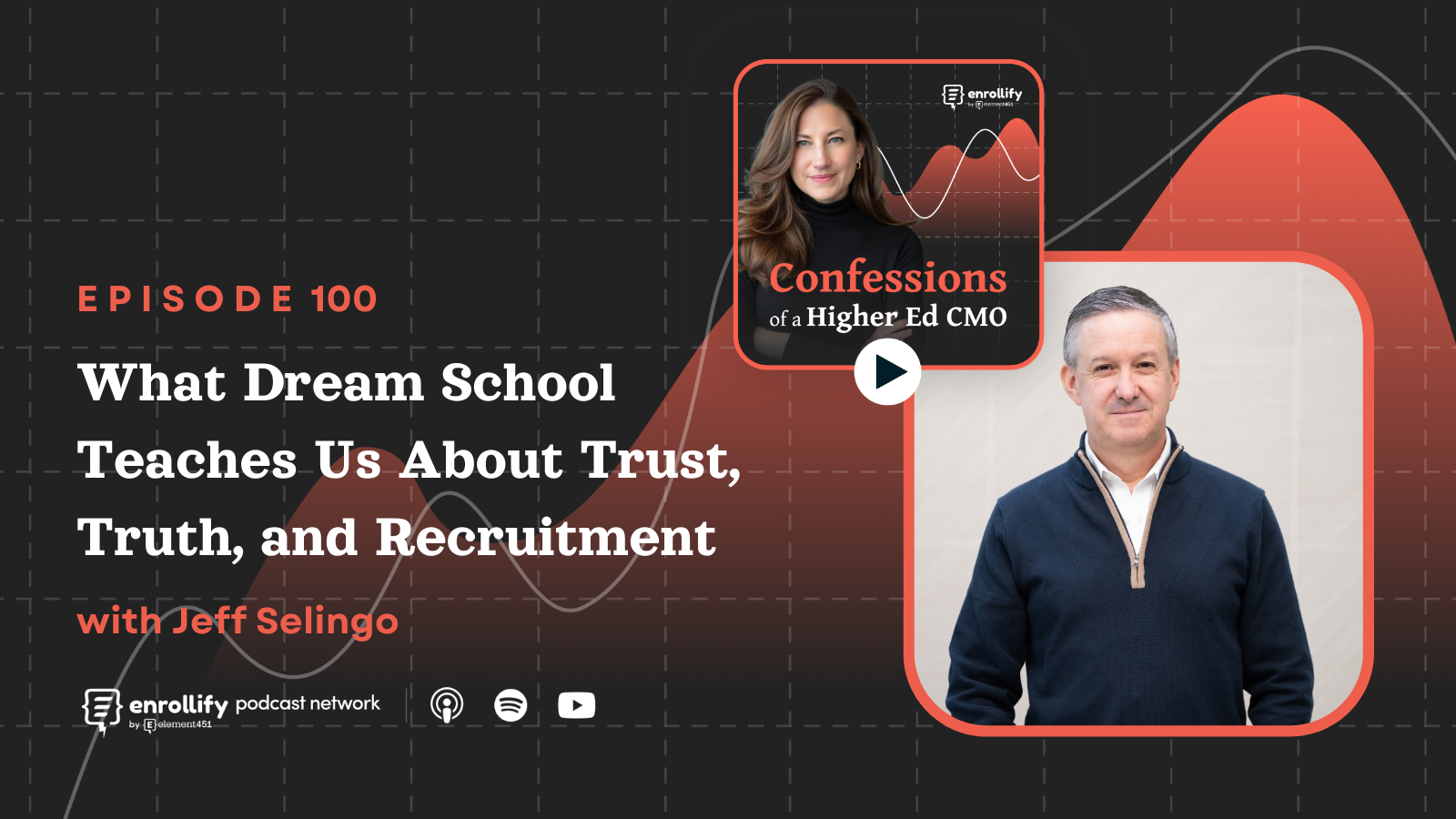




About the Episode
About the Episode:
Jaime Hunt sits down with higher education journalist and bestselling author Jeff Selingo to unpack insights from his newest book, Dream School: Finding the College That’s Right for You. Drawing from two years of research—including surveys of more than 3,000 parents—Selingo explains how families are redefining what makes a “good college.”
The conversation explores the evolving role of prestige, the growing importance of outcomes and ROI, and what enrollment marketers must understand about parents, counselors, and the modern college search process. For higher ed professionals, this episode is a powerful lens into the shifting expectations shaping enrollment marketing today.
Key Takeaways
- Prestige is losing ground to perceived value. Families increasingly prioritize outcomes and ROI over institutional prestige when making college decisions.
- Enrollment marketing must combine storytelling with meaningful data. Parents want contextualized outcomes data—not just brand narratives.
- Parents are key decision-makers throughout the enrollment funnel. Engaging parents early and continuing communication after enrollment can improve retention and student success strategies.
- The college search process is confusing for families. Institutions that simplify the journey and provide helpful guidance can build trust and increase yield.
- Experiential learning and mentorship drive perceived value. Hands-on learning opportunities and strong faculty relationships significantly influence how families evaluate schools.
- Institutions should market sector value—not just institutional value. Promoting the broader benefits of higher education strengthens the entire ecosystem.
Why Prestige Is Losing Ground to Value in Higher Education Marketing
One of the biggest themes from Jeff Selingo’s Dream School is a shift in how families evaluate colleges. While prestige still matters, Selingo’s research shows that value—especially perceived return on investment—now plays a bigger role in decision-making. Rising tuition costs and increased transparency around outcomes have pushed families to ask tougher questions about what they’re getting for their money.
Parents are no longer simply chasing highly selective institutions. Instead, many are comparing schools based on employment outcomes, career readiness, and affordability. Even families who can afford full tuition are increasingly evaluating whether a school’s price aligns with the long-term value of the degree.
For enrollment marketers, this shift signals an important evolution in enrollment marketing strategy. Institutions must move beyond prestige-based messaging and instead clearly articulate outcomes, career pathways, and the long-term benefits of their educational experience.
The Data Families Actually Care About During the College Search
Higher ed institutions often focus heavily on storytelling, but Selingo argues that stories alone aren’t enough. Families want stories backed by meaningful, easy-to-understand data—especially around outcomes like employment, internships, and career trajectories.
Parents today have access to more information than ever before. Tools like the College Scorecard, online rankings, and social media communities give families new ways to evaluate institutions. In fact, Selingo notes that many parents spend significant time in places higher ed marketers rarely monitor—Reddit threads and Facebook groups dedicated to the college search.
This is where data analytics in higher education becomes a powerful marketing tool. Institutions that clearly communicate outcomes data, contextualize metrics, and connect those insights to student experiences can stand out in an increasingly crowded and confusing marketplace.
Why Parents Should Be a Core Audience in Enrollment Marketing
One of the most important insights from the episode is the central role parents play in the college decision process. While students ultimately enroll, parents often drive the research, comparisons, and financial decisions behind the scenes.
Parents actively participate in online communities where they ask questions, share advice, and evaluate schools together. These conversations shape perceptions of institutions long before a student ever submits an application. Yet many colleges still treat parents as a secondary audience—or stop communicating with them once a student enrolls.
Selingo suggests institutions should rethink this approach. By providing helpful resources throughout the college journey—from admissions guidance to support during the first year—schools can strengthen trust and improve student success strategies. Engaged parents can also become advocates, career connectors, and even future donors.
The Student Experience Signals That Matter Most
Through extensive research, Selingo identified several elements that consistently influence how families evaluate colleges. These factors go beyond traditional rankings and focus instead on the student experience and post-graduation outcomes.
First-year experience programs play a significant role in helping students build confidence and belonging. When students feel supported early, they’re more likely to persist and succeed academically. Families increasingly look for institutions that intentionally design this transition into college life.
Experiential learning opportunities are equally important. Internships, co-ops, research opportunities, and real-world learning environments signal strong career preparation. Combined with mentorship from faculty and staff, these experiences create the types of outcomes families are prioritizing in their college search.
For enrollment marketers, highlighting these elements is critical. These experiences connect directly to student success strategies and marketing strategy for student recruitment, making them powerful differentiators when communicating institutional value.
The Opportunity for Higher Ed to Simplify the College Search
Perhaps the most compelling takeaway from the conversation is how overwhelming the college search process feels for families. From application timelines to financial aid forms, the journey is filled with complexity that most families navigate only once.
Selingo argues that institutions could build enormous trust by helping students and parents navigate this process—even when it doesn’t directly benefit their institution. Providing guidance, educational resources, and step-by-step clarity could position colleges as trusted advisors rather than just competitors for enrollment.
This approach aligns perfectly with higher education content marketing strategies. By delivering helpful information at every stage of the prospective student journey, institutions can build relationships that ultimately influence enrollment decisions.
Connect With Our Host:
Jaime Hunt
https://twitter.com/JaimeHuntIMC
Enrollify is produced by Element451 — the next-generation AI student engagement platform helping institutions create meaningful and personalized interactions with students. Learn more at element451.com.



.svg)
.svg)
