






About the Episode
Got a story to tell? An innovative idea to share? Fill out our guest nomination form and let's chat!
About The Episode:
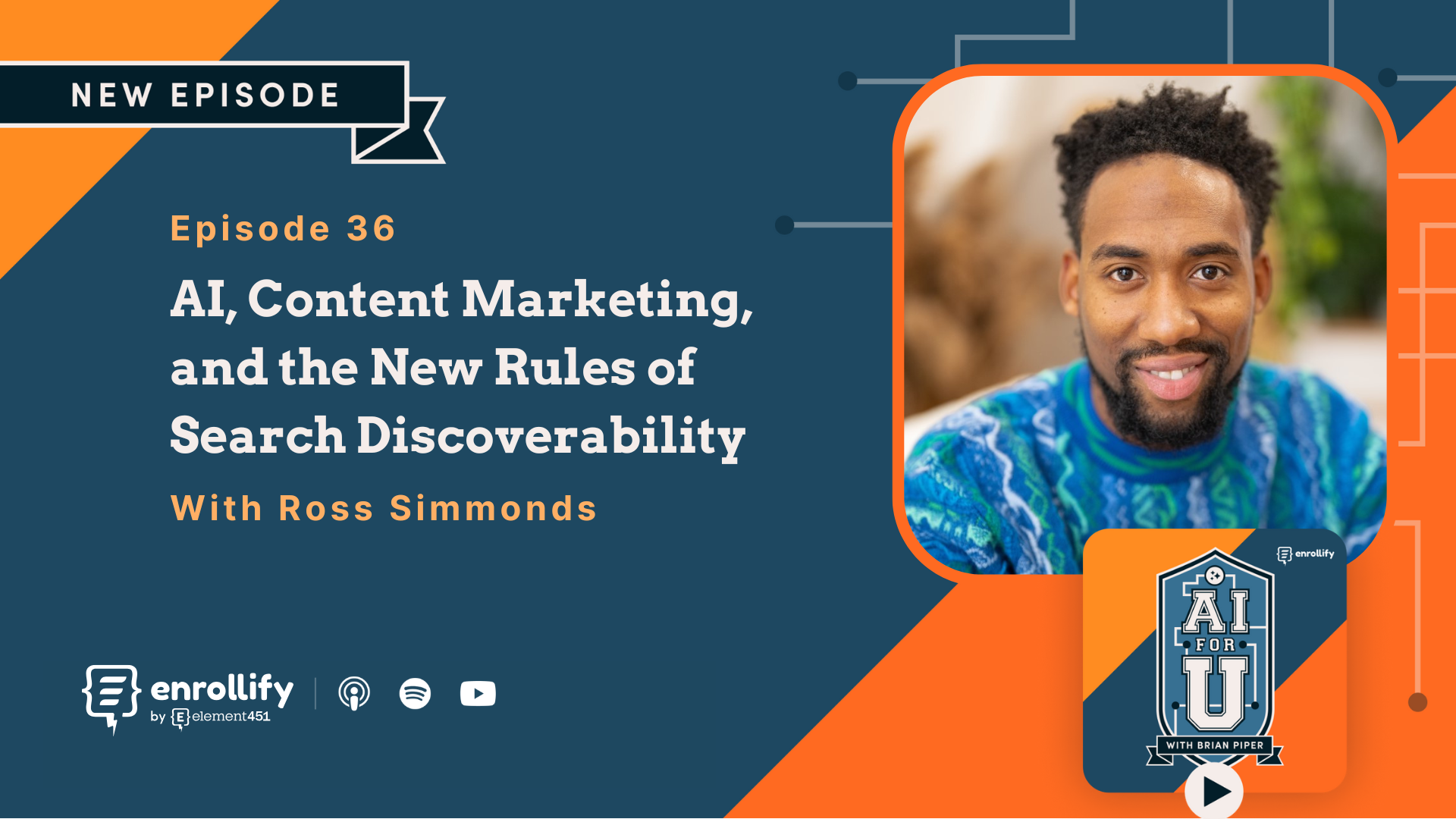
Brian Piper sits down with Ross Simmonds, founder of Foundation Marketing and author of Create Once, Distribute Forever, to unpack how higher ed institutions can use platform-specific audience research to make smarter content marketing decisions. From AI-driven search changes to content repurposing strategies, the duo explores how to avoid “random acts of content” and instead implement a precise distribution framework. If your institution struggles with discoverability, AI integration, or content ROI, this episode is your roadmap.
Key Takeaways
- Intentionality is everything: Before creating content, institutions must conduct deep audience research to identify which platforms matter most to their audience.
- Optimize for discoverability: AI and LLMs are reshaping search. Institutions must now think beyond SEO to include answer engine optimization and generative search readiness.
- AI isn’t just a tool—it’s a teammate: AI can scale content production and help marketers do more with less, but humans remain essential for quality, tone, and brand consistency.
- Cultural alignment is step one: AI adoption in higher ed starts with mindset and strategy—not tools. Change management is more critical than implementation.
- Future of content? AI-to-AI communication: Agents will interact with each other to make decisions—like applying to universities—based on crawlable content and brand trust.
- Multi-platform storytelling matters: Your institution’s visibility depends on how well you repurpose content across Reddit, YouTube, LinkedIn, and more—not just your website.
- AI enables personalization at scale: But the edge still comes from human insight, institutional knowledge, and strategic storytelling.
Episode Summary
Why do most higher ed content strategies fall short?
Ross Simmonds opens the episode with a clear truth: most colleges and universities aren’t lacking content—they’re lacking strategy. Institutions are often stuck in a "create-first, distribute-later" cycle, which leads to misaligned messaging and poor content ROI. According to Ross, effective marketing begins with research. Institutions need to analyze behavior patterns, identify which platforms their audiences use, and then create content tailored to those channels. Instead of spreading content across every platform, the goal should be targeted distribution—placing your best stories exactly where your audience is most likely to find and engage with them.
Ross emphasizes the importance of platform validation: does your prospective student use YouTube for research? Are alumni conversations happening on Reddit? Is your brand being cited in AI-generated overviews? These insights help institutions prioritize distribution efforts, instead of wasting resources on irrelevant platforms. Brian agrees and introduces the idea of “random acts of content”—the enemy of strategic marketing. Their shared advice: slow down, research, and align content with platform behavior before hitting publish.
How should higher ed approach AI adoption across campus?
AI is here, but its adoption in higher ed has been uneven and often misunderstood. Ross urges institutions to stop blocking AI access and instead align culturally around it as a vital tool. He notes that AI is like spellcheck or calculators—once controversial, now indispensable. The first step in AI integration? Cultural alignment. Institutions must create space for early adopters to lead internal conversations and champion use cases.
Ross and Brian stress that AI implementation is not a technology project—it’s change management. Without leadership buy-in and cross-functional collaboration, no AI tool will succeed. Ross recommends identifying or bringing in AI-savvy professionals to train teams, audit current workflows, and suggest where AI can drive efficiencies. Whether in IT, admissions, or marketing, the goal is to use AI to augment teams, not replace them. Institutions that embrace this philosophy will move faster, cut costs, and increase output—without burning out their teams.
Where does AI help most in content marketing—and where does it fall short?
Ross shares that AI excels in scaling written content, SEO, and even repurposing. Content marketers can use AI to generate thousands of pages that answer common student queries, fine-tune them with human editing, and significantly increase organic visibility. He calls this shift “answer engine optimization”—designing content to be cited by AI, not just indexed by Google.
However, Ross is quick to point out AI’s limits. It lacks emotional intelligence, cultural nuance, and good taste—qualities essential for strong branding. Human marketers still need to guide strategy, provide creative vision, and ensure brand authenticity. AI can handle the “IQ tasks,” but the “EQ tasks” remain human territory. For example, AI can help generate the structure of a campaign, but only a human can tie it to institutional history, brand voice, or timely cultural context. The winning formula? AI + Human = Content Superpower.
How is generative search changing the game for enrollment marketing?
The conversation shifts to generative AI in search—arguably the most disruptive trend in digital marketing today. Ross notes that higher ed institutions are already seeing lower organic click-through rates as AI-powered overviews replace traditional search results. But he warns: this trend will only accelerate. The solution? Optimize your content for how AI consumes and ranks it.
He recommends ensuring your content is crawlable, E-E-A-T optimized (Experience, Expertise, Authoritativeness, Trustworthiness), and multi-channeled. That means updating your website to answer specific long-tail queries and strategically publishing on platforms like Reddit, LinkedIn, and YouTube. Ross shares that 60% of ChatGPT search results now cite Reddit threads—making it critical for universities to manage their brand presence on such forums.
Further, he encourages institutions to consider “transactionless transactions.” In the near future, prospective students may ask an AI assistant to apply to universities for them—based entirely on what the assistant can find online. That makes content completeness, clarity, and brand equity more important than ever.
What does the near future of AI + marketing look like?
Looking ahead just 1–2 years, Ross paints a future where consumers rely on personal AI agents to make purchases, apply to schools, and handle decision-making. In that world, institutions must prepare their websites and brand presence to be “agent-friendly.” If your content can’t be easily found, understood, and trusted by AI, you’ll be left out of the conversation—literally.
But there’s a silver lining. Ross believes AI may allow marketers to return to what matters most: strategic, human-centric work. With AI handling more tactical execution, marketers can focus on building deeper brand relationships, exploring emerging platforms, and crafting creative narratives that resonate. His advice to marketers? Don’t chase volume—chase value. Use AI to free up time and energy to do your most impactful work.
Connect With Our Host:
Brian Piper
https://www.linkedin.com/in/brianwpiper/
About The Enrollify Podcast Network:
AI for U is a part of the Enrollify Podcast Network. If you like this podcast, chances are you’ll like other Enrollify shows too!
Some of our favorites include Generation AI and Mastering the Next.
Enrollify is produced by Element451 — the next-generation AI student engagement platform helping institutions create meaningful and personalized interactions with students. Learn more at element451.com.


.svg)
.svg)
